Knowledge What is the specific role of a laboratory oven in carbon fiber pretreatment? Ensure Perfect TiO2 Coating Adhesion
Author avatar

Tech Team · Kintek Solution

Updated 3 days ago

What is the specific role of a laboratory oven in carbon fiber pretreatment? Ensure Perfect TiO2 Coating Adhesion


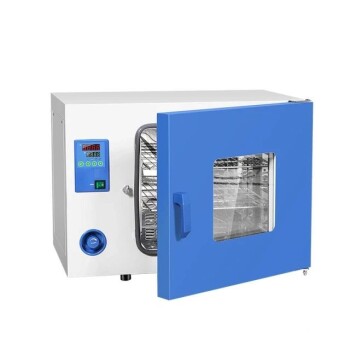
The specific role of a laboratory oven during the pretreatment stage is to execute a critical drying phase on raw carbon fibers immediately after they have been chemically cleaned with a sodium hydroxide solution. By maintaining a strictly constant temperature, the oven thoroughly eliminates residual moisture from the fiber surfaces. This step creates the dry, clean substrate base required for the subsequent impregnation and uniform coating of the titanium dioxide precursor.

Core Takeaway The laboratory oven is not merely a heating device; it is a surface preparation tool that transforms chemically cleaned carbon fibers into a stable substrate. Its primary function is to remove physical moisture to ensure the fiber surface is receptive to the titanium dioxide coating, preventing adhesion failures or coating inconsistencies.

The Objective of Pretreatment Drying

Establishing a Receptive Surface

After carbon fibers undergo cleaning with sodium hydroxide (NaOH), they retain significant moisture. The laboratory oven removes this residual water to expose the clean fiber surface.

Without this drying step, the remaining moisture would act as a barrier. This barrier prevents the titanium dioxide precursor solution from making direct contact with the carbon fiber, compromising the quality of the final composite.

Facilitating Uniform Impregnation

For a nanocomposite to function effectively, the coating must be even. A laboratory oven provides the dry environment necessary for the precursor solution to spread uniformly across the fiber.

A thoroughly dried substrate ensures that the chemical interactions between the fiber and the precursor occur consistently across the entire surface area.

The Mechanism of Action

Constant Temperature Maintenance

The oven’s value lies in its ability to provide a stable thermal environment. Unlike open-air drying, which creates variable conditions, the oven maintains a fixed temperature.

This consistency is vital for reproducibility. It ensures that every batch of carbon fibers reaches the same level of dryness before moving to the coating stage.

Removal of Physically Adsorbed Water

The heating process targets not just surface droplets, but physically adsorbed water clinging to the fiber's microstructure.

By gently heating the material, the oven liberates these water molecules. This prepares the physical structure of the fiber for further processing without altering its chemical composition.

Understanding the Trade-offs

The Risk of Thermal Shock

While drying is essential, the application of heat must be controlled. Rapid changes in temperature or excessive heat can damage the fiber's integrity.

If the drying temperature is too high, it may cause defects in the fiber structure. Conversely, if the temperature is too low or inconsistent, moisture pockets may remain, leading to poor coating adhesion later.

Efficiency vs. Structural Integrity

In broader applications involving nanocomposites, forced air drying is often used to accelerate solvent removal. However, speed must be balanced against stability.

Rapid evaporation can lead to cracking in gel structures or precursors. Therefore, the laboratory oven must be set to a temperature that balances efficient moisture removal with the preservation of the fiber's morphology.

Making the Right Choice for Your Goal

To ensure the success of your titanium dioxide nanocomposite, consider how you operate the drying phase based on your specific objectives.

  • If your primary focus is Coating Uniformity: Ensure the oven acts as a steady-state environment to remove all adsorbed water, creating a perfectly dry substrate for the precursor.
  • If your primary focus is Structural Integrity: Avoid excessive temperatures that could degrade the fiber surface; prioritize a longer, gentler drying cycle over rapid heating.

The laboratory oven is the gatekeeper between the cleaning phase and the synthesis phase; its proper use determines whether the carbon fiber accepts or rejects the titanium dioxide coating.

Summary Table:

Process Phase Role of Laboratory Oven Impact on Nanocomposite
Moisture Removal Eliminates physically adsorbed water post-NaOH cleaning Prevents moisture barriers between fiber and precursor
Surface Prep Creates a dry, receptive substrate base Ensures uniform impregnation of titanium dioxide
Thermal Control Maintains constant, stable temperature Prevents structural defects and ensures reproducibility
Adhesion Support Prepares surface for chemical interaction Prevents coating inconsistencies and adhesion failures

Elevate Your Nanomaterial Research with KINTEK Precision

Precision in pretreatment is the foundation of high-performance nanocomposites. KINTEK specializes in advanced laboratory equipment designed to meet the rigorous demands of material science. From high-stability laboratory ovens and muffle furnaces for perfect substrate preparation to our comprehensive range of high-pressure reactors, crushing systems, and specialized ceramics, we provide the tools necessary for consistent, reproducible results.

Don't let inconsistent drying compromise your carbon fiber coatings. Contact KINTEK today to find the perfect thermal or processing solution for your lab!

References

  1. Wan‐Kuen Jo, Ho-Hwan Chun. Titania Nanotubes Grown on Carbon Fibers for Photocatalytic Decomposition of Gas-Phase Aromatic Pollutants. DOI: 10.3390/ma7031801

This article is also based on technical information from Kintek Solution Knowledge Base .

Related Products

People Also Ask

Related Products

Benchtop Laboratory Freeze Dryer for Lab Use

Benchtop Laboratory Freeze Dryer for Lab Use

Premium benchtop laboratory freeze dryer for lyophilization, preserving samples with ≤ -60°C cooling. Ideal for pharmaceuticals & research.

Small Vacuum Heat Treat and Tungsten Wire Sintering Furnace

Small Vacuum Heat Treat and Tungsten Wire Sintering Furnace

The small vacuum tungsten wire sintering furnace is a compact experimental vacuum furnace specially designed for universities and scientific research institutes. The furnace features a CNC welded shell and vacuum piping to ensure leak-free operation. Quick-connect electrical connections facilitate relocation and debugging, and the standard electrical control cabinet is safe and convenient to operate.

Vacuum Heat Treat Furnace with Ceramic Fiber Liner

Vacuum Heat Treat Furnace with Ceramic Fiber Liner

Vacuum furnace with polycrystalline ceramic fiber insulation liner for excellent heat insulation and uniform temperature field. Choose from 1200℃ or 1700℃ max. working temperature with high vacuum performance and precise temperature control.

Dental Porcelain Zirconia Sintering Ceramic Vacuum Press Furnace

Dental Porcelain Zirconia Sintering Ceramic Vacuum Press Furnace

Get precise dental results with Dental Vacuum Press Furnace. Automatic temperature calibration, low noise tray, and touch screen operation. Order now!

Graphite Vacuum Furnace IGBT Experimental Graphitization Furnace

Graphite Vacuum Furnace IGBT Experimental Graphitization Furnace

IGBT experimental graphitization furnace, a tailored solution for universities and research institutions, with high heating efficiency, user-friendliness, and precise temperature control.

High-Energy Omnidirectional Planetary Ball Mill Milling Machine for Laboratory

High-Energy Omnidirectional Planetary Ball Mill Milling Machine for Laboratory

The KT-P4000E is a new product derived from the vertical high-energy planetary ball mill with a 360° swivel function. Experience faster, uniform, and smaller sample output results with 4 ≤1000ml ball mill jars.

High Pressure Laboratory Vacuum Tube Furnace Quartz Tubular Furnace

High Pressure Laboratory Vacuum Tube Furnace Quartz Tubular Furnace

KT-PTF High Pressure Tube Furnace: Compact split tube furnace with strong positive pressure resistance. Working temp up to 1100°C and pressure up to 15Mpa. Also works under controller atmosphere or high vacuum.

Laboratory Ten-Body Horizontal Jar Mill for Lab Use

Laboratory Ten-Body Horizontal Jar Mill for Lab Use

The Ten-body horizontal jar mill is for 10 ball mill pots (3000ml or less). It has frequency conversion control, rubber roller movement, and PE protective cover.

Laboratory Single Horizontal Jar Mill

Laboratory Single Horizontal Jar Mill

KT-JM3000 is a mixing and grinding instrument for placing a ball milling tank with a volume of 3000ml or less. It adopts frequency conversion control to realize timing, constant speed, direction change, overload protection and other functions.

High Energy Planetary Ball Mill Milling Machine for Laboratory

High Energy Planetary Ball Mill Milling Machine for Laboratory

The biggest feature is that the high energy planetary ball mill can not only perform fast and effective grinding, but also has good crushing ability

Vacuum Sealed Continuous Working Rotary Tube Furnace Rotating Tube Furnace

Vacuum Sealed Continuous Working Rotary Tube Furnace Rotating Tube Furnace

Experience efficient material processing with our vacuum-sealed rotary tube furnace. Perfect for experiments or industrial production, equipped with optional features for controlled feeding and optimized results. Order now.

High Energy Planetary Ball Mill Milling Machine for Laboratory

High Energy Planetary Ball Mill Milling Machine for Laboratory

Experience fast and effective sample processing with the F-P2000 high-energy planetary ball mill. This versatile equipment offers precise control and excellent grinding capabilities. Perfect for laboratories, it features multiple grinding bowls for simultaneous testing and high output. Achieve optimal results with its ergonomic design, compact structure, and advanced features. Ideal for a wide range of materials, it ensures consistent particle size reduction and low maintenance.

Laboratory Jaw Crusher

Laboratory Jaw Crusher

Discover the small jaw crusher for efficient, flexible, and affordable crushing in labs and small mines. Ideal for coal, ores, and rocks. Learn more now!

High Energy Planetary Ball Mill for Laboratory Horizontal Tank Type Milling Machine

High Energy Planetary Ball Mill for Laboratory Horizontal Tank Type Milling Machine

KT-P4000H uses the unique Y-axis planetary motion trajectory, and utilizes the collision, friction and gravity between the sample and the grinding ball to have a certain anti-sinking ability, which can obtain better grinding or mixing effects and further improve the sample output.

Twin Screw Extruder Plastic Granulation Machine

Twin Screw Extruder Plastic Granulation Machine

Twin screw extruder plastic granulation machine is designed for the mixing and processing experiments of engineering plastics, modified plastics, waste plastics and masterbatches.

1400℃ Laboratory High Temperature Tube Furnace with Alumina Tube

1400℃ Laboratory High Temperature Tube Furnace with Alumina Tube

Looking for a tube furnace for high-temperature applications? Our 1400℃ Tube Furnace with Alumina Tube is perfect for research and industrial use.

Laboratory Planetary Ball Mill Rotating Ball Milling Machine

Laboratory Planetary Ball Mill Rotating Ball Milling Machine

KT-P400E is a desktop multi-directional planetary ball mill with unique grinding and mixing capabilities. It offers continuous and intermittent operation, timing, and overload protection, making it ideal for various applications.

Laboratory Rapid Thermal Processing (RTP) Quartz Tube Furnace

Laboratory Rapid Thermal Processing (RTP) Quartz Tube Furnace

Get lightning-fast heating with our RTP Rapid Heating Tube Furnace. Designed for precise, high-speed heating and cooling with convenient sliding rail and TFT touch screen controller. Order now for ideal thermal processing!

Electric Rotary Kiln Continuous Working Small Rotary Furnace Heating Pyrolysis Plant

Electric Rotary Kiln Continuous Working Small Rotary Furnace Heating Pyrolysis Plant

Efficiently calcine and dry bulk powder and lump fluid materials with an electric heating rotary furnace. Ideal for processing lithium ion battery materials and more.

Laboratory Multifunctional Small Speed-Adjustable Horizontal Mechanical Shaker for Lab

Laboratory Multifunctional Small Speed-Adjustable Horizontal Mechanical Shaker for Lab

The laboratory multifunctional speed-regulating oscillator is a constant-speed experimental equipment specially developed for modern bioengineering production units.


Leave Your Message