Knowledge What is the structure of single-wall carbon nanotubes? Understanding Chirality for Metallic or Semiconducting Properties
Author avatar

Tech Team · Kintek Solution

Updated 1 week ago

What is the structure of single-wall carbon nanotubes? Understanding Chirality for Metallic or Semiconducting Properties


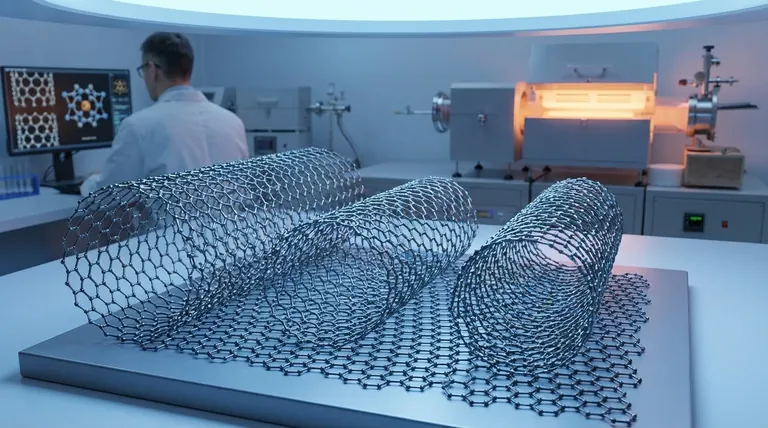
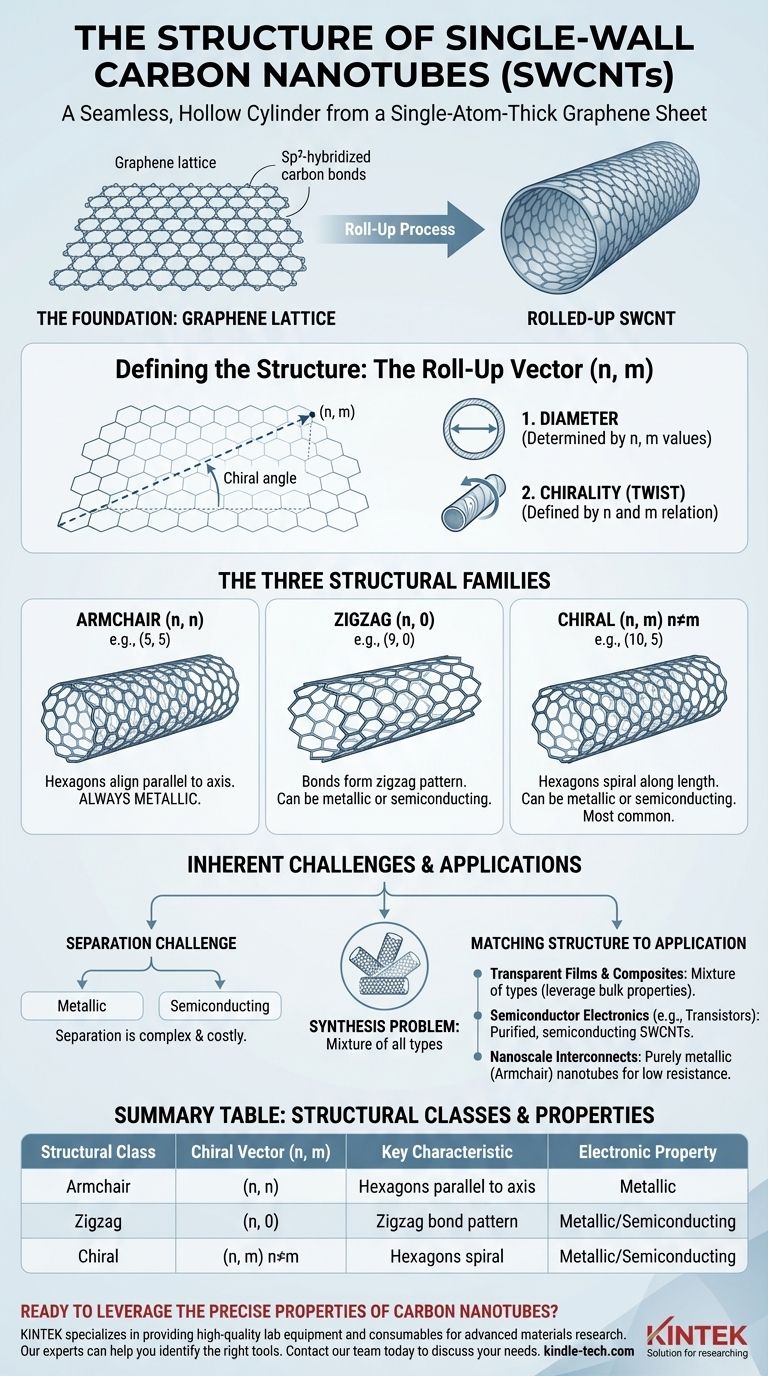
In essence, a single-wall carbon nanotube (SWCNT) is a seamless, hollow cylinder formed by rolling a single-atom-thick sheet of graphene. The structure is composed entirely of carbon atoms arranged in a hexagonal honeycomb lattice. This fundamental architecture, inherited from graphene, is responsible for the nanotube's extraordinary properties.

The most critical structural detail is not just that it's a rolled-up sheet, but how it is rolled. This "twist," known as chirality, dictates the nanotube's diameter, atomic arrangement, and most importantly, its fundamental electronic properties.
What is the structure of single-wall carbon nanotubes? Understanding Chirality for Metallic or Semiconducting Properties

The Foundation: From Graphene to Nanotube

To truly understand an SWCNT's structure, we must start with its building block: a sheet of graphene.

The Graphene Lattice

Graphene is a one-atom-thick layer of carbon atoms bonded together in a honeycomb pattern. These bonds are known as sp2-hybridized bonds, the same type found in graphite, and are exceptionally strong.

The Concept of the Roll-up Vector

Imagine taking that flat sheet of graphene and rolling it into a tube. The angle at which you roll it determines the pattern of the hexagons along the seam of the tube.

This "roll-up" is defined by a mathematical concept called the chiral vector, denoted by a pair of integers (n, m). These indices specify which two points on the graphene lattice are joined together to form the cylinder's circumference.

How (n, m) Defines the Structure

The (n, m) indices are the unique blueprint for every SWCNT. They precisely define two key physical attributes:

  1. Diameter: The values of n and m directly determine the diameter of the nanotube.
  2. Chirality (Twist): The relationship between n and m defines the chiral angle, or the degree of twist in the hexagonal lattice as it wraps around the tube.

The Three Classes of SWCNT Structures

Based on their (n, m) indices, all single-wall carbon nanotubes fall into one of three distinct structural families.

Armchair Nanotubes (n, n)

When the indices are identical (e.g., (5, 5) or (10, 10)), the resulting structure is called armchair. The hexagonal rings are aligned perfectly parallel to the tube's axis, creating a pattern that resembles an armrest along the circumference.

Zigzag Nanotubes (n, 0)

When the second index is zero (e.g., (9, 0) or (12, 0)), the nanotube has a zigzag structure. The pattern of carbon bonds forms a distinct zigzag shape along the circumference of the tube.

Chiral Nanotubes (n, m)

This is the most general case, where n ≠ m and m ≠ 0 (e.g., (10, 5)). These chiral nanotubes have a visible twist, with the hexagons spiraling down the length of the tube at a specific angle. They are the most common type found in real-world synthesis.

Understanding the Inherent Challenges

The direct link between atomic structure and properties creates a significant hurdle in nanotube applications.

The Synthesis Problem

Current large-scale synthesis methods, like chemical vapor deposition (CVD), inevitably produce a mixture of all three types of SWCNTs. The output is a blend of armchair, zigzag, and chiral tubes with a wide distribution of diameters.

The Separation Challenge

This structural diversity means that any raw sample contains both metallic and semiconducting nanotubes. For high-performance electronics, these must be separated, a complex and costly process that remains a major focus of materials research.

Matching Structure to Your Application

The specific (n, m) structure you need is entirely dependent on your end goal.

  • If your primary focus is transparent conductive films or high-strength composites: A mixture of SWCNT types is often sufficient, as you are leveraging the average bulk properties of the material.
  • If your primary focus is semiconductor electronics like transistors: You must use highly purified, semiconducting SWCNTs, making the isolation of specific chiral or zigzag types absolutely critical.
  • If your primary focus is creating nanoscale electrical interconnects: The ideal structure would be purely metallic (armchair) nanotubes to achieve the lowest possible electrical resistance.

Ultimately, understanding the atomic structure of a carbon nanotube is the key to harnessing its unparalleled technological potential.

Summary Table:

Structural Class Chiral Vector (n, m) Key Characteristic Electronic Property
Armchair (n, n) Hexagons aligned parallel to tube axis Metallic (always)
Zigzag (n, 0) Carbon bonds form a zigzag pattern Can be metallic or semiconducting
Chiral (n, m) n≠m Hexagons spiral along the tube length Can be metallic or semiconducting

Ready to leverage the precise properties of carbon nanotubes in your research or product development? The specific (n, m) structure of an SWCNT directly determines its electronic behavior, making material selection critical for applications in electronics, composites, and more. KINTEK specializes in providing high-quality lab equipment and consumables for advanced materials research. Our experts can help you identify the right tools for your nanotube synthesis, characterization, and application challenges.

Contact our team today to discuss how we can support your laboratory's specific needs.

Visual Guide
What is the structure of single-wall carbon nanotubes? Understanding Chirality for Metallic or Semiconducting Properties Visual Guide

Related Products

People Also Ask

Related Products

Chemical Vapor Deposition CVD Equipment System Chamber Slide PECVD Tube Furnace with Liquid Gasifier PECVD Machine

Chemical Vapor Deposition CVD Equipment System Chamber Slide PECVD Tube Furnace with Liquid Gasifier PECVD Machine

KT-PE12 Slide PECVD System: Wide power range, programmable temp control, fast heating/cooling with sliding system, MFC mass flow control & vacuum pump.

RF PECVD System Radio Frequency Plasma-Enhanced Chemical Vapor Deposition RF PECVD

RF PECVD System Radio Frequency Plasma-Enhanced Chemical Vapor Deposition RF PECVD

RF-PECVD is an acronym for "Radio Frequency Plasma-Enhanced Chemical Vapor Deposition." It deposits DLC (Diamond-like carbon film) on germanium and silicon substrates. It is utilized in the 3-12um infrared wavelength range.

Customer Made Versatile CVD Tube Furnace Chemical Vapor Deposition Chamber System Equipment

Customer Made Versatile CVD Tube Furnace Chemical Vapor Deposition Chamber System Equipment

Get your exclusive CVD furnace with KT-CTF16 Customer Made Versatile Furnace. Customizable sliding, rotating, and tilting functions for precise reactions. Order now!

Split Chamber CVD Tube Furnace with Vacuum Station Chemical Vapor Deposition System Equipment Machine

Split Chamber CVD Tube Furnace with Vacuum Station Chemical Vapor Deposition System Equipment Machine

Efficient split chamber CVD furnace with vacuum station for intuitive sample checking and quick cooling. Up to 1200℃ max temperature with accurate MFC mass flowmeter control.

1200℃ Split Tube Furnace with Quartz Tube Laboratory Tubular Furnace

1200℃ Split Tube Furnace with Quartz Tube Laboratory Tubular Furnace

KT-TF12 split tube furnace: high-purity insulation, embedded heating wire coils, and max. 1200C. Widely used for new materials and chemical vapour deposition.

Graphite Vacuum Continuous Graphitization Furnace

Graphite Vacuum Continuous Graphitization Furnace

High-temperature graphitization furnace is a professional equipment for graphitization treatment of carbon materials. It is a key equipment for the production of high-quality graphite products. It has high temperature, high efficiency and uniform heating. It is suitable for various high-temperature treatments and graphitization treatments. It is widely used in metallurgy, electronics, aerospace, etc. industry.

Multi Zone Laboratory Quartz Tube Furnace Tubular Furnace

Multi Zone Laboratory Quartz Tube Furnace Tubular Furnace

Experience precise, efficient thermal testing with our Multi Zone Tube Furnace. Independent heating zones and temperature sensors allow for controlled high-temperature gradient heating fields. Order now for advanced thermal analysis!

1800℃ Muffle Oven Furnace for Laboratory

1800℃ Muffle Oven Furnace for Laboratory

KT-18 muffle furnace with Japan Al2O3 polycrystalline fibe and Silicon Molybdenum heating element, up to 1900℃, PID temperature control and 7" smart touch screen. Compact design, low heat loss, and high energy efficiency. Safety interlock system and versatile functions.

1700℃ Laboratory Quartz Tube Furnace with Alumina Tube Tubular Furnace

1700℃ Laboratory Quartz Tube Furnace with Alumina Tube Tubular Furnace

Looking for a high-temperature tube furnace? Check out our 1700℃ Tube Furnace with Alumina Tube. Perfect for research and industrial applications up to 1700C.

Rotary Tube Furnace Split Multi Heating Zone Rotating Tube Furnace

Rotary Tube Furnace Split Multi Heating Zone Rotating Tube Furnace

Multi zone rotary furnace for high-precision temperature control with 2-8 independent heating zones. Ideal for lithium ion battery electrode materials and high-temperature reactions. Can work under vacuum and controlled atmosphere.

Vertical High Temperature Graphite Vacuum Graphitization Furnace

Vertical High Temperature Graphite Vacuum Graphitization Furnace

Vertical high temperature graphitization furnace for carbonization and graphitization of carbon materials up to 3100℃.Suitable for shaped graphitization of carbon fiber filaments and other materials sintered in a carbon environment.Applications in metallurgy, electronics, and aerospace for producing high-quality graphite products like electrodes and crucibles.

1400℃ Laboratory Quartz Tube Furnace with Alumina Tube Tubular Furnace

1400℃ Laboratory Quartz Tube Furnace with Alumina Tube Tubular Furnace

Looking for a tube furnace for high-temperature applications? Our 1400℃ Tube Furnace with Alumina Tube is perfect for research and industrial use.

Vertical Laboratory Quartz Tube Furnace Tubular Furnace

Vertical Laboratory Quartz Tube Furnace Tubular Furnace

Elevate your experiments with our Vertical Tube Furnace. Versatile design allows for operation under various environments and heat treatment applications. Order now for precise results!

High Temperature Muffle Oven Furnace for Laboratory Debinding and Pre Sintering

High Temperature Muffle Oven Furnace for Laboratory Debinding and Pre Sintering

KT-MD High temperature debinding and pre-sintering furnace for ceramic materials with various molding processes. Ideal for electronic components such as MLCC and NFC.

Laboratory Muffle Oven Furnace Bottom Lifting Muffle Furnace

Laboratory Muffle Oven Furnace Bottom Lifting Muffle Furnace

Efficiently produce batches with excellent temperature uniformity using our Bottom Lifting Furnace. Features two electric lifting stages and advanced temperature control up to 1600℃.

1700℃ Controlled Atmosphere Furnace Nitrogen Inert Atmosphere Furnace

1700℃ Controlled Atmosphere Furnace Nitrogen Inert Atmosphere Furnace

KT-17A Controlled atmosphere furnace: 1700℃ heating, vacuum sealing technology, PID temperature control, and versatile TFT smart touch screen controller for laboratory and industrial use.

1400℃ Controlled Atmosphere Furnace with Nitrogen and Inert Atmosphere

1400℃ Controlled Atmosphere Furnace with Nitrogen and Inert Atmosphere

Achieve precise heat treatment with KT-14A controlled atmosphere furnace. Vacuum sealed with a smart controller, it's ideal for lab and industrial use up to 1400℃.

1700℃ Muffle Oven Furnace for Laboratory

1700℃ Muffle Oven Furnace for Laboratory

Get superior heat control with our 1700℃ Muffle Furnace. Equipped with intelligent temperature microprocessor, TFT touch screen controller & advanced insulation materials for precise heating up to 1700C. Order now!

1400℃ Muffle Oven Furnace for Laboratory

1400℃ Muffle Oven Furnace for Laboratory

Get precise high-temperature control up to 1500℃ with KT-14M Muffle furnace. Equipped with a smart touch screen controller and advanced insulation materials.

Vacuum Sealed Continuous Working Rotary Tube Furnace Rotating Tube Furnace

Vacuum Sealed Continuous Working Rotary Tube Furnace Rotating Tube Furnace

Experience efficient material processing with our vacuum-sealed rotary tube furnace. Perfect for experiments or industrial production, equipped with optional features for controlled feeding and optimized results. Order now.


Leave Your Message