Knowledge What is the synthesis process of carbon nanotubes? A Guide to Methods and Optimization
Author avatar

Tech Team · Kintek Solution

Updated 1 week ago

What is the synthesis process of carbon nanotubes? A Guide to Methods and Optimization


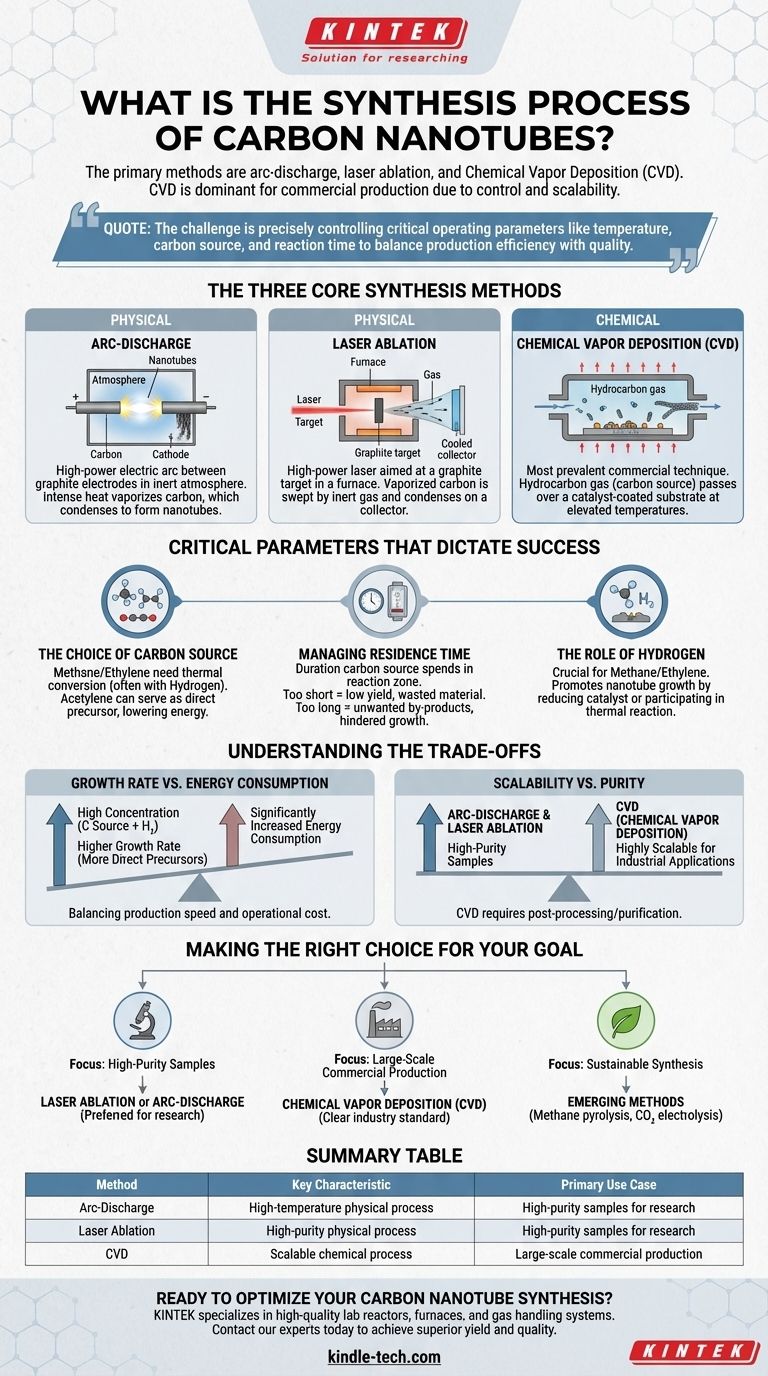
The primary methods for synthesizing carbon nanotubes are arc-discharge, laser ablation, and Chemical Vapor Deposition (CVD). While arc-discharge and laser ablation are traditional high-temperature techniques, CVD has become the dominant process for commercial-scale production due to its superior control and scalability.

The challenge in carbon nanotube synthesis is not merely choosing a method, but precisely controlling a set of critical operating parameters—like temperature, carbon source, and reaction time—to balance production efficiency with the desired material quality.
What is the synthesis process of carbon nanotubes? A Guide to Methods and Optimization

The Three Core Synthesis Methods

At a high level, the methods for producing carbon nanotubes fall into two categories: physical and chemical deposition. The first two methods are physical, relying on high energy to vaporize pure carbon, while the third is chemical, relying on the breakdown of a carbon-containing gas.

Arc-Discharge

This method uses a high-power electric arc between two graphite electrodes in an inert atmosphere. The intense heat vaporizes the carbon from the positive electrode, which then condenses to form carbon nanotubes on the cooler negative electrode.

Laser Ablation

In this process, a high-power laser is aimed at a graphite target inside a high-temperature furnace. The laser's energy vaporizes the carbon, which is then swept away by an inert gas onto a cooled collector, where the nanotubes assemble.

Chemical Vapor Deposition (CVD)

CVD is the most prevalent commercial technique. It involves passing a hydrocarbon gas (the carbon source) over a substrate coated with metal catalyst particles at elevated temperatures. The catalyst breaks down the gas, and the liberated carbon atoms reassemble into nanotubes.

Critical Parameters That Dictate Success

The final quality, yield, and efficiency of any synthesis process are determined by a few key variables. Mastering these parameters is essential for consistent and predictable results.

The Choice of Carbon Source

The type of hydrocarbon gas used in CVD significantly impacts the energy required. Gases like methane and ethylene need a thermal conversion process, often assisted by hydrogen, to form the direct carbon precursors needed for nanotube growth.

In contrast, acetylene can serve as a direct precursor without additional thermal conversion, lowering the overall energy requirement of the process.

Managing Residence Time

Residence time is the duration the carbon source spends in the reaction zone. This parameter must be carefully optimized.

A residence time that is too short results in insufficient accumulation of the carbon source, leading to wasted material and low yield.

A residence time that is too long can cause limited replenishment of the carbon source and an accumulation of unwanted by-products, which can hinder growth.

The Role of Hydrogen

For carbon sources like methane and ethylene, hydrogen plays a crucial role. It can promote the growth of nanotubes by helping to reduce the catalyst or by participating directly in the thermal reaction that creates the carbon precursors.

Understanding the Trade-offs

Optimizing carbon nanotube synthesis is a constant balancing act between competing factors. Understanding these trade-offs is key to developing an efficient process.

Growth Rate vs. Energy Consumption

Using a high concentration of the carbon source and hydrogen can lead to a higher growth rate because more direct carbon precursors are available.

However, this strategy also leads to significantly increased energy consumption. The process must be tuned to find the optimal balance between production speed and operational cost.

Scalability vs. Purity

Traditional methods like arc-discharge and laser ablation are known for producing high-purity carbon nanotubes but are generally difficult and expensive to scale for large-volume production.

Chemical Vapor Deposition (CVD) is highly scalable, making it the standard for industrial applications. However, the resulting nanotubes often require post-processing and purification to remove residual catalyst material.

Making the Right Choice for Your Goal

The ideal synthesis strategy depends entirely on your end objective.

  • If your primary focus is high-purity samples for research: Laser ablation or arc-discharge are often the preferred methods.
  • If your primary focus is large-scale commercial production: Chemical Vapor Deposition (CVD) is the clear industry standard due to its scalability and process control.
  • If your primary focus is sustainable synthesis: Emerging methods using green feedstocks, such as methane pyrolysis or electrolysis of captured CO2, represent the future of production.

Ultimately, mastering carbon nanotube synthesis lies in the precise control of its core variables to match your specific application.

Summary Table:

Method Key Characteristic Primary Use Case
Arc-Discharge High-temperature physical process High-purity samples for research
Laser Ablation High-purity physical process High-purity samples for research
Chemical Vapor Deposition (CVD) Scalable chemical process Large-scale commercial production

Ready to optimize your carbon nanotube synthesis? The right lab equipment is critical for precise control of parameters like temperature, gas flow, and catalyst preparation. KINTEK specializes in high-quality lab reactors, furnaces, and gas handling systems designed for advanced materials research and development. Contact our experts today to discuss how our solutions can help you achieve superior yield and quality in your nanotube production.

Visual Guide
What is the synthesis process of carbon nanotubes? A Guide to Methods and Optimization Visual Guide

Related Products

People Also Ask

Related Products

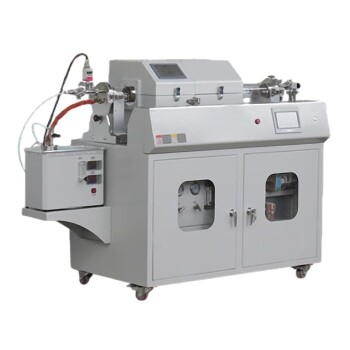
Chemical Vapor Deposition CVD Equipment System Chamber Slide PECVD Tube Furnace with Liquid Gasifier PECVD Machine

Chemical Vapor Deposition CVD Equipment System Chamber Slide PECVD Tube Furnace with Liquid Gasifier PECVD Machine

KT-PE12 Slide PECVD System: Wide power range, programmable temp control, fast heating/cooling with sliding system, MFC mass flow control & vacuum pump.

Customer Made Versatile CVD Tube Furnace Chemical Vapor Deposition Chamber System Equipment

Customer Made Versatile CVD Tube Furnace Chemical Vapor Deposition Chamber System Equipment

Get your exclusive CVD furnace with KT-CTF16 Customer Made Versatile Furnace. Customizable sliding, rotating, and tilting functions for precise reactions. Order now!

Inclined Rotary Plasma Enhanced Chemical Vapor Deposition PECVD Equipment Tube Furnace Machine

Inclined Rotary Plasma Enhanced Chemical Vapor Deposition PECVD Equipment Tube Furnace Machine

Upgrade your coating process with PECVD coating equipment. Ideal for LED, power semiconductors, MEMS and more. Deposits high-quality solid films at low temps.

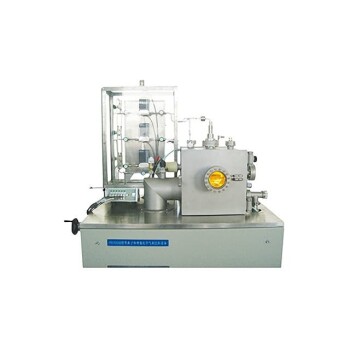
Split Chamber CVD Tube Furnace with Vacuum Station Chemical Vapor Deposition System Equipment Machine

Split Chamber CVD Tube Furnace with Vacuum Station Chemical Vapor Deposition System Equipment Machine

Efficient split chamber CVD furnace with vacuum station for intuitive sample checking and quick cooling. Up to 1200℃ max temperature with accurate MFC mass flowmeter control.

RF PECVD System Radio Frequency Plasma-Enhanced Chemical Vapor Deposition RF PECVD

RF PECVD System Radio Frequency Plasma-Enhanced Chemical Vapor Deposition RF PECVD

RF-PECVD is an acronym for "Radio Frequency Plasma-Enhanced Chemical Vapor Deposition." It deposits DLC (Diamond-like carbon film) on germanium and silicon substrates. It is utilized in the 3-12um infrared wavelength range.

Microwave Plasma Chemical Vapor Deposition MPCVD Machine System Reactor for Lab and Diamond Growth

Microwave Plasma Chemical Vapor Deposition MPCVD Machine System Reactor for Lab and Diamond Growth

Get high-quality diamond films with our Bell-jar Resonator MPCVD machine designed for lab and diamond growth. Discover how Microwave Plasma Chemical Vapor Deposition works for growing diamonds using carbon gas and plasma.

Cylindrical Resonator MPCVD Machine System Reactor for Microwave Plasma Chemical Vapor Deposition and Lab Diamond Growth

Cylindrical Resonator MPCVD Machine System Reactor for Microwave Plasma Chemical Vapor Deposition and Lab Diamond Growth

Learn about Cylindrical Resonator MPCVD Machine, the microwave plasma chemical vapor deposition method used for growing diamond gemstones and films in the jewelry and semi-conductor industries. Discover its cost-effective advantages over traditional HPHT methods.

1200℃ Split Tube Furnace with Quartz Tube Laboratory Tubular Furnace

1200℃ Split Tube Furnace with Quartz Tube Laboratory Tubular Furnace

KT-TF12 split tube furnace: high-purity insulation, embedded heating wire coils, and max. 1200C. Widely used for new materials and chemical vapour deposition.

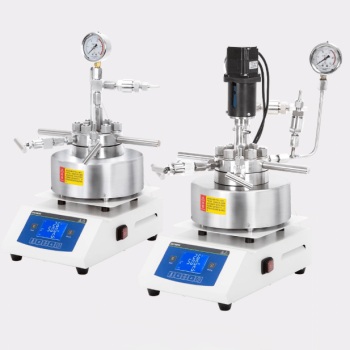
Mini SS High Pressure Autoclave Reactor for Laboratory Use

Mini SS High Pressure Autoclave Reactor for Laboratory Use

Mini SS High Pressure Reactor - Ideal for medicine, chemical, and scientific research industries. Programmed heating temp and stirring speed, up to 22Mpa pressure.

Customizable High Pressure Reactors for Advanced Scientific and Industrial Applications

Customizable High Pressure Reactors for Advanced Scientific and Industrial Applications

This laboratory-scale high-pressure reactor is a high-performance autoclave engineered for precision and safety in demanding research and development environments.

High Pressure Laboratory Autoclave Reactor for Hydrothermal Synthesis

High Pressure Laboratory Autoclave Reactor for Hydrothermal Synthesis

Discover the applications of Hydrothermal Synthesis Reactor - a small, corrosion-resistant reactor for chemical labs. Achieve rapid digestion of insoluble substances in a safe and reliable way. Learn more now.

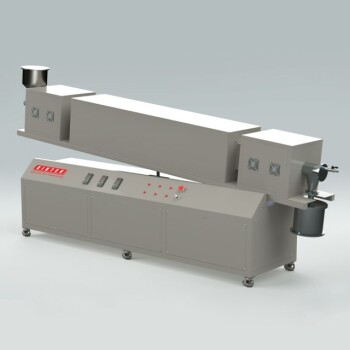
Vacuum Sealed Continuous Working Rotary Tube Furnace Rotating Tube Furnace

Vacuum Sealed Continuous Working Rotary Tube Furnace Rotating Tube Furnace

Experience efficient material processing with our vacuum-sealed rotary tube furnace. Perfect for experiments or industrial production, equipped with optional features for controlled feeding and optimized results. Order now.

Multi Zone Laboratory Quartz Tube Furnace Tubular Furnace

Multi Zone Laboratory Quartz Tube Furnace Tubular Furnace

Experience precise, efficient thermal testing with our Multi Zone Tube Furnace. Independent heating zones and temperature sensors allow for controlled high-temperature gradient heating fields. Order now for advanced thermal analysis!

Laboratory Vacuum Tilt Rotary Tube Furnace Rotating Tube Furnace

Laboratory Vacuum Tilt Rotary Tube Furnace Rotating Tube Furnace

Discover the versatility of Laboratory Rotary Furnace: Ideal for calcination, drying, sintering, and high-temperature reactions. Adjustable rotating and tilting functions for optimal heating. Suitable for vacuum and controlled atmosphere environments. Learn more now!

Vertical High Temperature Graphite Vacuum Graphitization Furnace

Vertical High Temperature Graphite Vacuum Graphitization Furnace

Vertical high temperature graphitization furnace for carbonization and graphitization of carbon materials up to 3100℃.Suitable for shaped graphitization of carbon fiber filaments and other materials sintered in a carbon environment.Applications in metallurgy, electronics, and aerospace for producing high-quality graphite products like electrodes and crucibles.

1700℃ Controlled Atmosphere Furnace Nitrogen Inert Atmosphere Furnace

1700℃ Controlled Atmosphere Furnace Nitrogen Inert Atmosphere Furnace

KT-17A Controlled atmosphere furnace: 1700℃ heating, vacuum sealing technology, PID temperature control, and versatile TFT smart touch screen controller for laboratory and industrial use.

1400℃ Controlled Atmosphere Furnace with Nitrogen and Inert Atmosphere

1400℃ Controlled Atmosphere Furnace with Nitrogen and Inert Atmosphere

Achieve precise heat treatment with KT-14A controlled atmosphere furnace. Vacuum sealed with a smart controller, it's ideal for lab and industrial use up to 1400℃.

Vacuum Heat Treat and Molybdenum Wire Sintering Furnace for Vacuum Sintering

Vacuum Heat Treat and Molybdenum Wire Sintering Furnace for Vacuum Sintering

A vacuum molybdenum wire sintering furnace is a vertical or bedroom structure, which is suitable for withdrawal, brazing, sintering and degassing of metal materials under high vacuum and high temperature conditions. It is also suitable for dehydroxylation treatment of quartz materials.

Molybdenum Vacuum Heat Treat Furnace

Molybdenum Vacuum Heat Treat Furnace

Discover the benefits of a high-configuration molybdenum vacuum furnace with heat shield insulation. Ideal for high-purity, vacuum environments like sapphire crystal growth and heat treatment.

Stainless High Pressure Autoclave Reactor Laboratory Pressure Reactor

Stainless High Pressure Autoclave Reactor Laboratory Pressure Reactor

Discover the versatility of Stainless High Pressure Reactor - a safe and reliable solution for direct and indirect heating. Built with stainless steel, it can withstand high temperatures and pressures. Learn more now.


Leave Your Message