Knowledge Vacuum Furnace What is the temperature of vacuum brazing? Achieve Perfect Joints Without Compromising Your Materials
Author avatar

Tech Team · Kintek Solution

Updated 2 months ago

What is the temperature of vacuum brazing? Achieve Perfect Joints Without Compromising Your Materials


The temperature for vacuum brazing is not a single value but is fundamentally determined by the specific filler metal and base materials being joined. While all brazing occurs above 450°C (840°F), the precise temperature is carefully chosen to be above the filler metal's melting point but safely below the melting point of the components being bonded.

The core principle of vacuum brazing is that the temperature must be high enough to fully melt the filler alloy, allowing it to flow into the joint, yet low enough to prevent any melting or damage to the base materials being assembled.
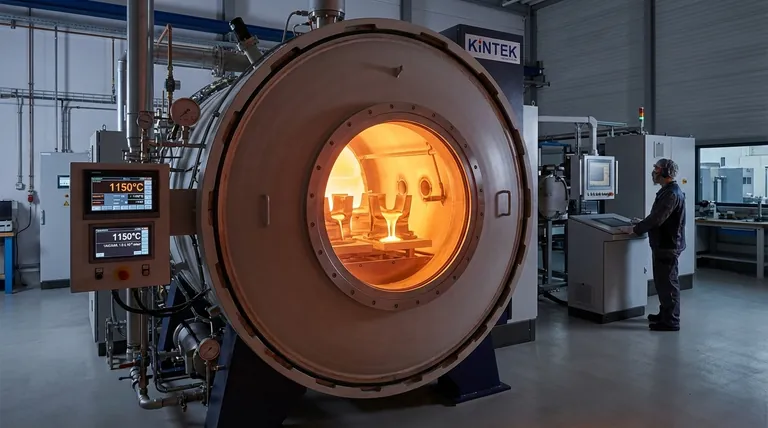
What is the temperature of vacuum brazing? Achieve Perfect Joints Without Compromising Your Materials

Why There Is No Single Brazing Temperature

The selection of a brazing temperature is a critical engineering decision based on the metallurgy of the assembly. It is a balancing act between the properties of the filler metal and the base materials.

The Role of the Filler Metal

The primary factor dictating the minimum brazing temperature is the filler metal, also known as the braze alloy.

Every braze alloy has a liquidus temperature, which is the point at which it becomes completely liquid. The brazing temperature must be set above this liquidus point to ensure the alloy can flow freely into the joint via capillary action.

For example, some copper-based alloys may become fully liquid around 900°C (1650°F), while high-performance nickel-based alloys might require temperatures exceeding 1150°C (2100°F).

The Importance of the Base Material

The second critical factor is the base material of the parts being joined.

The base material has a solidus temperature, the point at which it begins to melt. The brazing temperature must always remain safely below this point to maintain the structural integrity of the workpiece.

Heating a base metal too close to its solidus can cause distortion, grain growth, or other undesirable metallurgical changes, even if it doesn't melt.

The Vacuum Brazing Temperature Cycle

The final brazing temperature is just one point in a carefully controlled heating and cooling cycle. Each stage serves a distinct purpose.

Heating to Brazing Temperature

The furnace heats the components at a controlled rate. This slow, steady increase prevents thermal shock and allows all parts of the assembly, thick and thin, to heat up evenly.

Temperature Soak (Stand-off)

Before reaching the final brazing temperature, the cycle often includes a "soak." The furnace holds the assembly at a stand-off temperature for a period to ensure complete temperature uniformity across the entire workpiece.

This step is critical for complex geometries, ensuring that when the filler metal melts, all parts of the joint are at the correct temperature to accept it.

Final Heating and Brazing

After the soak, the temperature is raised to the final brazing point, above the filler's liquidus. It is held here for a specific duration to allow the filler to flow completely throughout the joint, after which a controlled cooling cycle begins.

Common Pitfalls to Avoid

Setting the wrong temperature can lead to complete failure of the brazed joint. Understanding the risks is key to a successful process.

The Risk of Overheating

Setting the temperature too high can be catastrophic. It can cause the base material to warp, sag, or even begin to melt. This damages the components and creates a weak, unreliable joint.

The Risk of Insufficient Temperature

Setting the temperature too low, or too close to the filler's liquidus, is also a common failure mode. The filler metal will be sluggish and will not flow properly, resulting in voids, incomplete joint fill, and a weak bond.

Making the Right Choice for Your Goal

The correct temperature is always derived from the material specifications provided by the filler metal manufacturer and a thorough understanding of your base materials.

  • If your primary focus is joining standard steels with a copper-based filler: Your brazing temperature will likely be in the range of 1090-1150°C (2000-2100°F).
  • If your primary focus is joining stainless steels with a nickel-based filler: You will be operating at higher temperatures, often between 1000-1200°C (1830-2200°F), depending on the specific alloy.
  • If your primary focus is joining heat-sensitive or aluminum components: You will use specialized, lower-temperature filler alloys, with brazing temperatures carefully controlled to avoid damaging the base metal.

Ultimately, successful vacuum brazing depends on selecting a temperature that creates perfect fluidity for the filler without compromising the integrity of the workpiece.

Summary Table:

Key Factor Role in Temperature Selection
Filler Metal Liquidus Determines the minimum temperature (must be exceeded for proper flow).
Base Material Solidus Determines the maximum temperature (must not be exceeded to prevent damage).
Common Temperature Ranges Copper alloys: ~1090-1150°C; Nickel alloys: ~1000-1200°C; Aluminum alloys: Lower, specific ranges.

Ready to perfect your vacuum brazing process?

Choosing the precise temperature is critical for joint strength and component integrity. At KINTEK, we specialize in providing the lab equipment and consumables you need for reliable, high-performance brazing. Our expertise ensures you can achieve flawless results, whether you're working with standard steels, stainless steels, or heat-sensitive materials.

Let's discuss your specific application. Contact our experts today to find the ideal solution for your laboratory's brazing challenges.

Visual Guide
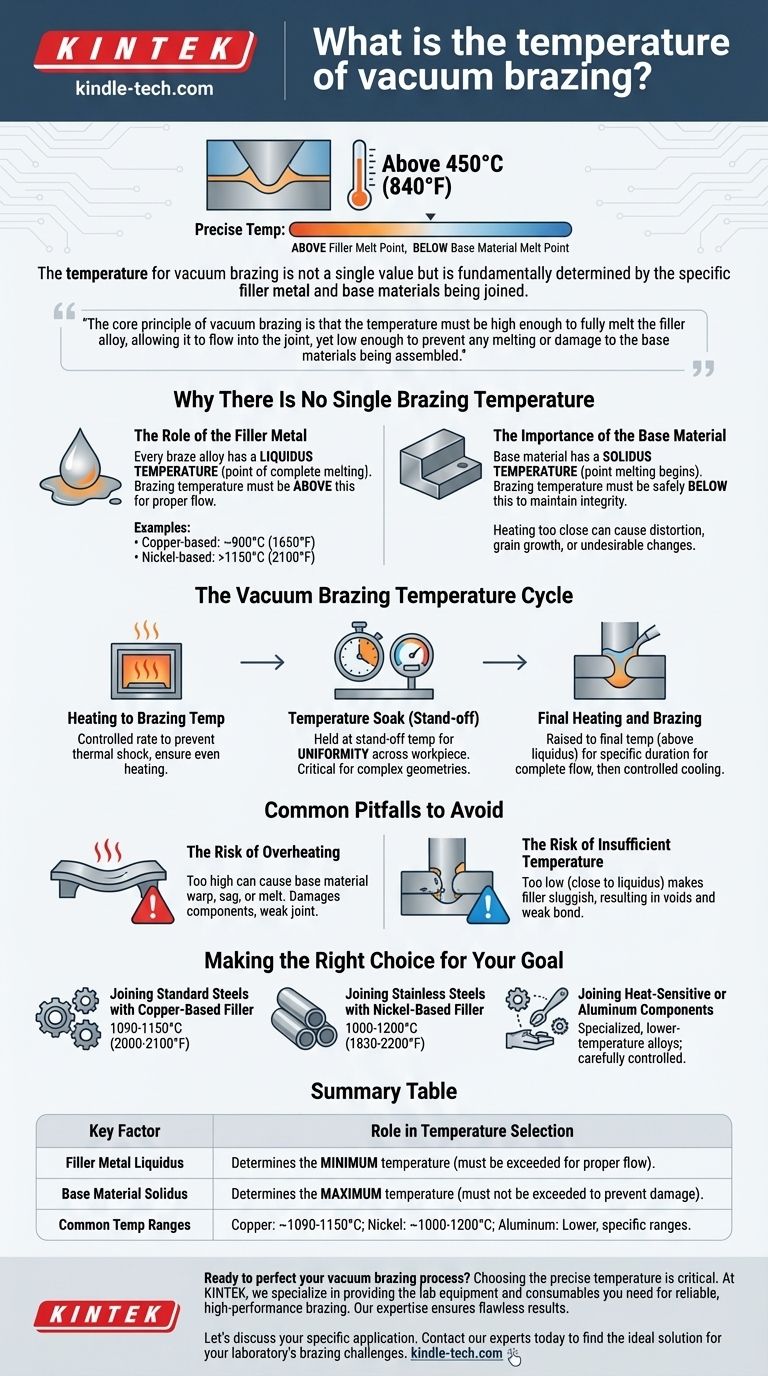
What is the temperature of vacuum brazing? Achieve Perfect Joints Without Compromising Your Materials Visual Guide

Related Products

People Also Ask

Related Products

Vacuum Heat Treat Sintering Brazing Furnace

Vacuum Heat Treat Sintering Brazing Furnace

A vacuum brazing furnace is a type of industrial furnace used for brazing, a metalworking process that joins two pieces of metal using a filler metal that melts at a lower temperature than the base metals. Vacuum brazing furnaces are typically used for high-quality applications where a strong, clean joint is required.

Vacuum Hot Press Furnace Machine for Lamination and Heating

Vacuum Hot Press Furnace Machine for Lamination and Heating

Experience clean and precise lamination with Vacuum Lamination Press. Perfect for wafer bonding, thin-film transformations, and LCP lamination. Order now!

Vacuum Cold Mounting Machine for Sample Preparation

Vacuum Cold Mounting Machine for Sample Preparation

Vacuum Cold Mounting Machine for precise sample prep. Handles porous, fragile materials with -0.08MPa vacuum. Ideal for electronics, metallurgy, and failure analysis.

Vacuum Dental Porcelain Sintering Furnace

Vacuum Dental Porcelain Sintering Furnace

Get precise and reliable results with KinTek's Vacuum Porcelain Furnace. Suitable for all porcelain powders, it features hyperbolic ceramic furnace function, voice prompt, and automatic temperature calibration.

Vacuum Hot Press Furnace Machine Heated Vacuum Press

Vacuum Hot Press Furnace Machine Heated Vacuum Press

Discover the advantages of Vacuum Hot Press Furnace! Manufacture dense refractory metals & compounds, ceramics, and composites under high temp and pressure.

Horizontal High Temperature Graphite Vacuum Graphitization Furnace

Horizontal High Temperature Graphite Vacuum Graphitization Furnace

Horizontal Graphitization Furnace: This type of furnace is designed with the heating elements placed horizontally, allowing for uniform heating of the sample. It's well-suited for graphitizing large or bulky samples that require precise temperature control and uniformity.

Vacuum Hot Press Furnace Heated Vacuum Press Machine Tube Furnace

Vacuum Hot Press Furnace Heated Vacuum Press Machine Tube Furnace

Reduce forming pressure & shorten sintering time with Vacuum Tube Hot Press Furnace for high-density, fine-grain materials. Ideal for refractory metals.

Vacuum Heat Treat and Pressure Sintering Furnace for High Temperature Applications

Vacuum Heat Treat and Pressure Sintering Furnace for High Temperature Applications

Vacuum pressure sintering furnaces are designed for high temperature hot pressing applications in metal and ceramic sintering. Its advanced features ensure precise temperature control, reliable pressure maintenance, and a robust design for seamless operation.

600T Vacuum Induction Hot Press Furnace for Heat Treat and Sintering

600T Vacuum Induction Hot Press Furnace for Heat Treat and Sintering

Discover the 600T Vacuum Induction Hot Press Furnace, designed for high-temperature sintering experiments in vacuum or protected atmospheres. Its precise temperature and pressure control, adjustable working pressure, and advanced safety features make it ideal for nonmetal materials, carbon composites, ceramics, and metal powders.

Laboratory Sterilizer Lab Autoclave Pulsating Vacuum Desktop Steam Sterilizer

Laboratory Sterilizer Lab Autoclave Pulsating Vacuum Desktop Steam Sterilizer

The pulsating vacuum desktop steam sterilizer is a compact and reliable device used for rapid sterilization of medical, pharmaceutical, and research items.

Electric Heated Hydraulic Vacuum Heat Press for Lab

Electric Heated Hydraulic Vacuum Heat Press for Lab

The Electric Vacuum Heat Press is a specialized heat press equipment that operates in a vacuum environment, utilizing advanced infrared heating and precise temperature control for high quality, rugged and reliable performance.

Vacuum Heat Treat and Molybdenum Wire Sintering Furnace for Vacuum Sintering

Vacuum Heat Treat and Molybdenum Wire Sintering Furnace for Vacuum Sintering

A vacuum molybdenum wire sintering furnace is a vertical or bedroom structure, which is suitable for withdrawal, brazing, sintering and degassing of metal materials under high vacuum and high temperature conditions. It is also suitable for dehydroxylation treatment of quartz materials.

Lab-Scale Vacuum Induction Melting Furnace

Lab-Scale Vacuum Induction Melting Furnace

Get precise alloy composition with our Vacuum Induction Melting Furnace. Ideal for aerospace, nuclear energy, and electronic industries. Order now for effective smelting and casting of metals and alloys.

Small Vacuum Heat Treat and Tungsten Wire Sintering Furnace

Small Vacuum Heat Treat and Tungsten Wire Sintering Furnace

The small vacuum tungsten wire sintering furnace is a compact experimental vacuum furnace specially designed for universities and scientific research institutes. The furnace features a CNC welded shell and vacuum piping to ensure leak-free operation. Quick-connect electrical connections facilitate relocation and debugging, and the standard electrical control cabinet is safe and convenient to operate.

Vacuum Arc Induction Melting Furnace

Vacuum Arc Induction Melting Furnace

Discover the power of Vacuum Arc Furnace for melting active & refractory metals. High-speed, remarkable degassing effect, and free of contamination. Learn more now!

Vacuum Induction Melting Spinning System Arc Melting Furnace

Vacuum Induction Melting Spinning System Arc Melting Furnace

Develop metastable materials with ease using our Vacuum Melt Spinning System. Ideal for research and experimental work with amorphous and microcrystalline materials. Order now for effective results.

Vacuum Heat Treat Furnace with Ceramic Fiber Liner

Vacuum Heat Treat Furnace with Ceramic Fiber Liner

Vacuum furnace with polycrystalline ceramic fiber insulation liner for excellent heat insulation and uniform temperature field. Choose from 1200℃ or 1700℃ max. working temperature with high vacuum performance and precise temperature control.

Stainless Steel Quick Release Vacuum Chain Three-Section Clamp

Stainless Steel Quick Release Vacuum Chain Three-Section Clamp

Discover our stainless steel quick release clamp vacuum clamp, Ideal for high vacuum applications, Strong connections, reliable sealing, Easy installation, and durable design.

Dental Porcelain Zirconia Sintering Ceramic Vacuum Press Furnace

Dental Porcelain Zirconia Sintering Ceramic Vacuum Press Furnace

Get precise dental results with Dental Vacuum Press Furnace. Automatic temperature calibration, low noise tray, and touch screen operation. Order now!

23L Laboratory Vacuum Drying Oven

23L Laboratory Vacuum Drying Oven

Kintek Intelligent Vacuum Drying Oven for labs: precise, stable, low-temp drying. Ideal for heat-sensitive materials. Get a quote now!


Leave Your Message