
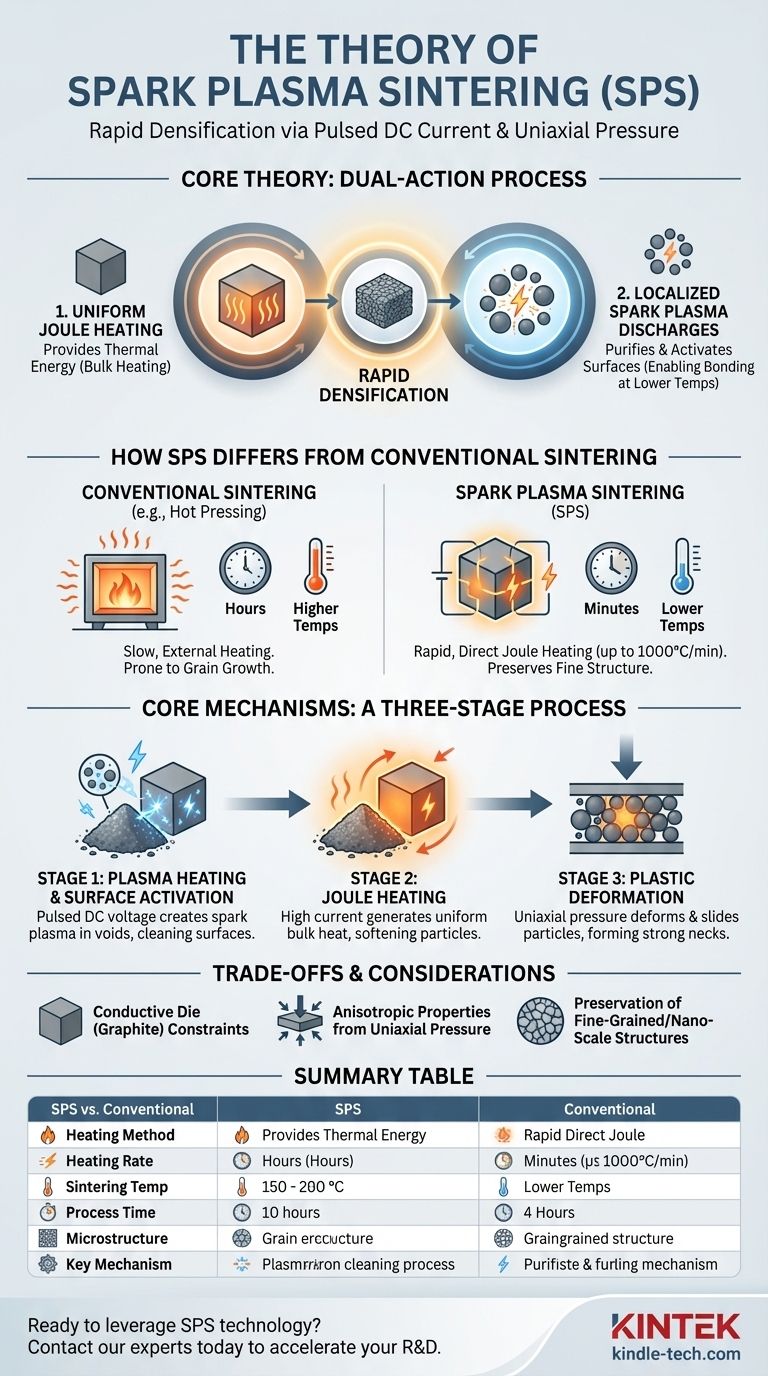
At its core, the theory of spark plasma sintering (SPS) describes a material consolidation process that uses a pulsed direct electric current and uniaxial pressure to achieve rapid densification. Unlike conventional sintering that relies on slow, external heating, SPS generates heat directly within the conductive die and the material itself, while also creating localized plasma between powder particles to dramatically accelerate the bonding process.
The central theory of SPS is not merely about rapid heating. It is a dual-action process where uniform Joule heating provides the thermal energy for densification, while localized spark plasma discharges between particles purify and activate their surfaces, enabling superior bonding at lower temperatures and in less time.
How SPS Differs from Conventional Sintering
To understand the theory of SPS, it is essential to contrast it with traditional methods like hot pressing, which also use heat and pressure. The key difference lies in the method and speed of energy delivery.
The Source of Heat
In conventional sintering or hot pressing, heat is generated by an external heating element and radiates inward to the sample. This is a relatively slow and often inefficient process.
SPS, also known as a field-assisted sintering technique (FAST), passes a powerful electric current directly through the graphite die and, if the material is conductive, the powder compact itself. This generates instantaneous, uniform Joule heat throughout the system.
The Speed and Temperature
The direct heating method of SPS allows for extremely rapid heating rates, sometimes as high as 1000°C/min. This shortens the entire sintering process from many hours to just a few minutes.
Consequently, densification is achieved at significantly lower overall temperatures—often several hundred degrees Celsius below what is required for conventional methods.
The Core Mechanisms: A Three-Stage Process
The unique effects of SPS can be understood as a sequence of three overlapping physical stages that work in concert to consolidate the material.
Stage 1: Plasma Heating and Surface Activation
When the pulsed DC voltage is first applied, a discharge occurs in the voids between individual powder particles. This creates momentary, localized pockets of spark plasma.
These sparks can reach temperatures of several thousand degrees Celsius. This intense, localized heat purifies the particle surfaces by vaporizing adsorbed gases and other contaminants. This "cleaning" effect activates the surfaces, making them highly receptive to bonding.
Stage 2: Joule Heating
Simultaneously, the high electric current flowing through the conductive die and the powder compact generates immense and uniform Joule heat.
This is the primary mechanism for raising the bulk temperature of the material. It softens the particles, preparing them for consolidation under the applied mechanical pressure.
Stage 3: Plastic Deformation
With the particle surfaces purified and the bulk material heated, an external, uniaxial pressure is applied. This mechanical force causes the softened particles to deform and slide against one another.
This action eliminates the voids between particles and forces the activated surfaces into intimate contact, forming strong metallurgical "necks" that lead to a dense final product.
Understanding the Trade-offs and Considerations
While powerful, the theory behind SPS also implies several operational constraints that are critical to understand.
Material and Geometric Constraints
The process relies on a conductive die, which is almost always graphite. This places practical limits on the size and complexity of the shapes that can be produced. Furthermore, the powder itself must be able to withstand the direct effects of the electric current.
Uniaxial Pressure Effects
Because pressure is applied from a single direction (uniaxially), the resulting material can have anisotropic properties, meaning its mechanical characteristics may differ depending on the direction of measurement.
Preservation of Microstructure
One of the most significant advantages derived from the theory is the preservation of fine-grained or nano-scale structures. The extremely short sintering time and lower temperatures prevent the grain growth that plagues conventional, high-temperature methods. This is critical for creating materials with enhanced mechanical properties.
Making the Right Choice for Your Goal
Applying the theory of SPS depends entirely on your end goal for the material.
- If your primary focus is speed and throughput: SPS is an unparalleled technology for rapidly producing dense material samples in a laboratory or small-scale production setting.
- If your primary focus is preserving nano-scale structures: The combination of low temperature and short holding time makes SPS the ideal choice for consolidating advanced, nanostructured powders without destroying their unique properties.
- If your primary focus is material purity and bonding: The unique plasma-cleaning effect offers an in-situ surface purification mechanism that can lead to superior bonding interfaces compared to other methods.
Ultimately, understanding the theory of SPS allows you to leverage its unique combination of thermal, electrical, and mechanical forces to produce advanced materials that are simply not achievable through conventional methods.
Summary Table:
| Aspect | Spark Plasma Sintering (SPS) | Conventional Sintering |
|---|---|---|
| Heating Method | Direct Joule heating within die/powder | External, radiant heating |
| Heating Rate | Very high (up to 1000°C/min) | Slow |
| Sintering Temperature | Lower | Higher |
| Process Time | Minutes | Hours |
| Microstructure | Preserves fine/nano grains | Prone to grain growth |
| Key Mechanism | Spark plasma surface activation + Joule heating | Thermal diffusion |
Ready to leverage SPS technology for your advanced materials?
KINTEK specializes in providing state-of-the-art lab equipment and consumables for materials research and development. Our expertise in sintering technologies can help you achieve rapid densification, preserve nanoscale structures, and enhance material purity for superior results.
Contact our experts today to discuss how our solutions can accelerate your R&D and production goals.
Visual Guide
Related Products
- Spark Plasma Sintering Furnace SPS Furnace
- Vacuum Heat Treat and Sintering Furnace with 9MPa Air Pressure
- High Temperature Muffle Oven Furnace for Laboratory Debinding and Pre Sintering
- 600T Vacuum Induction Hot Press Furnace for Heat Treat and Sintering
- Vacuum Heat Treat and Pressure Sintering Furnace for High Temperature Applications
People Also Ask
- What is the difference between spark plasma sintering and flash sintering? A Guide to Advanced Sintering Methods
- What are the fundamentals of spark plasma sintering process? Unlock Rapid, High-Performance Material Consolidation
- What is the mechanism of SPS process? A Deep Dive into Rapid, Low-Temperature Sintering
- Why are Spark Plasma Sintering (SPS) furnaces or hot presses utilized in the preparation of Li3PS4 solid electrolytes?
- What is the pressure for spark plasma sintering? A Guide to Optimizing SPS Parameters



















