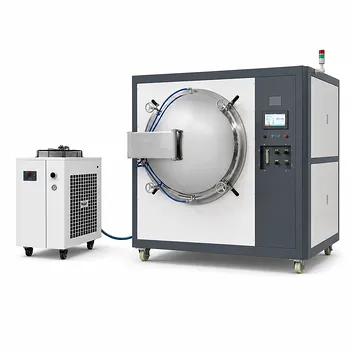
A vacuum hot press furnace provides a distinct processing environment defined by the simultaneous application of high temperature (e.g., 950°C), uniaxial mechanical pressure (e.g., 20 MPa), and a controlled vacuum.
This tri-fold approach is specifically engineered to consolidate Cu/Ti3SiC2/C nanocomposites by driving material densification while strictly prohibiting the oxidation of the copper matrix and the degradation of carbon-based reinforcements.
The primary advantage of this apparatus is its ability to force plastic deformation and particle rearrangement through mechanical pressure, while the vacuum environment ensures the chemical stability of reactive components that would otherwise degrade in open-air sintering.
The Role of the Vacuum Environment
Preventing Matrix Oxidation
The most immediate function of the vacuum chamber is the protection of the metal matrix.
Copper is highly susceptible to oxidation at the elevated temperatures required for sintering. The vacuum environment lowers the oxygen partial pressure significantly, ensuring the copper remains metallic and conductive rather than forming brittle oxides.
Protecting Reinforcement Phases
The vacuum is equally critical for the reinforcement phases, specifically the carbon components (C) and the MAX phase (Ti3SiC2).
Carbon nanomaterials, such as nanotubes or graphite, are prone to ablation (burning off) if exposed to oxygen at high heat. The vacuum shields these materials, preserving their structural integrity and their contribution to the composite's mechanical properties.
Elimination of Adsorbed Gases
Beyond preventing reactions, the vacuum actively facilitates the removal of gases trapped within the interstitial spaces of the powder particles.
By degassing the powder compact during the heating phase, the furnace reduces the likelihood of micro-porosity in the final product. This leads to a denser structure with superior electrical conductivity.
Mechanisms of Densification
Simultaneous Thermal and Mechanical Energy
Unlike conventional sintering, which relies solely on thermal diffusion, hot pressing adds a mechanical driving force.
The furnace applies a constant uniaxial pressure (typically 20–30 MPa) while the material is heated to temperatures around 950°C. This combination accelerates the consolidation process significantly.
Particle Rearrangement and Plastic Flow
The applied pressure physically forces powder particles to slide past one another and rearrange into a tighter packing configuration.
As the temperature rises, the copper matrix softens, allowing for plastic deformation. The pressure drives this softened material to fill voids between the harder Ti3SiC2 and carbon particles, effectively eliminating internal pores.
Enhanced Interfacial Bonding
The combination of pressure and heat promotes the formation of sintering necks between particles.
This results in improved interfacial bonding between the copper matrix and the reinforcements. Strong interfaces are essential for transferring stress and conducting electrons efficiently throughout the composite.
Understanding the Trade-offs
Process Limitations
While vacuum hot pressing yields superior density, it is inherently a batch process constrained by the size of the die.
It is generally slower and more expensive than pressureless sintering techniques due to the complexity of maintaining high vacuum and mechanical loads simultaneously.
Risks of Decomposition
Precise control of the thermal field is required to prevent unintended phase changes.
Although the vacuum protects against oxidation, extreme temperatures or prolonged hold times can still risk the decomposition of the Ti3SiC2 phase or excessive grain growth, which would negatively impact the composite's performance.
Making the Right Choice for Your Goal
To maximize the quality of your Cu/Ti3SiC2/C nanocomposites, align your processing parameters with your specific performance targets:
- If your primary focus is Maximum Density: Prioritize the optimization of uniaxial pressure (e.g., >20 MPa) to force plastic flow and eliminate residual porosity.
- If your primary focus is Electrical Conductivity: Prioritize the integrity of the vacuum level to ensure thorough degassing and the complete prevention of copper oxidation.
- If your primary focus is Mechanical Strength: Focus on the thermal-mechanical balance to ensure strong interfacial bonding without overheating and decomposing the Ti3SiC2 reinforcement.
By leveraging the vacuum hot press to apply force and heat in a chemically inert environment, you achieve a dense, high-purity composite that pressureless methods cannot replicate.
Summary Table:
| Condition | Parameter | Primary Function in Sintering |
|---|---|---|
| Temperature | ~950°C | Facilitates thermal diffusion and softens the metal matrix. |
| Pressure | 20-30 MPa | Drives particle rearrangement, plastic flow, and eliminates pores. |
| Atmosphere | Vacuum | Prevents oxidation of Cu and protects carbon-based reinforcements. |
| Action | Uniaxial Force | Promotes strong interfacial bonding and maximum material density. |
Elevate Your Advanced Material Research with KINTEK
Achieve unparalleled density and purity in your nanocomposites with KINTEK’s precision engineering solutions. Whether you are developing Cu/Ti3SiC2/C composites or exploring next-generation metallurgy, our vacuum hot press furnaces and isostatic presses provide the exact thermal-mechanical control required for superior results.
Our value to you:
- Comprehensive Equipment Range: From high-temperature furnaces (vacuum, tube, muffle) to crushing and milling systems for powder preparation.
- Advanced Sintering Solutions: High-pressure reactors, autoclaves, and hydraulic pellet presses designed for consistency.
- Expert Consumables: High-quality PTFE products, ceramics, and crucibles to maintain material integrity.
Ready to optimize your laboratory's sintering process? Contact KINTEK today for a customized quote and see how our expertise in laboratory equipment and consumables can accelerate your research.
Related Products
- Vacuum Hot Press Furnace Heated Vacuum Press Machine Tube Furnace
- 600T Vacuum Induction Hot Press Furnace for Heat Treat and Sintering
- Vacuum Hot Press Furnace Machine Heated Vacuum Press
- Vacuum Hot Press Furnace Machine for Lamination and Heating
- Vacuum Heat Treat and Pressure Sintering Furnace for High Temperature Applications
People Also Ask
- What advantages does a vacuum hot press furnace provide for LSLBO ceramic electrolytes? Achieve 94% Relative Density
- What role does a Vacuum Hot Press (VHP) furnace play in the densification of austenitic stainless steel 316 composites?
- What are the advantages of using a vacuum hot pressing furnace? Superior Densification for 2024Al/Gr/SiC Composites
- What are the advantages of a vacuum hot press furnace for LTPO solid electrolytes? Boost Density and Conductivity
- What core processing conditions does a vacuum hot press furnace provide? Achieve High-Density Cu-SiC/Diamond Composites