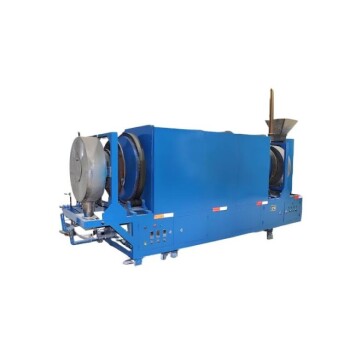
The primary function of a heating furnace in the synthesis of Li2OHBr is to provide a precise, low-temperature environment at approximately 300 degrees Celsius. This thermal energy drives a solid-phase or melt reaction between pre-mixed Lithium Hydroxide (LiOH) and Lithium Bromide (LiBr) precursors. By facilitating this direct interaction, the furnace enables the creation of the final product in a single step without requiring further purification.
By maintaining a controlled temperature of 300°C, the furnace facilitates a "one-step" synthesis. This approach is highly efficient because it yields the target material directly from raw ingredients, eliminating the need for complex downstream processing.
The Mechanics of Thermal Synthesis
Enabling the Chemical Reaction
The furnace serves as the reactor vessel where the transformation of raw materials occurs.
It heats a mixture of LiOH and LiBr to a specific thermal point.
At this temperature, the materials undergo a solid-phase or melt reaction, chemically bonding to form the target Li2OHBr structure.
The Importance of Low-Temperature Sintering
Unlike many ceramic synthesis processes that require extreme heat, this method relies on a relatively low temperature.
The furnace must maintain a steady environment of roughly 300 degrees Celsius.
This specific heat level is sufficient to drive the reaction to completion without degrading the materials or requiring excessive energy consumption.
Efficiency and Process Simplification
Achieving One-Step Production
The most significant advantage of using a furnace in this context is the simplification of the manufacturing workflow.
The heating step converts the pre-mixed precursors directly into the final product.
This effectively consolidates the synthesis into a single, streamlined operation.
Eliminating Post-Processing
In many chemical manufacturing processes, the heating stage is followed by washing, filtration, or purification.
However, the furnace-driven reaction for Li2OHBr is clean and direct.
This negates the need for complex subsequent purification, significantly reducing the time and cost associated with production.
Operational Considerations and Trade-offs
Necessity of Pre-Mixing
While the furnace drives the chemical change, it cannot correct physical inconsistencies.
The reference notes that materials must be "pre-mixed."
If the LiOH and LiBr are not blended homogeneously before entering the furnace, the reaction may be incomplete or uneven.
Sensitivity to Temperature Control
The efficiency of this process relies heavily on maintaining the 300°C target.
Fluctuations in furnace temperature could disrupt the solid-phase or melt reaction mechanisms.
Therefore, the equipment used (whether muffle or tube furnace) must have reliable thermal regulation capabilities.
Making the Right Choice for Your Goal
To maximize the effectiveness of your synthesis process, consider the following based on your objectives:
- If your primary focus is production speed: Leverage the furnace's ability to perform one-step synthesis to bypass time-consuming purification stages.
- If your primary focus is reaction consistency: Ensure your raw LiOH and LiBr are thoroughly mixed and that your furnace is calibrated to hold exactly 300°C to facilitate a complete reaction.
By strictly controlling the thermal environment, the furnace transforms simple raw inputs into high-quality Li2OHBr powder efficiently and reliably.
Summary Table:
| Feature | Specification/Detail |
|---|---|
| Target Temperature | Approximately 300°C (Low-temperature sintering) |
| Precursors Used | Lithium Hydroxide (LiOH) and Lithium Bromide (LiBr) |
| Reaction Type | Solid-phase or melt reaction |
| Synthesis Advantage | One-step production with no post-purification required |
| Critical Success Factor | Homogeneous pre-mixing and precise thermal regulation |
Elevate Your Battery Material Synthesis with KINTEK
Precision is the backbone of high-quality Li2OHBr production. KINTEK specializes in advanced laboratory equipment designed to meet the rigorous thermal demands of modern material science. Whether you require a high-precision muffle furnace or a controlled-atmosphere tube furnace for your 300°C sintering processes, our solutions ensure uniform heating and reliable performance.
Beyond heating, KINTEK offers a comprehensive range of crushing and milling systems to ensure your precursors are perfectly mixed, along with vacuum systems, pellet presses, and high-temperature crucibles to complete your lab setup.
Ready to streamline your workflow and eliminate complex post-processing? Contact our experts today to find the ideal furnace and consumables for your research and production needs!
Related Products
- Ultra-High Temperature Graphite Vacuum Graphitization Furnace
- Controlled Nitrogen Inert Hydrogen Atmosphere Furnace
- Horizontal High Temperature Graphite Vacuum Graphitization Furnace
- Laboratory Rapid Thermal Processing (RTP) Quartz Tube Furnace
- Electric Rotary Kiln Continuous Working Small Rotary Furnace Heating Pyrolysis Plant
People Also Ask
- What is the disadvantage of graphite furnace? Managing Reactivity and Contamination Risks
- Is a graphite melting point high or low? Discover Its Extreme Thermal Resilience
- What are the advantages and disadvantages of graphite furnace? Unlock Extreme Heat Performance
- What gas is used in graphite furnace? Maximize Accuracy with the Right Inert Gas
- What are the disadvantages of graphite furnace? Key Limitations and Operational Costs