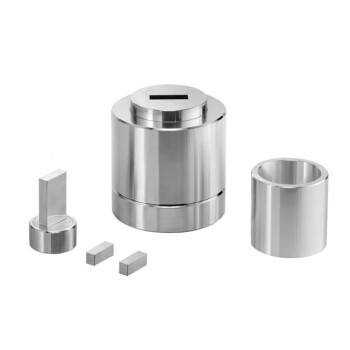
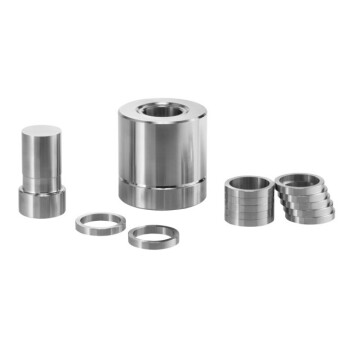
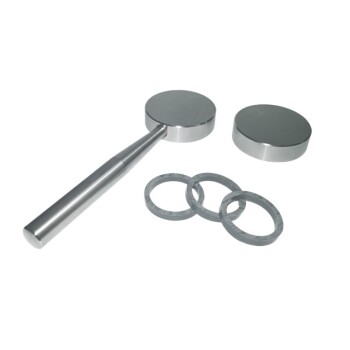
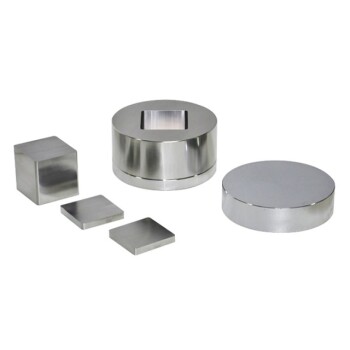
In the hot pressing sintering process of Cr50Cu50 alloys, a high-purity graphite mold functions primarily as a robust containment vessel and a critical pressure transmission medium. It maintains structural stability under extreme heat to uniformly transfer hydraulic force—typically around 12 MPa—directly to the internal metal powder, facilitating the densification of the material.
Core Takeaway: The graphite mold is not a passive container; it is an active mechanical and chemical participant in the sintering process. It enables high-density consolidation by withstanding immense physical stress while simultaneously creating a localized reducing environment that purifies the alloy powder.
The Mechanics of Densification
The success of creating a Cr50Cu50 alloy relies on transforming loose powder into a solid, dense block. The graphite mold is the engine that makes this physical transformation possible.
Acting as a Pressure Transmission Medium
According to standard hot pressing protocols, the mold serves as the interface between the hydraulic system and the alloy powder.
Because the mold allows for movement (often via plungers), it transmits the external uniaxial pressure directly to the powder. This pressure forces the particles to rearrange and undergo plastic deformation, closing internal pores and driving the relative density of the alloy as high as 96.09%.
Maintaining Structural Integrity
The process requires simultaneous high temperatures (e.g., 1050°C) and high pressure.
A high-purity graphite mold is selected because it remains dimensionally stable under these conditions. Whether subjected to 12 MPa or up to 30 MPa of axial pressure, the mold must not deform or fracture. This stability ensures that the final alloy retains the precise shape and dimensions intended by the design.
Thermal and Chemical Functions
Beyond the mechanical aspects of squeezing powder together, the graphite mold contributes to the metallurgical quality of the Cr50Cu50 alloy through thermal and chemical properties.
Uniform Heat Transfer
Graphite possesses high thermal conductivity. In a hot pressing furnace, the mold absorbs heat from the heating elements and transfers it evenly to the alloy powder inside.
This uniformity is critical. It prevents thermal gradients that could lead to uneven sintering, ensuring that the core of the alloy densifies at the same rate as the exterior.
Creating a Reducing Atmosphere
One of the most valuable, often overlooked roles of the graphite mold is its chemical interaction with the immediate environment.
At high temperatures, the graphite reacts with residual oxygen trapped in the mold or powder to generate trace amounts of Carbon Monoxide (CO). This creates a localized reducing atmosphere. This CO "scavenges" oxygen, effectively decomposing oxide layers on the powder surfaces. This allows for successful metallurgical bonding even if the powders were not pre-reduced.
Operational Constraints and Considerations
While high-purity graphite is the standard for this application, understanding its operational limits is vital for process consistency.
Pressure Limitations
While graphite is strong, it is brittle compared to metals. The applied pressure (e.g., 12 MPa to 30 MPa) must be carefully calculated against the mold's wall thickness and graphite grade. Exceeding the material's compressive strength will result in catastrophic mold failure rather than plastic deformation.
Consumable Nature
Because the mold actively reacts with oxygen to protect the alloy, the graphite surface degrades slightly over time. This chemical sacrifice means the molds are eventually consumable items. The "cleaning" effect on the alloy comes at the cost of gradual mold erosion, which must be monitored to maintain dimensional tolerance in repeated runs.
Making the Right Choice for Your Goal
When designing your sintering process for Cr50Cu50, the specific role of the graphite mold changes slightly based on your primary objective.
- If your primary focus is Maximum Density: Prioritize the mold's wall thickness and graphite grade to withstand higher hydraulic pressures (up to 30 MPa) to maximize particle deformation.
- If your primary focus is Material Purity: Rely on the graphite's ability to generate a reducing atmosphere to clean oxide layers, ensuring the vacuum environment is maintained to facilitate this reaction.
By leveraging the mechanical stability and chemical properties of high-purity graphite, you ensure the production of a dense, structurally sound, and oxidation-free alloy.
Summary Table:
| Function | Description | Benefit for Cr50Cu50 |
|---|---|---|
| Pressure Transmission | Transmits axial force (12-30 MPa) to powder | Drives densification to 96.09% relative density |
| Structural Integrity | Dimensionally stable at 1050°C+ | Ensures precise shape and dimensional tolerance |
| Thermal Conductivity | Rapid, uniform heat distribution | Prevents thermal gradients and uneven sintering |
| Chemical Reduction | Reacts with oxygen to create CO gas | Decomposes oxide layers for better metallurgical bonding |
Elevate Your Materials Research with KINTEK
Precision in hot pressing starts with the right equipment and consumables. At KINTEK, we specialize in providing high-performance laboratory solutions tailored for advanced metallurgy.
Our extensive portfolio includes:
- High-Temperature Furnaces: Muffle, vacuum, and CVD systems for precise thermal control.
- Hydraulic Presses: Pellet, hot, and isostatic presses for superior material densification.
- Essential Consumables: High-purity graphite molds, ceramic crucibles, and PTFE products.
Whether you are sintering Cr50Cu50 alloys or developing next-generation battery materials, our experts are ready to provide the tools you need for success. Contact KINTEK today to discuss your project requirements!
Related Products
- Carbon Graphite Plate Manufactured by Isostatic Pressing Method
- Double Plate Heating Press Mold for Lab
- Ball Press Mold for Lab
- Anti-Cracking Press Mold for Lab Use
- Lab Infrared Press Mold
People Also Ask
- What is the process of isostatic graphite manufacturing? Achieve Unmatched Material Uniformity and Performance
- What is isostatic graphite? The Ultimate Material for High-Tech and High-Temperature Applications
- What is the density of isostatic graphite? Unlock Superior Performance for Demanding Applications
- How big is the isostatic pressing market? A Deep Dive into the $1.2B+ Advanced Manufacturing Enabler
- Why Use an Isostatic or High-Precision Hydraulic Press for Li/LLZO/Li Batteries? Master Solid-State Interfaces