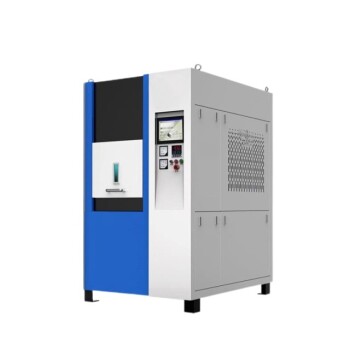
The high-temperature sintering furnace is the defining instrument in the final fabrication of Na3Zr2Si2PO12 (NZSP) ceramic electrolytes. It creates the rigorous thermal environment—specifically maintaining 1150°C for 18 hours—necessary to finalize crystal formation, eliminate phase impurities like Zirconium Dioxide (ZrO2), and drive the densification required for efficient ionic transport.
Core Takeaway The sintering furnace does not merely harden the material; it dictates the electrolyte's electrochemical performance. By sustaining 1150°C for an extended duration, the furnace facilitates the atomic diffusion required to remove grain boundary impurities and close pores, directly unlocking the material's maximum ionic conductivity.
The Critical Functions of Sintering for NZSP
The fabrication of NZSP involves complex solid-state chemistry that can only occur under specific thermal conditions. The furnace, typically a high-temperature box or muffle unit, serves three primary functions during this stage.
Completing Crystal Phase Formation
The primary role of the furnace is to finalize the crystal structure of the ceramic.
While precursor mixing and calcination may start the process, the final high-temperature dwell is where the Na3Zr2Si2PO12 phase fully stabilizes.
The furnace must reach and hold 1150°C. Without this specific thermal energy, the atomic lattice cannot arrange itself into the optimal structure required for sodium ion movement.
Eliminating Grain Boundary Impurities
One of the most specific and critical tasks of the furnace during NZSP fabrication is the removal of secondary phases.
The primary reference notes that ZrO2 (Zirconium Dioxide) often exists as an impurity phase at the grain boundaries.
Holding the temperature at 1150°C for 18 hours provides enough time for the diffusion processes necessary to eliminate these impurities. If these insulating phases remain, they act as roadblocks to ion flow, drastically reducing performance.
Achieving High Densification
A solid electrolyte must be dense and non-porous to function effectively.
The furnace applies heat that promotes atomic diffusion between ceramic particles. This drives the migration of grain boundaries and the elimination of residual pores.
The result is a transformation from a porous "green body" into a solid, dense ceramic pellet. High densification is non-negotiable, as porosity interrupts the conductive pathways and mechanically weakens the electrolyte.
Understanding the Trade-offs
Precise control over the furnace environment is essential, as deviations in temperature or time can ruin the batch.
The Risk of Under-Sintering
If the furnace fails to maintain 1150°C or cuts the duration short of 18 hours, the material will likely retain ZrO2 impurities.
This results in a ceramic that creates high resistance at the grain boundaries (grain boundary impedance). Even if the bulk material is conductive, ions will struggle to cross from one grain to the next.
The Challenge of Thermal Stability
The furnace must provide a stable thermal environment.
Fluctuations in temperature can lead to uneven grain growth. While large grains can improve conductivity (by reducing the number of boundaries), uncontrolled growth can lead to mechanical brittleness or trapped pores that cannot be removed.
Making the Right Choice for Your Goal
To ensure high-performance NZSP fabrication, your furnace operations must be aligned with your specific quality metrics.
- If your primary focus is Ionic Conductivity: Ensure the furnace maintains the full 18-hour dwell time to guarantee the complete elimination of resistive ZrO2 phases at the grain boundaries.
- If your primary focus is Mechanical Integrity: Prioritize the stability of the 1150°C setpoint to ensure uniform grain growth and maximum densification without inducing thermal stress.
Success in fabricating NZSP relies not just on reaching high temperatures, but on the precise maintenance of those conditions to engineer the material's microstructure.
Summary Table:
| Process Parameter | Required Condition | Impact on NZSP Electrolyte |
|---|---|---|
| Sintering Temperature | 1150°C | Finalizes crystal phase formation and stabilizes lattice structure. |
| Dwell Time | 18 Hours | Drives atomic diffusion to eliminate resistive ZrO2 impurities. |
| Thermal Stability | High Precision | Prevents uneven grain growth and ensures mechanical integrity. |
| Atmosphere Control | High-Temp Furnace | Promotes densification and closes pores to enable ionic transport. |
Elevate Your Solid-State Battery Research with KINTEK
Precision is the difference between a high-performance electrolyte and a failed batch. KINTEK specializes in high-performance laboratory equipment, providing the advanced high-temperature muffle and tube furnaces required to sustain 1150°C with the stability your NZSP research demands.
Beyond sintering, our comprehensive portfolio supports your entire workflow—from crushing and milling systems for precursor preparation to high-pressure hydraulic presses for pellet formation, and battery research tools for final testing.
Ready to achieve maximum ionic conductivity and superior densification? Contact our laboratory specialists today to find the perfect thermal solution for your ceramic electrolyte fabrication.
Related Products
- 2200 ℃ Tungsten Vacuum Heat Treat and Sintering Furnace
- Vacuum Heat Treat and Pressure Sintering Furnace for High Temperature Applications
- High Temperature Muffle Oven Furnace for Laboratory Debinding and Pre Sintering
- 2200 ℃ Graphite Vacuum Heat Treat Furnace
- Ultra-High Temperature Graphite Vacuum Graphitization Furnace
People Also Ask
- What is the melting point of tungsten in a vacuum? The Real Limit is Sublimation, Not Melting
- What happens to tungsten when heated? Discover Its Extreme Heat Resistance and Unique Properties
- How does a high-temperature vacuum sintering furnace facilitate the post-treatment of Zirconia coatings?
- How does a high-temperature vacuum sintering furnace contribute to the formation of Fe-Cr-Al porous materials?
- Why is it necessary to use sintering aids for PLS? Achieve Full Density in Ultra-High Temperature Ceramics