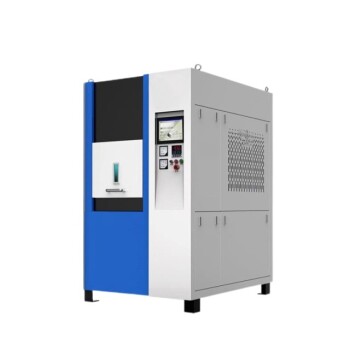
The high-temperature sintering furnace acts as the definitive driver for the crystalline formation of Lithium Titanate (Li4Ti5O12). It provides the sustained thermal energy required to initiate and complete the solid-state reaction between precursor powders, typically necessitating a stable environment of approximately 800°C for extended periods, such as 7 hours. Without this precise thermal treatment, the precursors cannot overcome the kinetic barriers required to form the uniform spinel structure essential for material performance.
By maintaining a controlled thermal profile, the sintering furnace facilitates the complete phase transformation from intermediate oxides into pure spinel Li4Ti5O12. This process is the primary determinant of the material's final stoichiometry, crystallinity, and purity.
The Mechanism of Phase Transformation
Driving the Solid-State Reaction
Solid-state synthesis is inherently distinct from liquid-phase reactions; it relies on the diffusion of ions across solid boundaries. A high-temperature sintering furnace provides the thermal energy necessary to mobilize these ions.
By holding the material at a constant high temperature (e.g., 800°C), the furnace ensures that the reaction proceeds to completion. This sustained heat input allows the precursors to fully interdiffuse and react, rather than remaining as a physical mixture of separate components.
Converting Intermediates to Spinel
The formation of Li4Ti5O12 is rarely instantaneous; it often involves the transition through intermediate phases. The primary reference highlights the specific transformation of anatase TiO2 into the desired spinel-structured Li4Ti5O12.
The furnace facilitates this structural rearrangement. It pushes the material past the energy barriers that stabilize intermediate forms, forcing the atomic lattice to reorganize into the final, stable spinel configuration.
Controlling Material Quality
Ensuring Phase Purity
The ultimate goal of using a muffle or sintering furnace is to achieve phase purity. This means eliminating secondary phases that could degrade electrochemical performance.
If the temperature is inconsistent or the duration is insufficient, unreacted precursors or intermediate phases will remain in the final product. The furnace’s ability to maintain a uniform temperature profile ensures that the entire batch reaches the required stoichiometry.
Managing Crystallinity and Grain Growth
Beyond chemical composition, the physical structure of the crystal is critical. The thermal environment controls grain growth and the degree of crystallinity.
Proper sintering produces well-defined crystals with minimized defects. This structural integrity is vital, as it dictates the electronic and ionic conductivity of the final battery material.
Understanding the Trade-offs
The Risk of Thermal Gradients
While high temperatures are necessary, uneven heating can be detrimental. If the furnace does not provide a uniform thermal environment, you may experience localized sintering.
This results in a heterogeneous sample where some areas are fully reacted while others remain amorphous or chemically incomplete. Precision in the furnace's heating elements is non-negotiable for high-quality Li4Ti5O12.
Sensitivity to Processing Time
The relationship between time and temperature is delicate. As noted, a duration of 7 hours is often cited for this specific reaction at 800°C.
Insufficient time leads to incomplete conversion (low purity), while excessive sintering time can lead to "over-sintering." This can cause excessive grain growth, reducing the surface area and potentially hampering the material's rate capability in battery applications.
Making the Right Choice for Your Synthesis
To optimize the formation of Li4Ti5O12, your thermal strategy must align with your specific material requirements.
- If your primary focus is Phase Purity: Prioritize a furnace with exceptional temperature uniformity to ensure the complete conversion of anatase TiO2 to spinel without leaving unreacted precursors.
- If your primary focus is Particle Size Control: Carefully optimize the dwell time (e.g., sticking strictly to the 7-hour baseline initially) to prevent excessive grain growth that limits surface area.
- If your primary focus is Experimental Validation: Utilize the furnace's programmable heating rates to simulate specific thermal histories, verifying compatibility before scaling up.
The sintering furnace is not merely an oven; it is a precision instrument that dictates the structural destiny of your Li4Ti5O12.
Summary Table:
| Process Parameter | Role in Li4Ti5O12 Synthesis | Impact on Material Quality |
|---|---|---|
| Sustained Heat (800°C) | Initiates ionic diffusion & solid-state reaction | Drives complete phase transformation to spinel |
| 7-Hour Dwell Time | Allows for complete chemical interdiffusion | Ensures phase purity and eliminates intermediates |
| Temperature Uniformity | Prevents localized sintering & gradients | Ensures consistent stoichiometry across the batch |
| Cooling/Heating Rate | Manages grain growth and lattice formation | Controls crystallinity and electronic conductivity |
Elevate Your Battery Material Research with KINTEK
Precision is the backbone of high-performance energy storage. At KINTEK, we specialize in advanced laboratory equipment designed to meet the rigorous demands of material science. Our high-temperature muffle and tube furnaces provide the exceptional thermal uniformity and programmable control required to master the crystalline phase formation of Li4Ti5O12 and other advanced battery precursors.
From high-temperature sintering and vacuum furnaces to specialized crushing, milling, and pelletizing systems, KINTEK provides the end-to-end solutions your lab needs to ensure phase purity and optimal grain growth. Whether you are scaling up synthesis or conducting fundamental research, our experts are here to support your mission with reliable equipment and essential consumables like PTFE products, ceramics, and crucibles.
Ready to optimize your synthesis process? Contact our technical team today to discover the perfect thermal solution for your lab!
Related Products
- 2200 ℃ Tungsten Vacuum Heat Treat and Sintering Furnace
- Vacuum Heat Treat and Pressure Sintering Furnace for High Temperature Applications
- High Temperature Muffle Oven Furnace for Laboratory Debinding and Pre Sintering
- 2200 ℃ Graphite Vacuum Heat Treat Furnace
- Ultra-High Temperature Graphite Vacuum Graphitization Furnace
People Also Ask
- What is the melting point of tungsten in a vacuum? The Real Limit is Sublimation, Not Melting
- What happens to tungsten when heated? Discover Its Extreme Heat Resistance and Unique Properties
- How does a high-temperature vacuum sintering furnace facilitate the post-treatment of Zirconia coatings?
- Why is it necessary to use sintering aids for PLS? Achieve Full Density in Ultra-High Temperature Ceramics
- How does a high-temperature vacuum sintering furnace contribute to the formation of Fe-Cr-Al porous materials?