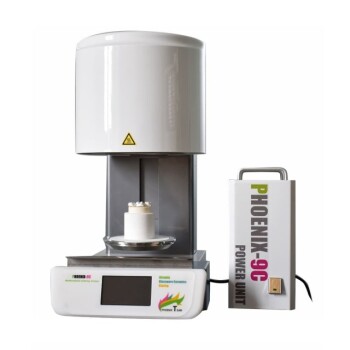
The high-temperature muffle furnace acts as the primary reaction vessel for the synthesis of samarium-doped strontium titanate, specifically facilitating the critical thermal treatment of mixed powders. Operating in an air environment at 1100°C, its function is to drive the solid-state reaction that transforms raw chemical precursors into a unified ceramic material.
The muffle furnace is not merely a heating device; it is a precision instrument used to decompose carbonates, synthesize the cubic perovskite phase, and manage internal material stresses through rigorous temperature profiling.
Orchestrating Chemical Phase Transformations
Decomposition of Precursors
The initial role of the furnace is to facilitate the complete thermal decomposition of strontium carbonate ($SrCO_3$).
At high temperatures, the furnace ensures that $SrCO_3$ breaks down effectively. This process releases carbon dioxide ($CO_2$) gas, which must be fully evacuated from the material to prevent defects.
Formation of the Perovskite Structure
Once decomposition is underway, the furnace promotes a phase transformation within the remaining powders.
The goal is to achieve a specific cubic strontium titanate phase which possesses a perovskite structure. This structural arrangement is fundamental to the material's final electrical and physical properties.
The Role of a Stable Thermal Field
To ensure these reactions occur uniformly throughout the batch, the furnace must maintain a stable thermal field.
Inconsistencies in temperature can lead to mixed phases or incomplete reactions. A high-quality muffle furnace ensures that the 1100°C environment is consistent across the entire sample volume.
Precision Control of Process Parameters
Regulating the Heating Rate
The rate at which the material is brought to temperature is as critical as the maximum temperature itself.
For samarium-doped strontium titanate, a specific heating rate of 10°C per minute is required. This controlled ramp-up prevents thermal shock and ensures that the chemical precursors react in an orderly fashion.
Enhancing Crystallinity via Cooling
The process concludes with a slow, controlled cooling phase, often extending over a 24-hour period.
This slow furnace cooling is essential for achieving high crystallinity. By allowing the lattice to arrange itself gradually, the process minimizes structural stress and maximizes the order of the crystal structure.
Understanding Process Risks
The Consequence of Rapid Cooling
Rushing the cooling process is a common pitfall in ceramic synthesis.
If the 24-hour cooling cycle is shortened, the material may suffer from internal micro-stresses. This structural stress can lead to lattice distortion or macroscopic cracking, compromising the integrity of the ceramic.
Incomplete Carbonate Decomposition
If the furnace fails to maintain the 1100°C temperature or adequate airflow, carbonate decomposition may remain incomplete.
Residual carbon or unreacted strontium carbonate will act as impurities. These impurities disrupt the formation of the cubic perovskite phase, leading to inferior material performance.
Making the Right Choice for Your Goal
To maximize the quality of samarium-doped strontium titanate, align your furnace protocols with your specific production objectives:
- If your primary focus is Phase Purity: Ensure the furnace can sustain a stable 1100°C in an air environment to guarantee full carbonate decomposition and perovskite formation.
- If your primary focus is Structural Integrity: Prioritize a programmable controller that can strictly enforce the 10°C/min heating rate and the extended 24-hour cooling cycle to eliminate stress.
Success depends on viewing the furnace not as a heat source, but as a tool for precise lattice engineering.
Summary Table:
| Process Step | Temperature / Rate | Key Function |
|---|---|---|
| Precursor Decomposition | 1100°C (Air) | Decomposes $SrCO_3$ and releases $CO_2$ |
| Phase Synthesis | 1100°C Stable Field | Formation of cubic perovskite structure |
| Heating Ramp | 10°C / minute | Prevents thermal shock; orderly reaction |
| Cooling Phase | 24-hour slow cool | Minimizes internal stress; maximizes crystallinity |
Elevate Your Ceramic Research with KINTEK Precision
Achieving the perfect cubic perovskite structure requires more than just heat—it requires the absolute thermal stability and programmable control found in KINTEK high-temperature muffle furnaces.
Whether you are synthesizing samarium-doped strontium titanate or developing advanced battery materials, KINTEK provides the specialized laboratory equipment you need to ensure success. Our comprehensive range includes:
- Advanced Furnaces: Muffle, tube, vacuum, and atmosphere furnaces for rigorous thermal profiling.
- Material Processing: High-performance crushing, milling, and hydraulic pellet presses for sample preparation.
- Specialized Reactors: High-temperature high-pressure reactors and autoclaves for complex synthesis.
Ready to eliminate lattice distortion and macroscopic cracking in your samples? Contact our laboratory specialists today to find the ideal thermal solution for your production goals.
References
- Maxim V. Zdorovets, Аrtem L. Kozlovskiy. Synthesis and Properties of SrTiO3 Ceramic Doped with Sm2O3. DOI: 10.3390/ma14247549
This article is also based on technical information from Kintek Solution Knowledge Base .
Related Products
- 1200℃ Muffle Furnace Oven for Laboratory
- High Temperature Muffle Oven Furnace for Laboratory Debinding and Pre Sintering
- 1400℃ Muffle Oven Furnace for Laboratory
- Ultra-High Temperature Graphite Vacuum Graphitization Furnace
- Vertical High Temperature Graphite Vacuum Graphitization Furnace
People Also Ask
- How does a muffle furnace ensure reliability in calcification roasting? Achieve Precision in Pellets Conversion
- Why is a laboratory high-temperature muffle furnace required for the post-annealing treatment of copper oxide?
- What role does a laboratory high-temperature muffle furnace play in iron-based composite phase structure development?
- How is a laboratory high-temperature muffle furnace utilized in sol-gel synthesis for perovskite catalysts?
- How does a muffle furnace influence 8YSZ ceramic densification? Master Precision Sintering at 1500°C