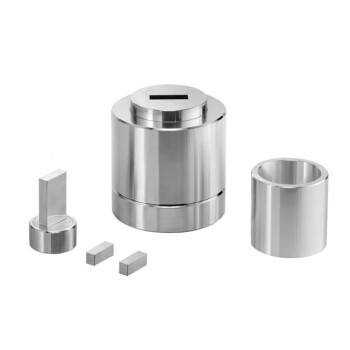
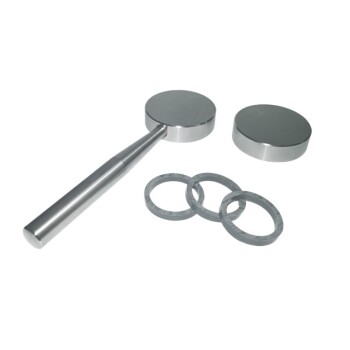
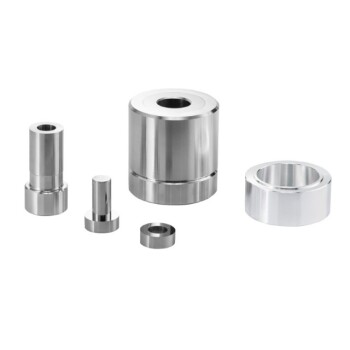
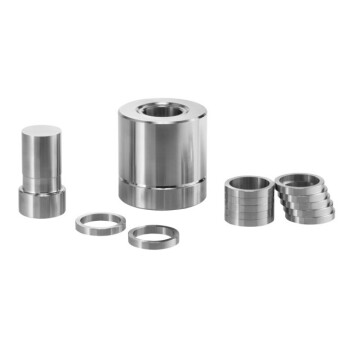
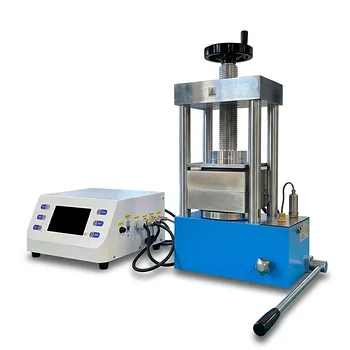
The laboratory hydraulic press is the critical tool used to transform loose fayalite slag powder into a solid, uniform pellet for X-ray fluorescence (XRF) analysis. By applying intense, consistent axial pressure, the press eliminates air pockets and surface irregularities that would otherwise distort X-ray signals. This mechanical preparation ensures the spectrometer receives a stable, reproducible fluorescence response, which is essential for accurate quantitative elemental data.
A laboratory hydraulic press ensures the structural integrity and surface flatness of fayalite slag samples. By standardizing the sample’s density and geometry, it removes the physical variables that cause measurement errors in XRF spectroscopy.
Transforming Raw Slag into Analytical Samples
The Mechanics of Pelletization
A hydraulic press applies high-intensity axial pressure to finely ground fayalite slag powder, often mixed with a chemical binder. This force compresses the particles into a dense, circular pellet that can be handled and loaded into the XRF spectrometer without crumbling.
Creating a Perfectly Flat Detection Surface
The press uses polished plates to create a perfectly flat and level surface on the sample. This geometry is vital because even minor surface roughness can cause light beam scattering and "shadow effects," where the X-ray source cannot evenly illuminate the sample.
Ensuring Structural Integrity
Fayalite slag is often brittle or abrasive; the hydraulic press provides the necessary force to ensure the sample stays completely compacted. This integrity prevents the sample from degrading inside the vacuum of the XRF chamber, which would protect the instrument from contamination.
Optimizing Signal Accuracy and Reproducibility
Overcoming the Particle Size Effect
Raw powder contains varying grain sizes and internal pores that interfere with X-ray penetration. The press effectively eliminates particle size effects by forcing the material into a uniform state, ensuring that the X-rays interact with a representative cross-section of the slag.
Reducing Matrix and Shadow Effects
Inconsistent sample density can lead to "matrix effects," where certain elements absorb or enhance the signals of others. By achieving consistent sample density, the hydraulic press minimizes these interferences, allowing for the precise quantification of major oxides like silica and alumina.
Improving Excitation Efficiency
A dense, smooth pellet improves the excitation efficiency of the fluorescence signal. When the sample is highly compacted, the X-ray bombardment yields a stronger, more consistent radiation response, which is necessary for detecting heavy metals and trace elements with high precision.
Understanding the Trade-offs and Pitfalls
The Risk of Sample Contamination
While binders are often necessary to hold the pellet together, they can introduce trace contaminants or dilute the sample concentration. You must carefully account for the binder's chemical signature during the calibration of your XRF equipment.
Pressure-Induced Heterogeneity
Applying pressure too quickly or unevenly can cause "pressure gradients" within the pellet. This results in non-uniform density, which may cause the pellet to crack or lead to inconsistent readings if the XRF beam hits a less dense area of the sample.
Limitations with Heterogeneous Slag
If the fayalite slag is not ground to a fine enough mesh (typically 200 mesh or finer) before pressing, the resulting pellet will still harbor mineralogical variations. The hydraulic press can fix physical packing issues, but it cannot compensate for a poorly homogenized raw sample.
How to Apply This to Your Laboratory Workflow
Choosing the Right Approach for Your Goal
To get the most out of your hydraulic press when preparing slag samples, consider your specific analytical requirements:
- If your primary focus is high-throughput screening: Use an automated hydraulic press to ensure every pellet is pressed with the exact same dwell time and pressure for maximum repeatability.
- If your primary focus is trace element detection: Use a manual press with high-purity binders to prevent the introduction of foreign elements that could skew low-concentration results.
- If your primary focus is analyzing major oxides (Silica/Alumina): Ensure your slag is ground to at least 200 mesh before pressing to achieve the signal stability required for major element quantification.
The laboratory hydraulic press is not merely a tool for convenience, but a fundamental component in achieving the sample uniformity required for world-class elemental analysis.
Summary Table:
| Preparation Step | Benefit of Using a Hydraulic Press | Impact on XRF Results |
|---|---|---|
| Pelletization | Compresses loose powder into dense, solid disks. | Ensures stable, reproducible fluorescence response. |
| Surface Leveling | Creates a perfectly flat, polished sample surface. | Minimizes beam scattering and "shadow effects." |
| Compaction | Eliminates internal air pockets and pores. | Removes particle size effects and signal interference. |
| Density Control | Achieves uniform material distribution. | Minimizes matrix effects for precise oxide quantification. |
| Structural Fixation | Prevents sample crumbling or degradation. | Protects spectrometer from vacuum contamination. |
Elevate Your Analytical Precision with KINTEK
Achieving world-class elemental data starts with flawless sample preparation. KINTEK specializes in high-performance laboratory solutions designed to eliminate variables in your XRF workflow. Our robust range of laboratory hydraulic presses—including manual, automated, and isostatic models—ensures the perfect pellet density and surface flatness required for even the most challenging fayalite slag samples.
By partnering with KINTEK, you gain access to:
- Advanced Sample Prep: High-precision presses and crushing/milling systems for 200-mesh homogenization.
- Complete Lab Ecosystem: From high-purity ceramics and crucibles to cooling solutions and high-temperature furnaces.
- Unmatched Reliability: Equipment engineered for structural integrity and long-term durability in abrasive environments.
Ready to optimize your lab's efficiency and accuracy? Contact our experts today to find the ideal preparation system for your specific research needs!
References
- Anton Andersson, Fredrik Engström. A Method for Synthesizing Iron Silicate Slags to Evaluate Their Performance as Supplementary Cementitious Materials. DOI: 10.3390/app13148357
This article is also based on technical information from Kintek Solution Knowledge Base .
Related Products
- Automatic Laboratory Hydraulic Pellet Press Machine for Lab Use
- Laboratory Manual Hydraulic Pellet Press for Lab Use
- Laboratory Manual Hydraulic Pellet Press for Lab Use
- Laboratory Hydraulic Pellet Press for XRF KBR FTIR Lab Applications
- Laboratory Hydraulic Press Lab Pellet Press Machine for Glove Box
People Also Ask
- What is the role of a laboratory hydraulic pellet press and stainless steel molds in the fabrication of RuO2/NbC anodes?
- What role does a laboratory pellet press play in the enhancement of biomass energy products? Optimize Fuel Efficiency
- What is the purpose of using a laboratory pellet press when evaluating the electronic conductivity of carbon powders? Guide
- How does a laboratory hydraulic pellet press contribute to SiCw/2024 aluminum composite preforms? Optimize Densification
- What is the significance of applying 200 MPa of pressure with a laboratory hydraulic pellet press for composite ceramics?