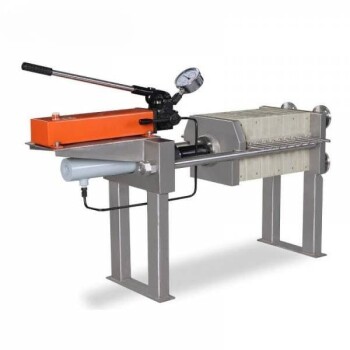
A laboratory hydraulic press serves as the critical bridge between loose mixed powders and the final sintering process. Its primary role in the pre-preparation of TiB2-TiN-WC tool materials is to compact sieved powders into a specific shape under defined pressure, typically around 1.5 MPa, to create a cohesive solid known as a "green body."
Core Takeaway The hydraulic press transforms loose powder into a manageable, shaped entity by eliminating air voids and forcing particles into initial contact. This "cold-pressing" step is essential for creating a green body with sufficient mechanical strength to be handled and loaded into a furnace, ensuring an optimal starting point for high-temperature sintering.
The Mechanics of Green Body Formation
Consolidation and Shaping
The fundamental function of the press is to convert the loose, sieved TiB2-TiN-WC mixture into a fixed geometry. By applying a defined pressure (such as 1.5 MPa), the machine forces the powder particles to aggregate.
Initial Degassing
Before the material ever reaches the heat of a furnace, the hydraulic press performs a crucial physical task: degassing. The compression forces air out from between the loose particles, reducing the porosity of the material before heating begins.
Establishing Particle Contact
The pressure establishes the necessary initial contact points between the TiB2, TiN, and WC particles. This physical proximity is a prerequisite for the chemical and physical bonding that will occur later during sintering.
Optimizing for the Sintering Process
Creating "Green Strength"
The immediate output of the press is a green body—a compacted sample that is not yet fully sintered but possesses enough structural integrity to hold its shape.
Without this step, the material would remain a loose powder, making it structurally impossible to handle or transport effectively.
Facilitating Furnace Loading
The hydraulic press ensures the material is in a state that facilitates loading into a hot-pressing furnace. Because the sample is now a solid unit rather than a pile of powder, it can be placed into sintering molds with precision.
Improving Sintering Outcomes
Pre-pressing creates an optimal initial packing state. By increasing the initial packing density and maximizing particle contact area, the press helps reduce excessive shrinkage and deformation that might otherwise occur during the high-temperature sintering phase.
Understanding the Trade-offs
The Necessity of Controlled Pressure
While the hydraulic press allows for densification, the pressure must be strictly defined and controlled.
If the pressure is too low, the green body will lack the mechanical strength to be handled, crumbling before it reaches the furnace.
Density vs. Sintering Requirements
It is important to distinguish between pre-pressing and sintering pressure. The pre-preparation pressure (e.g., 1.5 MPa) is significantly lower than the pressures used during the actual hot-pressing or sintering phase (which can reach 20 MPa or higher).
Attempting to achieve full density solely through cold hydraulic pressing is inefficient; its purpose is preparation, not finalization.
Making the Right Choice for Your Goal
To ensure the highest quality TiB2-TiN-WC tool materials, focus on the specific objectives of the pre-preparation phase:
- If your primary focus is Handling Logistics: ensure the hydraulic press applies enough pressure (approx. 1.5 MPa) to create a robust green body that will not crumble during furnace loading.
- If your primary focus is Final Sintering Quality: use the press to maximize the initial packing density, as this minimizes voids and reduces the risk of deformation during the high-temperature phase.
The laboratory hydraulic press turns undefined powder into a structured foundation, ensuring reproducible and mechanically sound results in the final tool material.
Summary Table:
| Function | Description | Impact on Sintering |
|---|---|---|
| Consolidation | Converts loose sieved powder into a fixed geometry | Enables handling and precise furnace loading |
| Degassing | Forces air out from between powder particles | Reduces initial porosity and prevents air pockets |
| Particle Contact | Establishes physical proximity between TiB2, TiN, and WC | Prerequisite for effective chemical bonding |
| Green Strength | Provides structural integrity at ~1.5 MPa | Prevents crumbling and material loss during transport |
| Density Prep | Maximizes initial packing density | Minimizes shrinkage and deformation during heating |
Elevate Your Material Research with KINTEK Precision
Achieving the perfect green body for your TiB2-TiN-WC tool materials requires precision and reliability. KINTEK specializes in advanced laboratory equipment, providing high-performance hydraulic presses (pellet, hot, isostatic) designed to ensure optimal packing density and structural integrity for your samples.
From crushing and milling systems to high-temperature furnaces (muffle, vacuum, CVD) and high-pressure reactors, our comprehensive portfolio supports your entire workflow. Whether you are working on battery research, ceramics, or advanced metallurgy, our experts are ready to provide the tools you need for reproducible results.
Ready to optimize your sintering process? Contact KINTEK today to find the perfect hydraulic press for your lab!
Related Products
- Laboratory Hydraulic Press Lab Pellet Press Machine for Glove Box
- Laboratory Hydraulic Press Split Electric Lab Pellet Press
- Automatic Laboratory Hydraulic Press for XRF & KBR Pellet Press
- Laboratory Hydraulic Press Lab Pellet Press for Button Battery
- Automatic Laboratory Hydraulic Pellet Press Machine for Lab Use
People Also Ask
- What is the function of a laboratory hydraulic press in W-Cu composites? Control Porosity and Material Ratio
- What is the role of a laboratory hydraulic press in the initial stages of Li6PS5Cl preparation? Key to Green Pellets
- What role does a laboratory hydraulic press play in triboelectric testing? Achieve Precision Alloy Sample Prep
- How can a laboratory hydraulic press be applied to chitosan for wastewater treatment? Optimize Pores & Strength
- How do a precision laboratory hydraulic press and specialized molds contribute to the fabrication of spherical ceramic samples? Achieving High-Density Material Precision