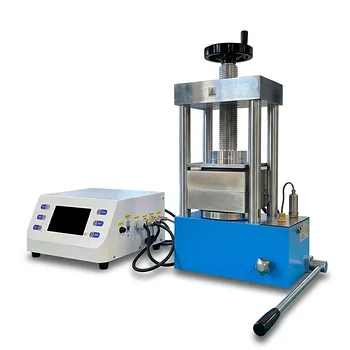
A laboratory uniaxial hydraulic press functions as the critical initial forming tool in the preparation of LATP (Li1.3Al0.3Ti1.7(PO4)3) green bodies. Its primary role is to apply a specific pre-pressure, generally around 0.3 MPa, to compact loose LATP powders into a cohesive cylindrical shape that possesses the structural integrity required for handling and loading into subsequent high-pressure assembly components.
The Core Takeaway While final material properties rely on sintering, the uniaxial press establishes the necessary physical foundation. It transforms volatile loose powder into a stable, geometrically defined "green body," ensuring the sample is robust enough to survive the transition to high-pressure treatments without disintegrating.
The Mechanics of Green Body Formation
Establishing Geometric Definition
The primary function of the press is to impose a defined geometry upon the raw material. Loose LATP powder lacks a fixed shape, making it impossible to process in advanced high-pressure rigs without prior conditioning.
By utilizing a mold, the press compacts the powder into a cylinder with a precise diameter. This ensures the sample fits perfectly into the assembly components used in later stages of synthesis or testing.
The Role of Pre-Pressure
According to standard preparation protocols, the press applies a "pre-pressure" typically in the range of 0.3 MPa.
This pressure is carefully calibrated: it is high enough to interlock the particles but low enough to avoid premature sealing of pores that might need to be managed later. This step is about structural organization rather than final densification.
Particle Rearrangement
Inside the mold, the uniaxial force overcomes the friction between powder granules.
This forces the particles to rearrange, reducing void space and creating a packed structure. This physical proximity is the precursor to chemical bonding, setting the stage for future diffusion during heating.
Achieving Handling Strength
Creating Mechanical Interlocking
Without a binder, loose powders rely on mechanical interlocking to stay together.
The hydraulic press forces particles into voids, creating points of contact that generate friction and cohesion. This results in "green strength"—the ability of the unsintered compacted powder to hold its shape under its own weight.
Facilitating Process Transfer
The most practical role of the press is operational.
LATP synthesis often involves complex high-pressure assemblies. A pressed green body can be picked up with tweezers or forceps and loaded into these assemblies precisely, whereas loose powder would spill, contaminate seal surfaces, or distribute unevenly.
Understanding the Trade-offs
Pre-forming vs. Final Densification
It is critical to distinguish between green body formation and final densification.
The 0.3 MPa applied by the uniaxial press is a forming pressure, not a sintering pressure. It creates a shape, but it does not produce the high relative density required for optimal ionic conductivity; that requires significantly higher pressures or high-temperature sintering.
The Risk of Density Gradients
Uniaxial pressing applies force from one direction (or two opposing directions).
This can sometimes lead to density variations, where the edges of the cylinder are denser than the center due to wall friction. While sufficient for creating a green body for handling, operators must be aware that this density gradient exists prior to sintering.
Making the Right Choice for Your Goal
When integrating a uniaxial hydraulic press into your LATP workflow, consider your specific objectives:
- If your primary focus is Sample Integrity: Ensure your pressure is sufficient (approx. 0.3 MPa) to prevent crumbling during transfer, but avoid excessive pressure that might laminate the sample.
- If your primary focus is Dimensional Tolerance: Use the press to establish the exact diameter required for your high-pressure cell, as the green body determines the fit of the final assembly.
The laboratory uniaxial press is not the tool that gives LATP its final electrochemical properties, but it is the essential "gatekeeper" that makes processing the material physically possible.
Summary Table:
| Function | Key Role in LATP Preparation | Typical Parameters |
|---|---|---|
| Geometric Definition | Converts loose powder into a precise cylindrical shape for rig compatibility. | Mold-dependent diameter |
| Pre-Pressure Application | Provides initial compaction to create a cohesive structure from loose particles. | ~0.3 MPa |
| Handling Strength | Establishes "green strength" via mechanical interlocking for easy transfer. | Non-binder cohesion |
| Process Foundation | Organizes particles to facilitate future chemical bonding and diffusion. | Physical rearrangement |
Elevate Your Material Synthesis with KINTEK Precision.
High-performance LATP green bodies require reliable compaction and precise pressure control. KINTEK specializes in advanced laboratory equipment, offering a robust range of manual and automatic hydraulic presses (pellet, hot, isostatic) designed to ensure structural integrity in your research.
From high-temperature furnaces and crushing systems to specialized consumables like PTFE and ceramics, KINTEK provides the comprehensive tools needed for cutting-edge battery research and material science.
Ready to optimize your sample preparation? Contact our technical experts today to find the perfect pressing solution for your lab!
Related Products
- Heated Hydraulic Press Machine with Integrated Manual Heated Plates for Lab Use
- Automatic Laboratory Hydraulic Press for XRF & KBR Pellet Press
- Laboratory Hydraulic Press Split Electric Lab Pellet Press
- Laboratory Hydraulic Pellet Press for XRF KBR FTIR Lab Applications
- 24T 30T 60T Heated Hydraulic Press Machine with Heated Plates for Laboratory Hot Press
People Also Ask
- Why is a heated laboratory hydraulic press necessary for composite laminates? Achieve Void-Free Structural Integrity
- What role does a heated hydraulic press play in Cold Sintering (CSP)? Enhancing LATP-Halide Densification
- What technical conditions does a heated hydraulic press provide for PEO batteries? Optimize Solid-State Interfaces
- Why is the heating function of a laboratory hydraulic press essential for MEA assembly in DEFC? Optimize Cell Bonding
- What are heated hydraulic presses used for? Molding Composites, Vulcanizing Rubber, and More