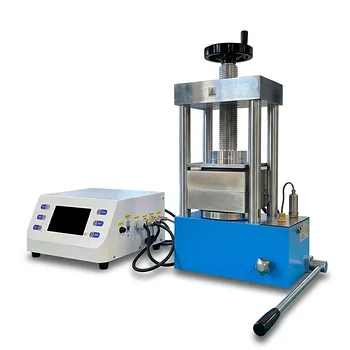
A uniaxial hydraulic press serves as the critical densification tool in solid-state battery fabrication. Its primary function is to compress synthesized electrolyte powders into dense, disc-shaped separators or pellets by applying substantial force, often transforming loose particles into a unified, defect-free solid layer.
The Core Takeaway The press does not merely shape the material; it fundamentally alters its microstructure. By applying high pressure to force plastic deformation, the press eliminates porosity and maximizes particle-to-particle contact, creating the continuous pathways necessary for efficient lithium-ion transport.
The Mechanism of Densification
Forcing Plastic Deformation
The primary reference highlights that simple compaction is not enough; the goal is plastic deformation. The press applies sufficient force to physically deform the powder particles, forcing them to pack tightly together rather than just sitting adjacent to one another.
Eliminating Porosity
Loose powder contains voids that block ion movement. The hydraulic press reduces this porosity significantly, creating a solid mass. This reduction in void space is the foundational step for ensuring the separator can function effectively within the battery.
Creating a Continuous Transport Network
By crushing particles into a dense state, the press establishes a continuous ion-transport network. As noted in supplementary data, this often requires pressures as high as 240 to 360 MPa to ensure that grain boundaries—the interfaces between particles—are minimized.
Impact on Battery Performance
Maximizing Ionic Conductivity
A dense pellet allows ions to move freely. The densification process reduces grain boundary resistance, which is a primary bottleneck in solid-state batteries. Without the high pressure applied by the press, the electrolyte would remain too porous to conduct electricity efficiently.
Suppressing Lithium Dendrites
The press plays a vital safety role. By creating a dense, non-porous physical barrier, the separator inhibits the nucleation and growth of lithium dendrites. These microscopic metal spikes can penetrate loose electrolytes and cause internal short circuits; high-pressure compaction prevents this expansion.
Enhancing Mechanical Strength
Beyond electrical performance, the press ensures the separator has the structural integrity to withstand handling and operation. A pellet compressed at high tonnage (e.g., 8 tons) possesses the mechanical strength required to serve as the backbone of the battery structure.
Engineering the Solid-Solid Interface
Reducing Interfacial Impedance
In solid-state batteries, the contact between the electrode (cathode/anode) and the electrolyte is a solid-to-solid connection, which naturally has high resistance. The hydraulic press forces these layers into intimate physical contact, drastically lowering the resistance at these interfaces.
The Stepwise Pressing Technique
Advanced preparation often involves a "sandwich" approach. A cathode layer may be pre-pressed, followed by the addition of electrolyte powder, and then co-pressed at higher pressures (e.g., 8 tons). This technique ensures the two layers are integrated into a single, cohesive bilayer unit rather than just resting on top of one another.
Common Pitfalls to Avoid
Insufficient Pressure Application
The most critical error is under-pressing. If the pressure applied is below the threshold required for plastic deformation (often <200 MPa for certain ceramics), the pellet will retain microscopic pores. These pores sever the ionic pathways, resulting in poor conductivity and a high risk of dendrite penetration.
Inconsistent Layer Integration
When co-pressing multiple layers (cathode + electrolyte), failure to apply pressure uniformly can lead to delamination. The press must provide enough force to lock the layers together without crushing the active electrode materials into inactivity.
Making the Right Choice for Your Goal
To maximize the utility of a uniaxial hydraulic press in your specific application, consider these focus areas:
- If your primary focus is Maximizing Conductivity: Prioritize extremely high pressures (up to 360 MPa) to eliminate virtually all porosity and minimize grain boundary resistance.
- If your primary focus is Full Cell Assembly: Utilize a stepwise pressing protocol (low-pressure pre-press followed by high-pressure co-press) to ensure low-impedance contact between the cathode and electrolyte.
- If your primary focus is Dendrite Prevention: Focus on achieving the highest possible density to create an impenetrable physical barrier against lithium growth.
Ultimately, the hydraulic press is the gatekeeper of performance, determining whether your electrolyte powder becomes a high-efficiency conductor or a resistive barrier.
Summary Table:
| Feature | Impact on Battery Performance | Critical Parameters |
|---|---|---|
| Densification | Eliminates porosity for a unified solid layer | Pressure: 240 - 360 MPa |
| Microstructure | Forces plastic deformation and particle contact | Minimizes grain boundary resistance |
| Safety | Creates dense barrier to suppress lithium dendrites | High-density mechanical strength |
| Interfacial Contact | Lowers resistance between electrode and electrolyte | Stepwise co-pressing technique |
| Mechanical Strength | Ensures structural integrity for handling | Tonnage: e.g., 8-ton compaction |
Elevate your solid-state battery research with KINTEK’s precision engineering. From high-tonnage hydraulic presses (pellet, hot, isostatic) to specialized crushing and milling systems, we provide the tools necessary to achieve maximum ionic conductivity and defect-free electrolyte pellets. Whether you need reliable high-temperature furnaces, PTFE consumables, or battery research tools, KINTEK empowers your lab to overcome interfacial impedance and dendrite growth. Contact us today to optimize your battery fabrication workflow!
Related Products
- Heated Hydraulic Press Machine with Integrated Manual Heated Plates for Lab Use
- Automatic Laboratory Hydraulic Press for XRF & KBR Pellet Press
- Laboratory Hydraulic Pellet Press for XRF KBR FTIR Lab Applications
- Laboratory Hydraulic Press Split Electric Lab Pellet Press
- 24T 30T 60T Heated Hydraulic Press Machine with Heated Plates for Laboratory Hot Press
People Also Ask
- Why is a heated laboratory hydraulic press necessary for composite laminates? Achieve Void-Free Structural Integrity
- What role does a heated hydraulic press play in Cold Sintering (CSP)? Enhancing LATP-Halide Densification
- What technical conditions does a heated hydraulic press provide for PEO batteries? Optimize Solid-State Interfaces
- Why is the heating function of a laboratory hydraulic press essential for MEA assembly in DEFC? Optimize Cell Bonding
- What are heated hydraulic presses used for? Molding Composites, Vulcanizing Rubber, and More