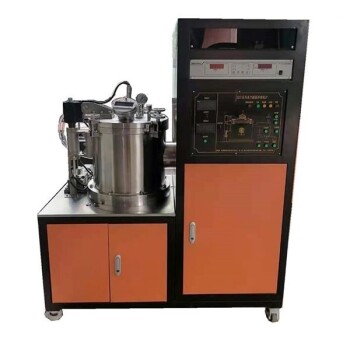
The vacuum annealing furnace plays a pivotal role in optimizing the structural and functional integrity of Co40Fe40B10Dy10 thin films. By subjecting the material to a strictly controlled thermal environment between 100°C and 300°C, the furnace induces atomic rearrangement and relieves internal stress. This process results in a smoother surface, higher magnetization, and improved electrical conductivity.
By applying stable thermal energy, the vacuum annealing furnace acts as a catalyst for microstructural refinement. It resolves internal defects to simultaneously lower surface roughness and elevate the film's electromagnetic performance.
The Mechanisms of Microstructural Change
The primary function of the furnace is not merely to heat the material, but to facilitate a precise reorganization of the film's internal structure.
Atomic Rearrangement
The deposition process often leaves atoms in a chaotic, non-equilibrium state. The thermal energy supplied by the furnace allows for atomic rearrangement, enabling atoms to migrate into more stable, orderly positions.
Internal Stress Release
Thin films frequently harbor significant internal stress due to the fabrication process. The controlled heating and cooling cycles effectively release this residual stress, preventing mechanical failures and ensuring the long-term stability of the film.
Grain Refinement
The thermal treatment promotes grain refinement within the Co40Fe40B10Dy10 alloy. This microstructural evolution is the foundational change that drives the enhancements in physical performance.
Tangible Performance Enhancements
The structural changes occurring at the atomic level translate directly into measurable improvements in the material's macroscopic properties.
Reduced Surface Roughness
A direct outcome of grain refinement and stress release is a significant reduction in surface roughness. The annealing process creates a flatter, more uniform surface profile, which is essential for high-precision applications.
Increased Magnetization
The ordering of the atomic structure directly benefits the magnetic properties of the film. Post-annealing, the Co40Fe40B10Dy10 thin films exhibit significantly enhanced magnetization, maximizing their efficiency in magnetic devices.
Superior Electrical Conductivity
Defects and internal stresses act as barriers to electron flow. By eliminating these defects through annealing, the material demonstrates a marked increase in electrical conductivity.
Critical Process Constraints
While the benefits are clear, the process relies heavily on precise environmental control.
The Thermal Window
The efficacy of this treatment is bound to a specific temperature range of 100°C to 300°C. Operating outside this window may fail to induce the necessary atomic mobility or could potentially damage the thin film structure.
Stability of Processing
The furnace must provide constant temperature processing. Fluctuations during the heating or cooling phases can reintroduce stress or lead to uneven grain growth, negating the benefits of the anneal.
Making the Right Choice for Your Goal
When integrating vacuum annealing into your fabrication process for Co40Fe40B10Dy10 films, align your parameters with your specific performance targets.
- If your primary focus is Surface Quality: Prioritize the grain refinement aspect to achieve the lowest possible surface roughness for interface compatibility.
- If your primary focus is Electromagnetic Efficiency: Focus on the stress release mechanism to maximize electron mobility and magnetic saturation.
The vacuum annealing furnace transforms Co40Fe40B10Dy10 from a raw deposited state into a high-performance material by harmonizing its atomic structure.
Summary Table:
| Feature | Impact on Co40Fe40B10Dy10 Thin Films |
|---|---|
| Temperature Range | Optimal results between 100°C and 300°C |
| Atomic Structure | Promotes rearrangement into stable, orderly positions |
| Surface Quality | Significant reduction in roughness for flatter profiles |
| Magnetic Properties | Increases magnetization for higher device efficiency |
| Electrical Performance | Eliminates defects to boost electrical conductivity |
| Mechanical Integrity | Releases internal residual stress to prevent failure |
Elevate Your Thin Film Research with KINTEK Precision
Unlock the full potential of your magnetic materials and advanced alloys. KINTEK specializes in high-performance laboratory equipment designed for the most demanding thermal processes. Whether you are optimizing Co40Fe40B10Dy10 thin films or developing next-generation electronics, our range of vacuum and atmosphere furnaces provides the thermal stability and precision your research requires.
Beyond annealing, our portfolio supports every stage of your workflow with:
- High-Temperature Furnaces: Muffle, tube, and CVD systems for precise material synthesis.
- Sample Preparation: Crushing, milling, and hydraulic presses for consistent pellet and thin film substrates.
- Specialized Reactors: High-temperature high-pressure reactors and autoclaves for advanced chemical processing.
Ready to achieve superior microstructural refinement and surface quality? Contact KINTEK today to find the perfect thermal solution for your lab!
References
- Wen-Jen Liu, Sin‐Liang Ou. Thickness, Annealing, and Surface Roughness Effect on Magnetic and Significant Properties of Co40Fe40B10Dy10 Thin Films. DOI: 10.3390/ma16175995
This article is also based on technical information from Kintek Solution Knowledge Base .
Related Products
- Vacuum Heat Treat Furnace with Ceramic Fiber Liner
- Vacuum Heat Treat Sintering Brazing Furnace
- Vacuum Sealed Continuous Working Rotary Tube Furnace Rotating Tube Furnace
- Vacuum Heat Treat and Pressure Sintering Furnace for High Temperature Applications
- Small Vacuum Heat Treat and Tungsten Wire Sintering Furnace
People Also Ask
- What is a vacuum heat treatment furnace? The Ultimate Guide to Controlled Atmosphere Processing
- What is a vacuum heat treatment furnace? Achieve Unmatched Purity and Control
- What is vacuum heat treatment process? Achieve Superior Control, Cleanliness, and Quality
- What is the temperature of vacuum heat treatment? Achieve Superior Material Properties & Pristine Finishes
- How does a vacuum heat treatment work? Achieve Superior Material Properties in a Pristine Environment