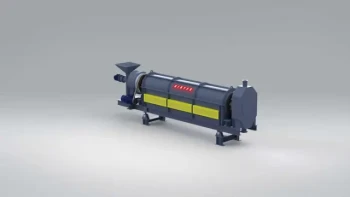
The industrial-grade tube furnace acts as the primary reactor for synthesizing iron-loaded carbon foam by providing a strictly controlled thermal and atmospheric environment. Specifically, it facilitates the dehydration and carbonization of precursors—such as natural starch—while maintaining an inert, oxygen-free atmosphere to prevent material oxidation. By precisely managing heating rates and temperature uniformity, the furnace dictates the final material's pore distribution, mechanical strength, and specific surface area.
The tube furnace is the critical enabling technology that transforms raw organic precursors into functional carbon scaffolds. It achieves this by balancing precise thermal profiles with chemical isolation, ensuring the material achieves the desired nanoporous structure without being lost to combustion.
The Role of Atmospheric Control and Isolation
Creating an Inert Environment
To carbonize iron-loaded foam without burning the carbon source, the furnace must provide a tightly sealed reaction chamber. This allows for the introduction of high-purity nitrogen or argon, which displaces oxygen and creates an inert atmosphere.
Preventing Material Loss
In the absence of a controlled atmosphere, carbon precursors would simply oxidize and turn into ash at high temperatures. The tube furnace ensures that the material undergoes thermal decomposition rather than combustion, preserving the structural integrity of the carbon scaffold.
Facilitating Surface Reactions
The controlled environment allows for specific chemical reactions between metal ions and surface functional groups. This interaction is essential for loading iron effectively onto the carbon foam, which later influences the material's adsorption activity and catalytic properties.
Precision Thermal Profiling and Transformation
Programmed Heating Rates
Industrial-grade furnaces utilize programmed temperature control to manage the transition from raw precursor to carbonized foam. A typical heating rate of 10 °C/min allows for the steady removal of volatile components, preventing structural collapse caused by rapid gas evolution.
Facilitating Dehydration and Carbonization
As temperatures reach levels between 600 °C and 900 °C, the furnace triggers the breaking and reorganization of chemical bonds. This process, known as carbonization, converts biomass or polymer sources into a stable, functionalized carbon material with a highly amorphous structure.
Driving Micro-Pore Generation
The high-temperature environment induces the collapse of macropores and the generation of a vast network of micropores. This significantly increases the specific surface area of the iron-loaded foam, which is critical for its performance in industrial applications like energy storage or filtration.
Ensuring Structural Integrity and Uniformity
The Importance of Thermal Field Uniformity
The uniformity of the thermal field within the tube is a decisive factor in the quality of the final product. Even minor temperature gradients can lead to inconsistent pore size distributions and weakened mechanical strength across the foam sample.
Achieving Consistent Microstructures
By maintaining a constant temperature zone, the furnace ensures that the iron particles are distributed evenly throughout the carbon matrix. This stability is vital for researchers and manufacturers who require repeatable results and predictable material behavior.
High-Temperature Limits and Capabilities
Industrial-grade units can reach temperatures up to 1400 °C, providing the overhead necessary for specialized calcination or the melting of additives. This range allows for the synthesis of advanced carbon-metal composites that require higher energy inputs than standard biomass carbonization.
Understanding the Trade-offs and Pitfalls
Thermal Gradients and Sample Placement
One of the primary challenges is the existence of temperature gradients near the ends of the tube. If the sample is placed outside the "sweet spot" or constant temperature zone, the carbonization will be uneven, leading to localized structural failures.
Gas Flow Dynamics
Excessive gas flow rates can lead to thermal shock or the uneven cooling of the sample surface. Conversely, insufficient flow may fail to remove volatile byproducts effectively, which can re-deposit onto the foam and clog the newly formed pores.
Equipment Contamination
In iron-loaded processes, cross-contamination within the tube can occur if multiple types of metal precursors are used over time. Residual metallic vapors can settle on the tube walls, potentially altering the chemical composition of future batches.
How to Optimize Your Carbonization Process
Successful synthesis of iron-loaded carbon foam depends on aligning furnace parameters with your specific material requirements.
- If your primary focus is maximizing surface area: Utilize a slower heating rate (5-10 °C/min) and a higher final carbonization temperature (800 °C+) to encourage the formation of dense micropore networks.
- If your primary focus is mechanical strength: Prioritize thermal field uniformity and precise dwell times to ensure the carbon scaffold develops a consistent, interconnected crystalline structure.
- If your primary focus is iron distribution: Ensure the inert gas flow is consistent throughout the entire heating cycle to prevent localized oxidation of the iron ions before they can integrate into the carbon matrix.
By mastering the precise control offered by an industrial tube furnace, you can transform simple starch and iron precursors into high-performance, nanoporous carbon materials.
Summary Table:
| Feature | Role in Carbonization Process |
|---|---|
| Atmospheric Control | Provides inert environment (N2/Ar) to prevent oxidation and material loss. |
| Thermal Profiling | Manages heating rates (e.g., 10°C/min) to drive dehydration and bond reorganization. |
| Pore Engineering | High temps (600-900°C) collapse macropores to create high-surface-area micropores. |
| Thermal Uniformity | Ensures consistent iron particle distribution and structural integrity across the foam. |
Elevate Your Material Synthesis with KINTEK Precision
Unlock the full potential of your carbon research with KINTEK’s high-performance industrial tube furnaces. Whether you are synthesizing iron-loaded carbon foams or advanced composites, our equipment provides the strictly controlled atmosphere and thermal uniformity essential for repeatable, high-quality results.
Beyond our specialized tube, muffle, and CVD furnaces, KINTEK offers a comprehensive range of laboratory solutions, including:
- High-temperature high-pressure reactors and autoclaves for advanced chemical processing.
- Crushing, milling, and pellet presses for precise sample preparation.
- Electrolytic cells and battery research tools for energy storage innovation.
Ready to optimize your carbonization process? Contact our technical experts today to find the perfect furnace or laboratory system tailored to your specific research requirements.
References
- Siphesihle Praise-God Khumalo, Ajay Sewpersad. Preparation and Use of Iron on Carbon Foam for Removal of Organic Dye from Water: Batch Studies. DOI: 10.3390/ma16196350
This article is also based on technical information from Kintek Solution Knowledge Base .
Related Products
- Graphite Vacuum Furnace Bottom Discharge Graphitization Furnace for Carbon Materials
- Vertical Laboratory Tube Furnace
- Multi Heating Zones CVD Tube Furnace Machine Chemical Vapor Deposition Chamber System Equipment
- 1200℃ Split Tube Furnace with Quartz Tube Laboratory Tubular Furnace
- Customer Made Versatile CVD Tube Furnace Chemical Vapor Deposition Chamber System Equipment
People Also Ask
- What is the use of graphite furnace? Achieve Extreme-Temperature Processing for Advanced Materials
- What is the disadvantage of graphite furnace? Managing Reactivity and Contamination Risks
- What gas is used in graphite furnace? Maximize Accuracy with the Right Inert Gas
- What are the benefits of a graphite furnace? Achieve Rapid, Uniform High-Temperature Processing
- What is the graphite furnace technique? Achieve Extreme Temperatures for Advanced Materials