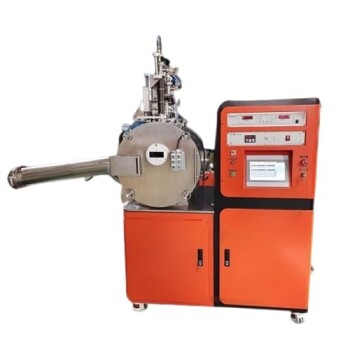
Spark Plasma Sintering (SPS) equipment serves as a rapid consolidation technology that transforms titanium-based alloy powders into high-performance solids using pulsed electric current and simultaneous pressure. By generating heat internally through the powder compact rather than applying it externally, SPS achieves full material densification in extremely short timeframes, preserving critical microstructural features that traditional sintering often destroys.
Core Insight: The unique value of SPS lies in its ability to decouple densification from grain growth. It allows Ti-Nb-Zr alloys to reach full density and high strength (>900 MPa) while maintaining a fine microstructure and the low elastic modulus required to prevent bone degradation in orthopedic implants.
The Mechanisms of SPS Processing
Direct Heating via Pulsed Current
SPS equipment utilizes pulsed electric current to generate high-energy Joule heat directly within the powder mold and the sample itself.
This mechanism allows for extremely rapid heating rates, reaching sintering temperatures between 1300°C and 1500°C efficiently. Because the heat is internal, the process bypasses the slow thermal lag inherent in conventional external heating methods.
Simultaneous Axial Pressure
While the current heats the material, the equipment applies consistent uniaxial pressure.
This mechanical force physically rearranges particles and breaks down agglomerates, facilitating densification at lower macroscopic temperatures. The combination of pressure and the plasma effect accelerates atomic diffusion, ensuring a fully dense component without prolonged exposure to heat.
Optimizing Microstructure for Biomedical Performance
Inhibiting Grain Growth
For biomedical implants, retaining a fine grain structure is essential for mechanical strength.
Because SPS completes the sintering process in a very short timeframe, it effectively inhibits grain growth. The result is a material with a uniform microstructure and superior mechanical properties, specifically exhibiting strength exceeding 900 MPa.
Homogenizing Difficult Alloying Elements
Alloying elements like niobium (Nb) are critical for biocompatibility but are notoriously slow to diffuse.
The high-energy environment and rapid diffusion facilitated by SPS ensure that these elements are distributed evenly throughout the titanium matrix. This chemical composition homogenization is vital for preventing weak points or segregation within the alloy.
Stabilizing the Beta Phase
The mechanical compatibility of an implant with human bone depends on having a low elastic modulus.
SPS equipment allows for precise control over cooling rates, which helps stabilize the beta phase of the titanium alloy. A stable beta-phase structure significantly lowers the elastic modulus, reducing the risk of "stress shielding," a phenomenon where an implant causes the surrounding bone to atrophy.
Understanding the Trade-offs
Geometric Constraints
The application of uniaxial pressure generally limits SPS to relatively simple shapes, such as cylinders or discs.
Producing complex, net-shape orthopedic implants often requires additional machining or post-processing, as the equipment cannot easily apply uniform pressure to intricate geometries during the sintering phase.
Scalability and Sample Size
SPS is typically a batch process rather than a continuous one.
While excellent for producing high-quality materials, the size of the sample is limited by the die size and the power capacity of the equipment. This can introduce challenges when scaling up from research prototypes to mass production of large implant components.
Making the Right Choice for Your Goal
To maximize the utility of Ti-Nb-Zr alloys, align your processing parameters with your specific biomedical requirements:
- If your primary focus is Maximum Strength (>900 MPa): Prioritize the short sintering times inherent to SPS to strictly inhibit grain growth and maintain a fine microstructure.
- If your primary focus is "Bone-Like" Elasticity: Optimize the cooling rates and sintering temperature (1300-1500°C) to maximize the stability of the beta phase, which lowers the elastic modulus.
- If your primary focus is Chemical Uniformity: Leverage the pulsed current mechanism to drive the diffusion of refractory elements like niobium, ensuring a homogeneous alloy composition.
SPS is the definitive choice when the application demands a specific balance of high strength and low stiffness that conventional sintering cannot achieve.
Summary Table:
| Feature | Spark Plasma Sintering (SPS) Benefit |
|---|---|
| Heating Method | Internal Joule heating via pulsed electric current |
| Temperature Range | Rapid reaching of 1300°C - 1500°C |
| Mechanical Strength | Consistently exceeds 900 MPa due to fine microstructure |
| Microstructure | Inhibits grain growth and homogenizes refractory elements (Nb) |
| Biomedical Value | Stabilizes beta phase for low elastic modulus (prevents stress shielding) |
| Process Speed | Full densification in minutes vs. hours in conventional methods |
Elevate your material research with KINTEK’s advanced Spark Plasma Sintering solutions. As experts in high-performance laboratory equipment, we provide the precision tools—including SPS systems, high-temperature furnaces, and hydraulic presses—needed to develop the next generation of Ti-based biomedical alloys. Whether you are aiming for high-strength dental implants or low-modulus orthopedic devices, KINTEK offers the crushing, milling, and sintering technology to ensure chemical homogeneity and superior mechanical performance. Contact our technical specialists today to find the perfect equipment for your laboratory.
References
- Iuliana Urzică, Petronela Gheorghe. Microfluidic properties of laser exposed metallic surface. DOI: 10.21175/rad.abstr.book.2023.5.6
This article is also based on technical information from Kintek Solution Knowledge Base .
Related Products
- Spark Plasma Sintering Furnace SPS Furnace
- Small Vacuum Heat Treat and Tungsten Wire Sintering Furnace
- Vacuum Heat Treat and Pressure Sintering Furnace for High Temperature Applications
- Vacuum Dental Porcelain Sintering Furnace
- Dental Porcelain Zirconia Sintering Ceramic Furnace Chairside with Transformer
People Also Ask
- What is SPS sintering method? A Guide to High-Speed, High-Performance Material Fabrication
- Why are Spark Plasma Sintering (SPS) furnaces or hot presses utilized in the preparation of Li3PS4 solid electrolytes?
- What is the difference between spark plasma sintering and flash sintering? A Guide to Advanced Sintering Methods
- What technical advantages does a Spark Plasma Sintering (SPS) furnace offer for LZP ceramics? Enhance Ionic Conductivity
- What is the theory of spark plasma sintering? A Guide to Rapid, Low-Temperature Densification