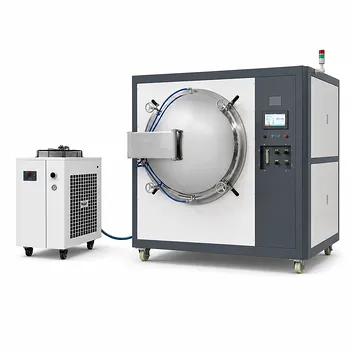
For manufacturing high-density Ni–35Mo–15Cr alloys, a vacuum hot pressing furnace provides a specialized environment defined by three specific parameters: a high vacuum level of approximately 1.33 x 10^-1 Pa, thermal energy reaching up to 1200°C, and uniaxial mechanical pressure up to 50 MPa. This simultaneous application of heat, pressure, and vacuum is engineered to eliminate internal porosity and prevent material degradation during formation.
The core value of this process lies in the synergy between thermal energy and mechanical force. By applying high pressure while the material is thermally softened in a vacuum, the furnace forces atomic diffusion and plastic deformation, closing internal pores that standard sintering would leave behind.
The Critical Process Conditions
To achieve superior mechanical properties in Ni–35Mo–15Cr alloys, the furnace must strictly maintain the following three variables.
The Thermal Threshold
The furnace must be capable of sustaining temperatures up to 1200°C.
At this temperature, the alloy matrix softens sufficiently to allow for atomic movement. This thermal energy is the catalyst that activates the material for densification.
High Mechanical Pressure
Simultaneous with heating, the system applies mechanical pressure up to 50 MPa.
Unlike pressureless sintering, where particles fuse only through heat, hot pressing physically forces particles together. This pressure is critical for overcoming the material's yield strength to collapse voids.
The Vacuum Environment
The process occurs within a vacuum of 1.33 x 10^-1 Pa.
This specific pressure level is not arbitrary; it is required to prevent oxidation of the metal constituents. A vacuum environment ensures the alloy remains clean and free of oxide inclusions that would otherwise weaken the final structure.
Mechanism of Densification
Understanding how these conditions interact is key to controlling the quality of the Ni–35Mo–15Cr alloy.
Synergistic Activation
The combination of 50 MPa pressure and 1200°C heat creates a synergistic effect.
Thermal energy increases the mobility of atoms, while mechanical pressure provides the driving force for them to move. This dual action accelerates the bonding process far beyond what either factor could achieve in isolation.
Elimination of Internal Pores
The primary goal of these conditions is the elimination of internal pores.
Through facilitated plastic deformation and diffusion creep, the material flows into void spaces. This results in a final product with high density and a microstructure free of the defects typical in conventional powder metallurgy.
Understanding the Trade-offs
While vacuum hot pressing produces superior material properties, it introduces specific constraints that you must plan for.
Process Complexity vs. Speed
This is a batch process, not a continuous one.
Because the vacuum must be established and the pressure applied carefully during the heating cycle, production throughput is lower compared to conventional atmospheric sintering.
Equipment Constraints
The requirement for simultaneous high pressure and high vacuum demands robust equipment.
Maintaining a seal capable of holding 1.33 x 10^-1 Pa while a ram exerts 50 MPa of force at 1200°C requires precise engineering and rigorous maintenance of the furnace seals and hydraulics.
Making the Right Choice for Your Goal
When configuring your process for Ni–35Mo–15Cr alloys, prioritize parameters based on your specific performance requirements.
- If your primary focus is Maximum Density: Prioritize maintaining the 50 MPa mechanical pressure throughout the peak temperature dwell time to physically close all residual porosity.
- If your primary focus is Material Purity: Ensure your vacuum system can reliably hold 1.33 x 10^-1 Pa or better, as preventing oxidation is critical to maintaining the alloy's intrinsic mechanical properties.
By strictly controlling the interplay of vacuum, heat, and pressure, you transform a porous powder compact into a high-performance, fully dense structural component.
Summary Table:
| Process Parameter | Required Specification | Role in Alloy Manufacturing |
|---|---|---|
| Vacuum Level | 1.33 x 10⁻¹ Pa | Prevents oxidation and ensures material purity |
| Temperature | Up to 1200°C | Softens alloy matrix to facilitate atomic diffusion |
| Mechanical Pressure | Up to 50 MPa | Forces particle bonding and collapses internal pores |
| Atmosphere Type | High Vacuum | Eliminates oxide inclusions and degradation |
| Output Result | Fully Dense Alloy | Produces high-performance, void-free microstructure |
Elevate Your Material Research with KINTEK Precision
Achieving the perfect synergy of 1200°C heat and 50 MPa pressure requires robust, reliable equipment. KINTEK specializes in advanced laboratory solutions, offering high-performance vacuum hot pressing furnaces, hydraulic presses, and specialized high-temperature sintering systems tailored for complex alloys like Ni–35Mo–15Cr.
From our comprehensive range of hot and isostatic presses to high-purity ceramic crucibles and cooling solutions, we provide the tools necessary to eliminate porosity and maximize density in your structural components.
Ready to optimize your densification process? Contact our technical experts today to find the ideal furnace configuration for your laboratory's needs!
Related Products
- Vacuum Hot Press Furnace Heated Vacuum Press Machine Tube Furnace
- 600T Vacuum Induction Hot Press Furnace for Heat Treat and Sintering
- Vacuum Hot Press Furnace Machine Heated Vacuum Press
- Vacuum Hot Press Furnace Machine for Lamination and Heating
- Vacuum Heat Treat and Pressure Sintering Furnace for High Temperature Applications
People Also Ask
- What advantages does a vacuum hot press furnace provide for LSLBO ceramic electrolytes? Achieve 94% Relative Density
- What role does a Vacuum Hot Press (VHP) furnace play in the densification of austenitic stainless steel 316 composites?
- What are the advantages of using a vacuum hot pressing furnace? Superior Densification for 2024Al/Gr/SiC Composites
- What are the advantages of a vacuum hot press furnace for LTPO solid electrolytes? Boost Density and Conductivity
- What core processing conditions does a vacuum hot press furnace provide? Achieve High-Density Cu-SiC/Diamond Composites