Knowledge What are the advantages of CVD for lithium anodes? Enhance Battery Stability with Precision Thin-Film Protection
Author avatar

Tech Team · Kintek Solution

Updated 1 month ago

What are the advantages of CVD for lithium anodes? Enhance Battery Stability with Precision Thin-Film Protection


Chemical Vapor Deposition (CVD) provides a decisive technical advantage by enabling the creation of nanoscale, highly conformal, and dense inorganic protection layers—specifically LiI or Li2Se—on lithium metal anodes. Because CVD is a gas-phase deposition technique, it allows for precise control over film thickness and the ability to penetrate and fill surface microstructures. This ensures the lithium metal is completely isolated from sulfide electrolytes, effectively inhibiting side reactions and suppressing dendrite growth.

The core value of CVD lies in its ability to create a hermetic seal on irregular surfaces. By eliminating direct contact between the electrolyte and the anode, CVD transforms a reactive interface into a stable, engineered barrier that preserves battery integrity.

The Mechanics of CVD Protection

Achieving Superior Conformality

The primary challenge with lithium metal is its surface irregularity. CVD utilizes a gas-phase approach, allowing reactants to access all exposed surfaces regardless of geometry.

This capability ensures that the protective layer fills surface microstructures rather than bridging over them. The result is a continuous coating that leaves no gaps for the electrolyte to penetrate.

Precision at the Nanoscale

Thick protective layers can impede ion flow, reducing battery performance. CVD systems offer precise control over film thickness, allowing for the deposition of ultra-thin, nanoscale layers.

This precision ensures the layer is thick enough to provide protection but thin enough to maintain necessary electrochemical properties.

Enhancing Anode Stability

Creating a Dense Physical Barrier

Porosity in a protective layer is a failure point. CVD deposits dense inorganic layers, such as LiI (Lithium Iodide) or Li2Se (Lithium Selenide).

This density creates a robust physical shield. It effectively isolates the chemically active lithium metal from the external environment.

Mitigating Chemical Degradation

When sulfide electrolytes come into direct contact with lithium metal, they often trigger unstable side reactions. The CVD-deposited layer acts as an interfacial separator.

By preventing this direct contact, the system inhibits these parasitic reactions. This stabilization is critical for preventing the degradation of both the electrolyte and the anode material.

Critical Considerations for Interface Engineering

The Necessity of Uniformity

In interface engineering, a coating is only as good as its weakest point. A non-conformal coating that leaves even microscopic voids renders the protection useless.

CVD addresses this by ensuring complete coverage. If the method used cannot fill microstructures, the "protection" becomes a liability, allowing dendrites to nucleate in the gaps.

Balancing Isolation and Function

The goal of the layer is isolation, but total insulation would stop the battery from working. The technical challenge is creating a barrier that stops reactions but permits function.

CVD solves this through material specificity (using LiI or Li2Se) and thickness control. The process enables the engineering of a layer that physically blocks large molecules while remaining chemically compatible with the anode's operation.

Making the Right Choice for Your Goal

To maximize the benefits of CVD for your specific application, consider the following:

  • If your primary focus is Cycle Life: Prioritize the density and conformality capabilities of CVD to ensure a complete hermetic seal against sulfide electrolytes, preventing degradation over time.
  • If your primary focus is Safety: Leverage the dendrite inhibition properties of the inorganic layer to physically suppress the growth of structures that could cause short circuits.

CVD transforms the lithium anode from a volatile component into a stable, engineered system capable of long-term performance.

Summary Table:

Feature CVD Technical Advantage Impact on Lithium Anode
Conformality Gas-phase deposition fills microstructures Creates a continuous, gap-free hermetic seal
Thickness Control Precise nanoscale layer deposition Minimizes ion resistance while ensuring protection
Layer Density Formation of dense inorganic films (LiI/Li2Se) Provides a robust physical barrier against electrolyte
Interface Stability Complete isolation of reactive surfaces Inhibits parasitic side reactions and degradation
Safety Uniform physical suppression Effectively suppresses lithium dendrite growth

Elevate Your Battery Research with KINTEK Precision

Unlock the full potential of your lithium metal anode development with KINTEK’s advanced CVD and PECVD systems. Whether you are engineering nanoscale LiI/Li2Se protection layers or exploring novel solid-state interfaces, our laboratory equipment is designed to provide the ultimate control over film density and conformality.

Beyond CVD, KINTEK specializes in a comprehensive range of solutions for energy research, including:

  • Crushing & Milling Systems for precursor preparation.
  • High-Temperature Furnaces (Muffle, Tube, Vacuum) for material synthesis.
  • Hydraulic Presses (Pellet, Isostatic) and Battery Research Tools.
  • High-Pressure Reactors & Autoclaves for advanced chemical processing.

Ready to stabilize your battery interfaces and extend cycle life? Contact our technical experts today to find the perfect equipment solution for your laboratory.

Related Products

People Also Ask

Related Products

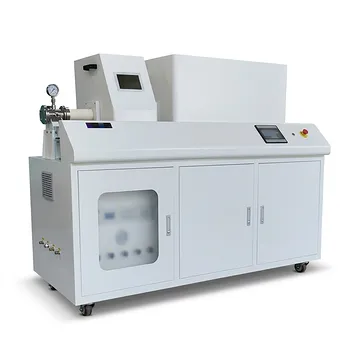
Inclined Rotary Plasma Enhanced Chemical Vapor Deposition PECVD Equipment Tube Furnace Machine

Inclined Rotary Plasma Enhanced Chemical Vapor Deposition PECVD Equipment Tube Furnace Machine

Upgrade your coating process with PECVD coating equipment. Ideal for LED, power semiconductors, MEMS and more. Deposits high-quality solid films at low temps.

Multi Heating Zones CVD Tube Furnace Machine Chemical Vapor Deposition Chamber System Equipment

Multi Heating Zones CVD Tube Furnace Machine Chemical Vapor Deposition Chamber System Equipment

KT-CTF14 Multi Heating Zones CVD Furnace - Precise Temperature Control and Gas Flow for Advanced Applications. Max temp up to 1200℃, 4 channels MFC mass flow meter, and 7" TFT touch screen controller.

Microwave Plasma Chemical Vapor Deposition MPCVD Machine System Reactor for Lab and Diamond Growth

Microwave Plasma Chemical Vapor Deposition MPCVD Machine System Reactor for Lab and Diamond Growth

Get high-quality diamond films with our Bell-jar Resonator MPCVD machine designed for lab and diamond growth. Discover how Microwave Plasma Chemical Vapor Deposition works for growing diamonds using carbon gas and plasma.

Split Chamber CVD Tube Furnace with Vacuum Station Chemical Vapor Deposition System Equipment Machine

Split Chamber CVD Tube Furnace with Vacuum Station Chemical Vapor Deposition System Equipment Machine

Efficient split chamber CVD furnace with vacuum station for intuitive sample checking and quick cooling. Up to 1200℃ max temperature with accurate MFC mass flowmeter control.

915MHz MPCVD Diamond Machine Microwave Plasma Chemical Vapor Deposition System Reactor

915MHz MPCVD Diamond Machine Microwave Plasma Chemical Vapor Deposition System Reactor

915MHz MPCVD Diamond Machine and its multi-crystal effective growth, the maximum area can reach 8 inches, the maximum effective growth area of single crystal can reach 5 inches. This equipment is mainly used for the production of large-size polycrystalline diamond films, the growth of long single crystal diamonds, the low-temperature growth of high-quality graphene, and other materials that require energy provided by microwave plasma for growth.

HFCVD Machine System Equipment for Drawing Die Nano-Diamond Coating

HFCVD Machine System Equipment for Drawing Die Nano-Diamond Coating

The nano-diamond composite coating drawing die uses cemented carbide (WC-Co) as the substrate, and uses the chemical vapor phase method ( CVD method for short ) to coat the conventional diamond and nano-diamond composite coating on the surface of the inner hole of the mold.

Graphite Vacuum Furnace High Thermal Conductivity Film Graphitization Furnace

Graphite Vacuum Furnace High Thermal Conductivity Film Graphitization Furnace

The high thermal conductivity film graphitization furnace has uniform temperature, low energy consumption and can operate continuously.

Mini SS High Pressure Autoclave Reactor for Laboratory Use

Mini SS High Pressure Autoclave Reactor for Laboratory Use

Mini SS High Pressure Reactor - Ideal for medicine, chemical, and scientific research industries. Programmed heating temp and stirring speed, up to 22Mpa pressure.

Small Vacuum Heat Treat and Tungsten Wire Sintering Furnace

Small Vacuum Heat Treat and Tungsten Wire Sintering Furnace

The small vacuum tungsten wire sintering furnace is a compact experimental vacuum furnace specially designed for universities and scientific research institutes. The furnace features a CNC welded shell and vacuum piping to ensure leak-free operation. Quick-connect electrical connections facilitate relocation and debugging, and the standard electrical control cabinet is safe and convenient to operate.

1200℃ Split Tube Furnace with Quartz Tube Laboratory Tubular Furnace

1200℃ Split Tube Furnace with Quartz Tube Laboratory Tubular Furnace

KT-TF12 split tube furnace: high-purity insulation, embedded heating wire coils, and max. 1200C. Widely used for new materials and chemical vapour deposition.

Horizontal High Temperature Graphite Vacuum Graphitization Furnace

Horizontal High Temperature Graphite Vacuum Graphitization Furnace

Horizontal Graphitization Furnace: This type of furnace is designed with the heating elements placed horizontally, allowing for uniform heating of the sample. It's well-suited for graphitizing large or bulky samples that require precise temperature control and uniformity.

Customizable Laboratory High Temperature High Pressure Reactors for Diverse Scientific Applications

Customizable Laboratory High Temperature High Pressure Reactors for Diverse Scientific Applications

High-pressure lab reactor for precise hydrothermal synthesis. Durable SU304L/316L, PTFE liner, PID control. Customizable volume & materials. Contact us!

Vacuum Heat Treat and Sintering Furnace with 9MPa Air Pressure

Vacuum Heat Treat and Sintering Furnace with 9MPa Air Pressure

The air pressure sintering furnace is a high-tech equipment commonly used for the sintering of advanced ceramic materials. It combines vacuum sintering and pressure sintering techniques to achieve high-density and high-strength ceramics.

Laboratory Vacuum Tilt Rotary Tube Furnace Rotating Tube Furnace

Laboratory Vacuum Tilt Rotary Tube Furnace Rotating Tube Furnace

Discover the versatility of Laboratory Rotary Furnace: Ideal for calcination, drying, sintering, and high-temperature reactions. Adjustable rotating and tilting functions for optimal heating. Suitable for vacuum and controlled atmosphere environments. Learn more now!

High Pressure Laboratory Autoclave Reactor for Hydrothermal Synthesis

High Pressure Laboratory Autoclave Reactor for Hydrothermal Synthesis

Discover the applications of Hydrothermal Synthesis Reactor - a small, corrosion-resistant reactor for chemical labs. Achieve rapid digestion of insoluble substances in a safe and reliable way. Learn more now.

Molybdenum Vacuum Heat Treat Furnace

Molybdenum Vacuum Heat Treat Furnace

Discover the benefits of a high-configuration molybdenum vacuum furnace with heat shield insulation. Ideal for high-purity, vacuum environments like sapphire crystal growth and heat treatment.

Vertical High Temperature Graphite Vacuum Graphitization Furnace

Vertical High Temperature Graphite Vacuum Graphitization Furnace

Vertical high temperature graphitization furnace for carbonization and graphitization of carbon materials up to 3100℃.Suitable for shaped graphitization of carbon fiber filaments and other materials sintered in a carbon environment.Applications in metallurgy, electronics, and aerospace for producing high-quality graphite products like electrodes and crucibles.

1700℃ Muffle Oven Furnace for Laboratory

1700℃ Muffle Oven Furnace for Laboratory

Get superior heat control with our 1700℃ Muffle Furnace. Equipped with intelligent temperature microprocessor, TFT touch screen controller & advanced insulation materials for precise heating up to 1700C. Order now!

1700℃ Controlled Atmosphere Furnace Nitrogen Inert Atmosphere Furnace

1700℃ Controlled Atmosphere Furnace Nitrogen Inert Atmosphere Furnace

KT-17A Controlled atmosphere furnace: 1700℃ heating, vacuum sealing technology, PID temperature control, and versatile TFT smart touch screen controller for laboratory and industrial use.

1700℃ Laboratory High Temperature Tube Furnace with Alumina Tube

1700℃ Laboratory High Temperature Tube Furnace with Alumina Tube

Looking for a high-temperature tube furnace? Check out our 1700℃ Tube Furnace with Alumina Tube. Perfect for research and industrial applications up to 1700C.


Leave Your Message