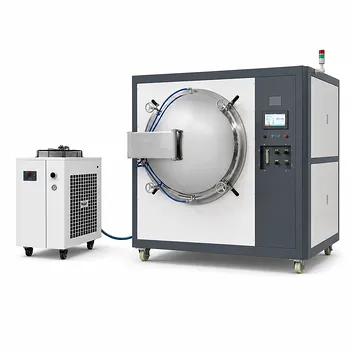
Hot pressing and Spark Plasma Sintering (SPS) furnaces provide a distinct technical advantage by applying axial mechanical pressure simultaneously with high-temperature thermal energy. This dual-action process significantly enhances the sintering driving force, effectively forcing grain fusion and eliminating internal voids. The result is a solid electrolyte with superior relative density, higher ionic conductivity, and greater mechanical strength compared to materials processed via standard pressureless sintering.
Core Takeaway By coupling mechanical pressure with heat, these specialized furnaces overcome the limitations of thermal energy alone. This approach allows for the creation of dense, highly conductive electrolytes at lower temperatures, preserving volatile elements and enhancing the material's ability to suppress lithium dendrite growth.
The Power of Pressure-Assisted Sintering
Simultaneous Mechanical and Thermal Energy
The fundamental advantage of these systems is the application of simultaneous mechanical pressure during the heating phase. Unlike conventional furnaces that rely solely on heat to bond particles, Hot Pressing and SPS actively compress the material while it is energetic.
Promoting Grain Fusion
This external pressure effectively promotes grain fusion within the ceramic microstructure. The physical force overcomes the resistance between particles, ensuring they bond more completely than they would under heat alone.
Eliminating Internal Voids
The primary result of this process is the significant reduction or elimination of internal voids. This leads to a substantial increase in the relative density of the electrolyte, which is critical for achieving high performance in solid-state batteries.
Performance Enhancements in Electrolytes
Superior Ionic Conductivity
Density directly correlates with performance. By maximizing grain contact and minimizing porosity, these furnaces produce electrolytes with superior ionic conductivity. The highly conductive solid-solid interfaces constructed during this process facilitate smoother ion transport.
Suppression of Lithium Dendrites
A critical technical benefit is the enhancement of mechanical strength. The dense, void-free structure created by pressure-assisted sintering is physically robust enough to suppress lithium dendrite growth, a common failure mode in solid-state batteries.
Addressing Heat-Sensitivity and Volatilization
Lowering Densification Temperatures
Hot pressing can significantly increase the sintering driving force, allowing materials to densify at lower temperatures. For example, specific oxide electrolytes (like NZTO) can be densified below 700°C, whereas pressureless methods might require much higher heat.
Suppressing Elemental Volatilization
Lower processing temperatures are vital for complex chemistries. By reducing the thermal requirement, these furnaces help suppress the high-temperature volatilization of volatile elements (such as sodium or lithium). This ensures the final stoichiometry of the electrolyte remains accurate and functional.
Operational Considerations and Environment
Atmosphere Control for Sulfides
While pressure is key for density, the processing environment is equally critical, particularly for crystalline sulfide electrolytes. These materials are highly reactive to moisture.
Preventing Structural Degradation
To process sulfides effectively, the furnace must utilize a strictly controlled inert gas environment (like argon) or high vacuum. This prevents the generation of toxic hydrogen sulfide gas and avoids the structural degradation or oxidation that destroys the electrolyte's performance.
Making the Right Choice for Your Goal
To maximize the effectiveness of your solid electrolyte preparation, consider these strategic priorities:
- If your primary focus is maximizing conductivity and density: Utilize Hot Pressing or SPS to leverage mechanical pressure, which eliminates voids and creates the tight grain boundaries necessary for optimal ion transport.
- If your primary focus is compositional stability (e.g., preventing Na/Li loss): distinct advantages of pressure-assisted sintering include the ability to densify materials at lower temperatures, thereby reducing the volatilization of sensitive elements.
Ultimately, the choice of a pressure-assisted furnace transforms the sintering process from a simple heat treatment into a precision engineering step that guarantees both structural integrity and electrochemical performance.
Summary Table:
| Feature | Hot Pressing / SPS Furnace | Conventional Pressureless Sintering |
|---|---|---|
| Sintering Force | Simultaneous Heat + Axial Pressure | Thermal Energy Only |
| Relative Density | Exceptionally High (Void-Free) | Moderate (Residual Porosity) |
| Ionic Conductivity | Superior (Enhanced Grain Fusion) | Standard |
| Process Temperature | Lower (Preserves Volatiles) | Higher (Risk of Element Loss) |
| Mechanical Strength | High (Suppresses Dendrite Growth) | Moderate |
| Material Compatibility | Oxides, Sulfides (with Atmosphere Control) | Limited by Thermal Resistance |
Accelerate your solid-state battery research with KINTEK's precision engineering solutions. Whether you require advanced hot pressing systems, SPS furnaces, or specialized vacuum and atmosphere furnaces to prevent sulfide degradation, our equipment is designed to maximize ionic conductivity and material density. KINTEK provides high-performance crushing and milling systems, pellet presses, and high-temperature crucibles tailored for developing next-generation electrolytes. Contact our technical experts today to optimize your sintering process and ensure superior electrochemical performance.
Related Products
- 600T Vacuum Induction Hot Press Furnace for Heat Treat and Sintering
- Vacuum Hot Press Furnace Heated Vacuum Press Machine Tube Furnace
- Vacuum Hot Press Furnace Machine for Lamination and Heating
- Vacuum Hot Press Furnace Machine Heated Vacuum Press
- Vacuum Heat Treat and Pressure Sintering Furnace for High Temperature Applications
People Also Ask
- What role does an induction vacuum hot pressing furnace play in sintering? Achieve 98% Density in Carbide Blocks
- What advantages does a vacuum hot press furnace provide for LSLBO ceramic electrolytes? Achieve 94% Relative Density
- What role does a Vacuum Hot Press (VHP) furnace play in the densification of austenitic stainless steel 316 composites?
- What are the advantages of a vacuum hot press furnace for W-50%Cu? Achieve 99.6% Density at Lower Temperatures
- What role does mechanical pressure play during the vacuum diffusion bonding of tungsten and copper? Keys to Solid Bonding