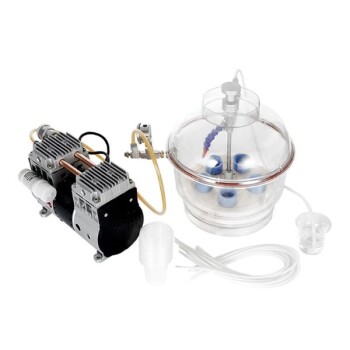
A penetrating vacuum chromizing unit fundamentally outperforms traditional methods by combining high-speed processing with superior structural integrity. This technology enables the simultaneous processing of multiple tubes, creating a uniform diffusion layer in as little as 3 to 5 minutes while strictly controlling temperature and evaporation rates to eliminate common quality defects.
Core Takeaway Traditional tube processing often relies on coating methods that can result in brittle surfaces. By utilizing a penetrating vacuum unit, you shift from surface spraying to rapid diffusion, achieving a durable, uniform layer that significantly boosts both industrial efficiency and product quality.
Transforming Production Efficiency
To understand the technical value of this unit, one must look at how it optimizes the manufacturing timeline.
Rapid Cycle Times
The most immediate operational advantage is speed. The unit can form a complete, uniform diffusion layer in typically 3 to 5 minutes. This is a drastic reduction in processing time compared to conventional methods that often require lengthy soaking or curing periods.
High-Volume Throughput
Efficiency is further amplified by the unit's capacity configuration. It is designed for the simultaneous processing of multiple tubes. This parallel processing capability, combined with short cycle times, allows for a massive increase in overall industrial production output.
Elevating Coating Quality and Integrity
Beyond speed, the penetrating vacuum chromizing unit addresses the "deep need" of reliability. It solves specific failure modes associated with older metallizing techniques.
Preventing Structural Weakness
A critical flaw in traditional methods is the tendency to produce "spray coatings." These can often be brittle and prone to cracking or delamination. This unit avoids the production of brittle spray coatings entirely by forming a diffusion layer, which integrates with the substrate rather than merely sitting on top of it.
Precision Process Control
Uniformity is achieved through rigorous regulation of the internal environment. The unit provides precise control over two critical variables:
- The evaporation rate of the metallizing agent.
- The surface temperature of the tubes.
Uniform Diffusion
By managing the variables above, the unit ensures the formation of a uniform diffusion layer. This consistency is vital for industrial applications where even minor variations in coating thickness can lead to premature part failure.
Overcoming Traditional Limitations
When evaluating this technology, it is helpful to contrast it directly with the pitfalls of the methods it replaces.
The Pitfall of Brittle Coatings
In traditional applications, the lack of vacuum control or precise temperature regulation often results in a distinct boundary between the coating and the tube. This interface is where brittle spray coatings fail. The vacuum chromizing unit eliminates this trade-off, prioritizing long-term durability over simple surface coverage.
Making the Right Choice for Your Goal
When deciding if a penetrating vacuum chromizing unit is the right upgrade for your facility, consider your specific production bottlenecks.
- If your primary focus is Production Speed: This unit is essential for reducing cycle times to the 3-5 minute range while handling multiple units simultaneously.
- If your primary focus is Product Durability: The unit is the superior choice for eliminating brittle spray coatings in favor of a robust, uniform diffusion layer.
Adopting this technology moves tube processing from a variable, time-consuming task to a precise, high-speed industrial operation.
Summary Table:
| Feature | Penetrating Vacuum Chromizing | Traditional Coating Methods |
|---|---|---|
| Processing Time | 3 - 5 Minutes | Extended Soaking/Curing |
| Layer Type | Uniform Diffusion Layer | Brittle Surface Spray Coating |
| Throughput | Simultaneous Multi-Tube Processing | Often Single-Unit or Low Volume |
| Structural Integrity | High; Integrated with Substrate | Prone to Cracking/Delamination |
| Process Control | Precise Temp & Evaporation Rate | Variable Manual Control |
Revolutionize Your Material Processing with KINTEK
Maximize your industrial efficiency and product durability with KINTEK’s advanced thermal processing solutions. As experts in laboratory and industrial equipment, we specialize in high-performance high-temperature furnaces (vacuum, tube, and atmosphere), crushing and milling systems, and precision hydraulic presses designed to meet the rigorous demands of modern manufacturing.
Whether you are scaling production for battery research or perfecting tube processing, KINTEK provides the high-quality consumables and machinery—from PTFE products and ceramics to high-pressure reactors—to ensure your success.
Ready to eliminate brittle coatings and reduce cycle times? Contact our technical specialists today to find the perfect solution for your facility!
References
- A. V. Hruzevych, D. О. Derecha. Diffusion-hardening effect on the technological properties of high-temperature steel. DOI: 10.1007/s42452-020-2943-5
This article is also based on technical information from Kintek Solution Knowledge Base .
Related Products
- Laboratory Rapid Thermal Processing (RTP) Quartz Tube Furnace
- Chemical Vapor Deposition CVD Equipment System Chamber Slide PECVD Tube Furnace with Liquid Gasifier PECVD Machine
- Split Chamber CVD Tube Furnace with Vacuum Station Chemical Vapor Deposition System Equipment Machine
- Laboratory High Pressure Vacuum Tube Furnace
- Vacuum Sealed Continuous Working Rotary Tube Furnace Rotating Tube Furnace
People Also Ask
- What technical advantages does an RTP tube furnace offer for photoelectrodes? Achieve Precision & High Phase Purity
- What is the temperature of a quartz tube furnace? Master the Limits for Safe, High-Temp Operation
- How does a quartz tube furnace facilitate the synthesis of rGO? Optimize Your Cathode Matrix with Precise Pyrolysis
- What are the advantages of using an electric heating furnace with a quartz tube for liquid bismuth corrosion control?
- What is the maximum temperature for a quartz tube furnace? Key Limits for Safe & Efficient Operation