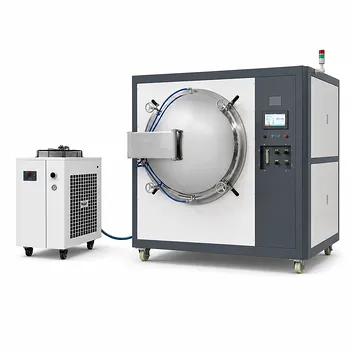
The technical conditions provided by a vacuum hot press sintering furnace for TiC/Ti synthesis are defined by a specific triad: a high vacuum of approximately 4.0 x 10^-3 kPa, a sintering temperature of 1200°C, and a mechanical pressure of 20 MPa. These parameters are not applied sequentially but simultaneously, creating a unique environment that manages the high chemical reactivity of titanium while physically forcing densification.
Core Insight The furnace relies on the "coupling effect" of applying thermal energy and mechanical force at the same time. This dual action drives solid-phase diffusion and plastic flow—mechanisms that are impossible to achieve effectively with heat alone—resulting in a high-density composite with a controlled microstructure.
The Critical Role of the Vacuum Environment
Preventing Titanium Oxidation
Titanium is a "highly active" metal, meaning it reacts aggressively with oxygen at elevated temperatures.
The furnace maintains a vacuum level of 4.0 x 10^-3 kPa specifically to neutralize this threat. By removing oxygen from the chamber, the furnace prevents the titanium powder from oxidizing, which would otherwise degrade the material's mechanical properties.
Facilitating Clean Particle Contact
Beyond preventing oxidation, the vacuum environment serves a secondary physical function.
It helps extract volatile gases trapped in the spaces between powder particles. Removing these gases ensures that the Titanium (Ti) and Carbon (C) particles have direct, clean contact, which is a prerequisite for strong bonding and successful diffusion.
The Synergy of Heat and Pressure
Driving In-Situ Reactions (Thermal Input)
The furnace maintains a temperature of 1200°C to initiate the chemical changes required for in-situ synthesis.
At this temperature, thermal energy promotes solid-phase diffusion reactions. This causes the Titanium and Carbon atoms to migrate and react chemically, forming the Titanium Carbide (TiC) reinforcement phase directly within the matrix.
Forcing Densification (Mechanical Input)
Simultaneously, the furnace applies 20 MPa of axial pressure.
While heat starts the reaction, diffusion alone often leaves microscopic voids or pores. The application of external pressure forces the plastic flow of the matrix. This mechanically closes pores and eliminates voids that thermal energy cannot remove on its own.
Understanding the Trade-offs
Process Sensitivity
The parameters for TiC/Ti composites are highly interdependent.
If the vacuum level drops (pressure rises), the titanium will oxidize regardless of the correct temperature or pressure. Conversely, if mechanical pressure is insufficient, the material may react chemically but fail to achieve full density, resulting in a porous, weak structure.
The Cost of Simultaneity
Achieving these conditions requires complex equipment capable of managing hydraulic loading and precise thermal control simultaneously.
While this results in superior material properties compared to pressureless sintering, it introduces higher operational complexity and equipment costs. The process is optimized for performance, not throughput speed.
Making the Right Choice for Your Goal
To ensure the successful synthesis of TiC/Ti composites, you must prioritize specific parameters based on your desired outcome:
- If your primary focus is Material Purity: Prioritize the integrity of the vacuum system ($4.0 \times 10^{-3}$ kPa or better) to strictly prevent the embrittlement caused by titanium oxidation.
- If your primary focus is Structural Density: Ensure the hydraulic system can maintain consistent pressure (20 MPa) at peak temperature to force the plastic flow necessary for eliminating porosity.
Ultimately, the success of in-situ TiC/Ti synthesis relies on the simultaneous application of force and heat within a protected vacuum to drive reaction and densification in a single step.
Summary Table:
| Parameter | Specification | Key Function |
|---|---|---|
| Vacuum Level | 4.0 x 10^-3 kPa | Prevents Ti oxidation & ensures clean particle contact |
| Sintering Temp | 1200°C | Drives solid-phase diffusion and TiC formation |
| Mechanical Pressure | 20 MPa | Forces plastic flow to eliminate pores and voids |
| Process Mechanism | Simultaneous Hot Pressing | Achieve full densification and in-situ reaction coupling |
Elevate Your Material Research with KINTEK Precision
Successful in-situ synthesis of TiC/Ti composites requires the perfect synergy of heat, pressure, and vacuum. KINTEK specializes in high-performance vacuum hot press sintering furnaces and high-temperature reactors designed to meet these exacting technical standards.
Our comprehensive range of laboratory equipment—from vacuum and atmosphere furnaces to isostatic hydraulic presses and MPCVD systems—provides researchers and industrial manufacturers with the tools needed for superior material density and purity.
Ready to optimize your sintering process? Contact us today to discover how KINTEK’s advanced laboratory solutions can enhance your composite manufacturing and material development.
Related Products
- 600T Vacuum Induction Hot Press Furnace for Heat Treat and Sintering
- Vacuum Heat Treat and Sintering Furnace with 9MPa Air Pressure
- Vacuum Heat Treat and Pressure Sintering Furnace for High Temperature Applications
- 2200 ℃ Tungsten Vacuum Heat Treat and Sintering Furnace
- Vacuum Hot Press Furnace Heated Vacuum Press Machine Tube Furnace
People Also Ask
- What role does an induction vacuum hot pressing furnace play in sintering? Achieve 98% Density in Carbide Blocks
- What advantages does a vacuum hot press furnace provide for LSLBO ceramic electrolytes? Achieve 94% Relative Density
- What role does a Vacuum Hot Press (VHP) furnace play in the densification of austenitic stainless steel 316 composites?
- What are the advantages of a vacuum hot press furnace for W-50%Cu? Achieve 99.6% Density at Lower Temperatures
- What role does mechanical pressure play during the vacuum diffusion bonding of tungsten and copper? Keys to Solid Bonding