Knowledge Vacuum Furnace What temperature do metal furnaces operate at? Master Metal Melting and Heat Treatment
Author avatar

Tech Team · Kintek Solution

Updated 2 months ago

What temperature do metal furnaces operate at? Master Metal Melting and Heat Treatment


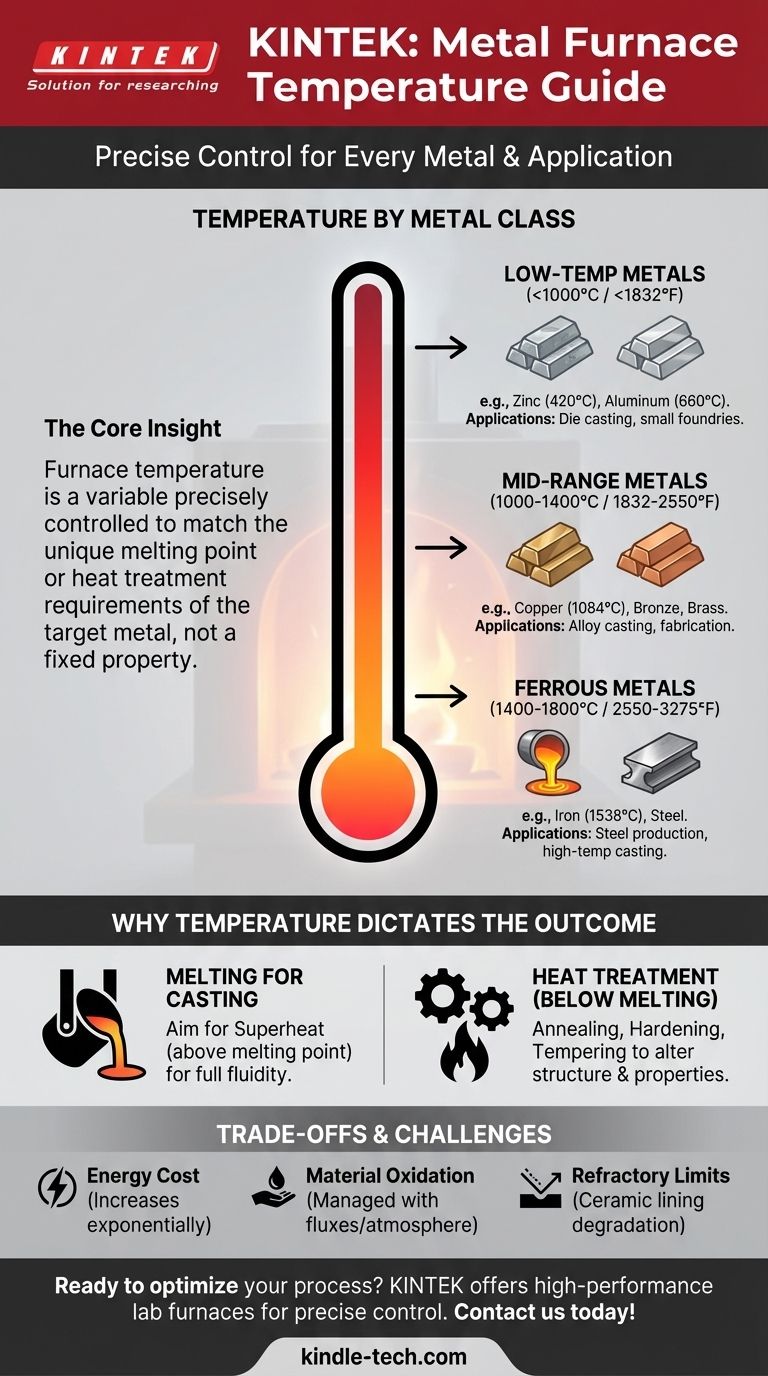
At their most extreme, metal furnaces operate at temperatures between 1400°C and 1800°C (2550°F to 3275°F). However, this range is reserved for high-temperature processes like melting steel. The exact operating temperature depends entirely on the specific metal being worked and the metallurgical goal, with many common applications requiring significantly lower heat.

The critical insight is that a furnace's temperature is not a fixed property of the furnace itself, but a variable precisely controlled to match the unique melting point or heat treatment requirements of the target metal.
What temperature do metal furnaces operate at? Master Metal Melting and Heat Treatment

Why Temperature Dictates the Outcome

In metallurgy, heat is the primary tool for changing a metal's physical state and internal structure. Different temperature ranges unlock entirely different processes and properties, making precise control essential for achieving the desired result.

The Goal: Reaching the Melting Point

The most common reason for heating a metal in a furnace is to melt it for casting. Every pure metal and alloy has a specific melting point that must be exceeded to transition it from a solid to a liquid state.

Furnace operators typically aim for a temperature significantly above the melting point to ensure the metal is fully liquid and fluid enough to pour, a state known as superheat.

The Goal: Changing Structure (Heat Treatment)

Many critical processes occur well below a metal's melting point. This is known as heat treatment.

Processes like annealing (softening), hardening (increasing strength), and tempering (reducing brittleness) rely on heating metal to specific temperatures to rearrange its internal crystal structure, fundamentally altering its mechanical properties without melting it.

Temperature Requirements by Metal Class

Furnaces are chosen based on their ability to reliably reach and hold the temperatures needed for a specific group of metals.

Low-Temperature Metals: Under 1000°C (1832°F)

Metals like zinc (melting point: 420°C) and aluminum (melting point: 660°C) require relatively low energy. Furnaces for these metals, often used in die casting and small-scale foundries, are simpler in construction.

Mid-Range Metals: 1000°C - 1400°C (1832°F - 2550°F)

This range covers common alloys like bronze and brass, as well as pure copper (melting point: 1084°C). These temperatures demand more robust furnace construction and better refractory (heat-resistant) linings.

Ferrous Metals: 1400°C - 1800°C (2550°F - 3275°F)

This is the domain of iron (melting point: 1538°C) and steel. Achieving these temperatures requires specialized high-temperature furnaces, often utilizing electric arc or induction technology. The 1400°C to 1800°C range cited for these furnaces accounts for the high melting point of iron and the need for superheat to cast complex steel alloys.

Understanding the Trade-offs and Challenges

Simply reaching a high temperature is not the only consideration. The process introduces significant technical and financial challenges.

The Cost of Heat

Energy consumption increases exponentially with temperature. Reaching steel-melting temperatures is far more expensive than melting aluminum, impacting everything from operational budget to equipment choice.

Material Oxidation

At high temperatures, most metals react aggressively with oxygen in the air, forming oxides (scale) that represent lost material and can cause defects in a final casting. This is managed by using fluxes, protective slag layers, or controlled-atmosphere furnaces.

Refractory and Equipment Limits

The furnace itself must withstand the heat it contains. The refractory lining, typically a specialized ceramic, has its own temperature limits. Pushing a furnace beyond its designed range will lead to rapid degradation and catastrophic failure.

Making the Right Choice for Your Goal

To select the correct operating temperature, you must first define your material and your objective.

  • If your primary focus is casting aluminum or zinc alloys: Your furnace will operate in the 700°C to 850°C range to ensure the metal is fully molten and fluid.
  • If your primary focus is melting bronze or copper: You need a furnace capable of reliably holding temperatures between 1100°C and 1250°C.
  • If your primary focus is melting steel: You must use a high-temperature furnace that can exceed 1600°C to properly melt the alloy and achieve the necessary fluidity for casting.
  • If your primary focus is forging or heat-treating steel: You will work well below its melting point, typically in the 800°C to 1250°C range, depending on the specific treatment.

Mastering temperature control is the foundation of achieving predictable and successful results in any metallurgical work.

Summary Table:

Metal Type Typical Operating Range (°C) Typical Operating Range (°F) Common Applications
Low-Temp (e.g., Zinc, Aluminum) < 1000°C < 1832°F Die casting, small foundries
Mid-Range (e.g., Bronze, Copper) 1000°C - 1400°C 1832°F - 2550°F Alloy casting, fabrication
Ferrous (e.g., Iron, Steel) 1400°C - 1800°C 2550°F - 3275°F Steel production, high-temp casting

Ready to optimize your metalworking process? KINTEK specializes in high-performance lab furnaces and equipment designed for precise temperature control, whether you're melting aluminum or heat-treating steel. Our solutions help you achieve superior results with energy efficiency and durability. Contact us today to discuss your specific needs and let our experts guide you to the right furnace for your application!

Visual Guide
What temperature do metal furnaces operate at? Master Metal Melting and Heat Treatment Visual Guide

Related Products

People Also Ask

Related Products

2200 ℃ Tungsten Vacuum Heat Treat and Sintering Furnace

2200 ℃ Tungsten Vacuum Heat Treat and Sintering Furnace

Experience the ultimate refractory metal furnace with our Tungsten vacuum furnace. Capable of reaching 2200℃, perfect for sintering advanced ceramics and refractory metals. Order now for high-quality results.

Non Consumable Vacuum Arc Induction Melting Furnace

Non Consumable Vacuum Arc Induction Melting Furnace

Explore the benefits of Non-Consumable Vacuum Arc Furnace with high melting point electrodes. Small, easy to operate & eco-friendly. Ideal for laboratory research on refractory metals & carbides.

High Temperature Muffle Oven Furnace for Laboratory Debinding and Pre Sintering

High Temperature Muffle Oven Furnace for Laboratory Debinding and Pre Sintering

KT-MD High temperature debinding and pre-sintering furnace for ceramic materials with various molding processes. Ideal for electronic components such as MLCC and NFC.

Graphite Vacuum Furnace High Thermal Conductivity Film Graphitization Furnace

Graphite Vacuum Furnace High Thermal Conductivity Film Graphitization Furnace

The high thermal conductivity film graphitization furnace has uniform temperature, low energy consumption and can operate continuously.

Vertical High Temperature Graphite Vacuum Graphitization Furnace

Vertical High Temperature Graphite Vacuum Graphitization Furnace

Vertical high temperature graphitization furnace for carbonization and graphitization of carbon materials up to 3100℃.Suitable for shaped graphitization of carbon fiber filaments and other materials sintered in a carbon environment.Applications in metallurgy, electronics, and aerospace for producing high-quality graphite products like electrodes and crucibles.

Ultra-High Temperature Graphite Vacuum Graphitization Furnace

Ultra-High Temperature Graphite Vacuum Graphitization Furnace

The ultra-high temperature graphitization furnace utilizes medium frequency induction heating in a vacuum or inert gas environment. The induction coil generates an alternating magnetic field, inducing eddy currents in the graphite crucible, which heats up and radiates heat to the workpiece, bringing it to the desired temperature. This furnace is primarily used for graphitization and sintering of carbon materials, carbon fiber materials, and other composite materials.

Large Vertical Graphite Vacuum Graphitization Furnace

Large Vertical Graphite Vacuum Graphitization Furnace

A large vertical high-temperature graphitization furnace is a type of industrial furnace used for the graphitization of carbon materials, such as carbon fiber and carbon black. It is a high-temperature furnace that can reach temperatures of up to 3100°C.

Mesh belt controlled atmosphere furnace

Mesh belt controlled atmosphere furnace

Discover our KT-MB mesh belt sintering furnace - perfect for high-temperature sintering of electronic components & glass insulators. Available for open air or controlled atmosphere environments.

Graphite Vacuum Furnace Bottom Discharge Graphitization Furnace for Carbon Materials

Graphite Vacuum Furnace Bottom Discharge Graphitization Furnace for Carbon Materials

Bottom-out graphitization furnace for carbon materials, ultra-high temperature furnace up to 3100°C, suitable for graphitization and sintering of carbon rods and carbon blocks. Vertical design, bottom discharging, convenient feeding and discharging, high temperature uniformity, low energy consumption, good stability, hydraulic lifting system, convenient loading and unloading.

Molybdenum Vacuum Heat Treat Furnace

Molybdenum Vacuum Heat Treat Furnace

Discover the benefits of a high-configuration molybdenum vacuum furnace with heat shield insulation. Ideal for high-purity, vacuum environments like sapphire crystal growth and heat treatment.

Horizontal High Temperature Graphite Vacuum Graphitization Furnace

Horizontal High Temperature Graphite Vacuum Graphitization Furnace

Horizontal Graphitization Furnace: This type of furnace is designed with the heating elements placed horizontally, allowing for uniform heating of the sample. It's well-suited for graphitizing large or bulky samples that require precise temperature control and uniformity.

Laboratory Muffle Oven Furnace Bottom Lifting Muffle Furnace

Laboratory Muffle Oven Furnace Bottom Lifting Muffle Furnace

Efficiently produce batches with excellent temperature uniformity using our Bottom Lifting Furnace. Features two electric lifting stages and advanced temperature control up to 1600℃.

Vacuum Heat Treat and Molybdenum Wire Sintering Furnace for Vacuum Sintering

Vacuum Heat Treat and Molybdenum Wire Sintering Furnace for Vacuum Sintering

A vacuum molybdenum wire sintering furnace is a vertical or bedroom structure, which is suitable for withdrawal, brazing, sintering and degassing of metal materials under high vacuum and high temperature conditions. It is also suitable for dehydroxylation treatment of quartz materials.

Graphite Vacuum Continuous Graphitization Furnace

Graphite Vacuum Continuous Graphitization Furnace

High-temperature graphitization furnace is a professional equipment for graphitization treatment of carbon materials. It is a key equipment for the production of high-quality graphite products. It has high temperature, high efficiency and uniform heating. It is suitable for various high-temperature treatments and graphitization treatments. It is widely used in metallurgy, electronics, aerospace, etc. industry.

1200℃ Controlled Atmosphere Furnace Nitrogen Inert Atmosphere Furnace

1200℃ Controlled Atmosphere Furnace Nitrogen Inert Atmosphere Furnace

Discover our KT-12A Pro Controlled atmosphere furnace - high precision, heavy duty vacuum chamber, versatile smart touch screen controller, and excellent temperature uniformity up to 1200C. Ideal for both laboratory and industrial application.

1700℃ Controlled Atmosphere Furnace Nitrogen Inert Atmosphere Furnace

1700℃ Controlled Atmosphere Furnace Nitrogen Inert Atmosphere Furnace

KT-17A Controlled atmosphere furnace: 1700℃ heating, vacuum sealing technology, PID temperature control, and versatile TFT smart touch screen controller for laboratory and industrial use.

Vacuum Heat Treat and Pressure Sintering Furnace for High Temperature Applications

Vacuum Heat Treat and Pressure Sintering Furnace for High Temperature Applications

Vacuum pressure sintering furnaces are designed for high temperature hot pressing applications in metal and ceramic sintering. Its advanced features ensure precise temperature control, reliable pressure maintenance, and a robust design for seamless operation.

Vertical Laboratory Tube Furnace

Vertical Laboratory Tube Furnace

Elevate your experiments with our Vertical Tube Furnace. Versatile design allows for operation under various environments and heat treatment applications. Order now for precise results!

1700℃ Muffle Oven Furnace for Laboratory

1700℃ Muffle Oven Furnace for Laboratory

Get superior heat control with our 1700℃ Muffle Furnace. Equipped with intelligent temperature microprocessor, TFT touch screen controller & advanced insulation materials for precise heating up to 1700C. Order now!

Vacuum Arc Induction Melting Furnace

Vacuum Arc Induction Melting Furnace

Discover the power of Vacuum Arc Furnace for melting active & refractory metals. High-speed, remarkable degassing effect, and free of contamination. Learn more now!


Leave Your Message



















