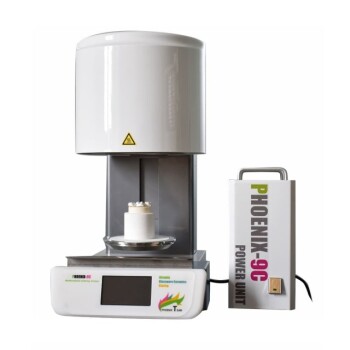
Knowledge muffle furnace What temperature does porcelain fire at? A Guide to the 1222°C-1300°C Range for Perfect Results
Author avatar

Tech Team · Kintek Solution

Updated 2 months ago

What temperature does porcelain fire at? A Guide to the 1222°C-1300°C Range for Perfect Results


In professional ceramics, porcelain is typically high-fired to a temperature between 1222°C and 1300°C (2232°F and 2372°F). This range corresponds to the pyrometric cone standards of Cone 6 to Cone 10. However, this single number represents only the final step; the correct temperature is part of a larger, carefully controlled process that includes a preliminary "bisque" firing at a much lower temperature.

The specific temperature is less important than the entire firing schedule—the controlled rate of heating, holding, and cooling. True success with porcelain comes from understanding this complete process, as it is the total "heat-work" that determines the final properties of the piece.
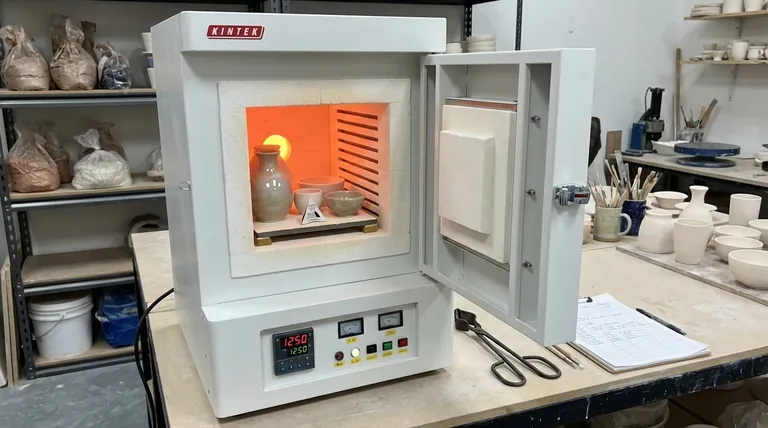
What temperature does porcelain fire at? A Guide to the 1222°C-1300°C Range for Perfect Results

The Two-Stage Firing Process Explained

Porcelain is almost never fired just once. Achieving its signature strength and translucency requires a two-step approach, with each stage serving a distinct purpose at a different temperature.

Stage 1: The Bisque Firing

The first firing, known as the bisque firing, is a lower-temperature step. Its goal is not to fully mature the clay but to transform it into a hardened, yet porous, ceramic state.

This porosity is critical because it allows the piece to readily absorb the water-based glaze in the next step without dissolving or breaking.

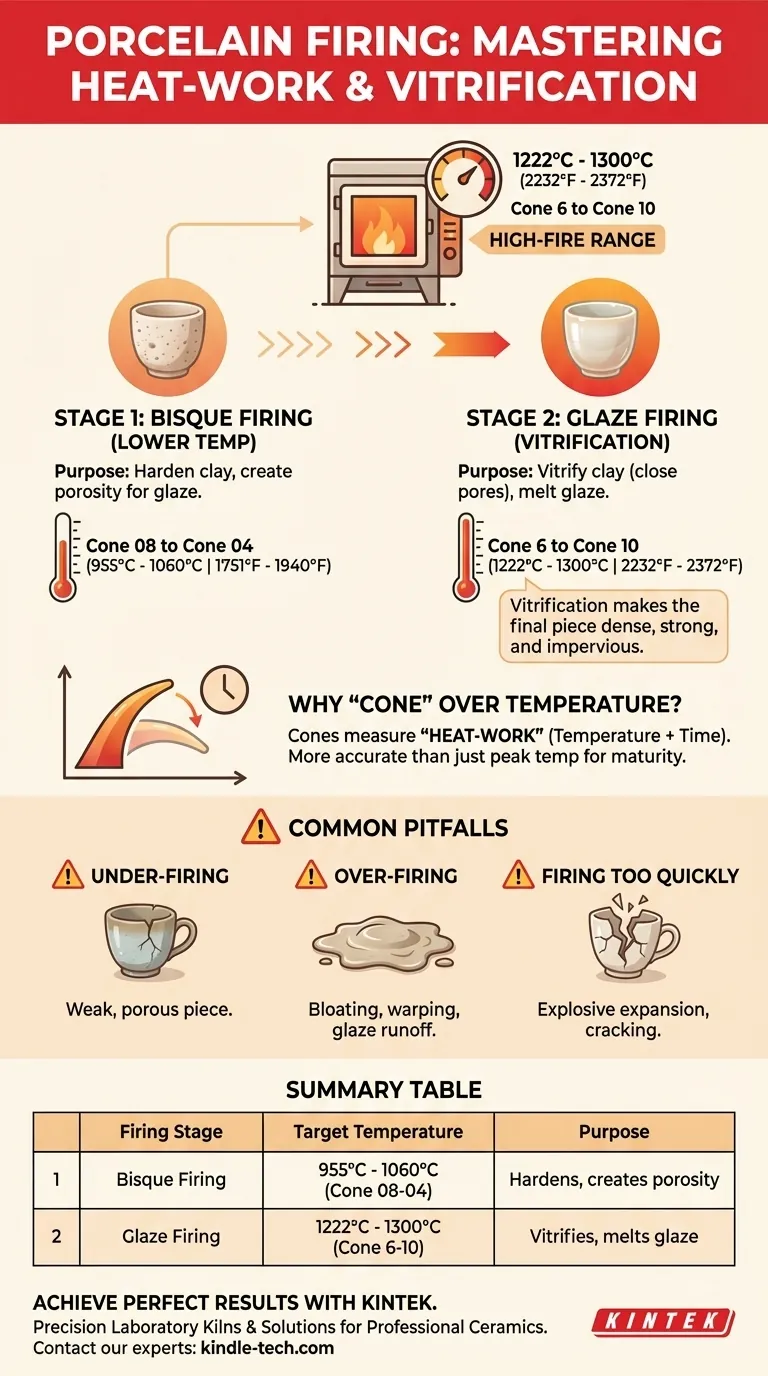
A typical porcelain bisque firing happens between Cone 08 and Cone 04, which is approximately 955°C to 1060°C (1751°F to 1940°F).

Stage 2: The Glaze Firing (Vitrification)

The second and final firing is the high-temperature glaze firing. This is where the porcelain reaches its peak temperature and undergoes vitrification.

Vitrification is the process where the clay particles melt and fuse together, closing the pores and making the final piece dense, strong, and impervious to water.

This is the firing that brings the piece to its final temperature of Cone 6 to Cone 10 (1222°C to 1300°C), melting the applied glaze into a smooth, glassy coating that bonds permanently to the clay body.

Why "Cone" is More Important Than Temperature

In ceramics, professionals rarely talk about temperature alone. Instead, they refer to pyrometric cones, which provide a more accurate measure of what happens inside a kiln.

What is a Pyrometric Cone?

A pyrometric cone is a small, pyramid-shaped tool made of ceramic materials. It is designed to soften and bend at a specific combination of temperature and time.

Measuring "Heat-Work," Not Just Heat

A kiln can reach a target temperature very quickly or very slowly. These two paths will produce dramatically different results in the clay, even if the peak temperature is identical.

Cones measure this total energy input, known as "heat-work." When the correct cone bends, it confirms the porcelain has absorbed the right amount of energy to mature properly, providing a more reliable outcome than a simple temperature reading.

Common Pitfalls to Avoid

The firing schedule is a precise formula. Deviating from the requirements of your specific clay body can easily ruin a piece.

The Risk of Under-firing

If the porcelain does not reach its required maturation temperature, it will not fully vitrify. The resulting piece will be weak, porous, and prone to breaking. The glaze may also appear dull, rough, or poorly fitted.

The Danger of Over-firing

Firing porcelain to a temperature higher than its intended cone rating is equally damaging. The clay body can bloat, warp, or even melt into a puddle on the kiln shelf. Glazes will become overly fluid, running off the piece and potentially damaging your equipment.

Firing Too Quickly

Ramping up the temperature too fast, especially during the early stages, can cause moisture trapped in the clay to turn to steam and expand explosively. This is a primary cause of cracking and shattering inside the kiln.

Making the Right Choice for Your Goal

Always match your firing program to your materials. There is no universal setting that works for all types of porcelain.

  • If your primary focus is working with a commercial clay body: Always follow the manufacturer's recommended cone firing range. This information is non-negotiable and is printed on the packaging.
  • If your primary focus is ensuring glaze compatibility: Make sure the cone rating of your glaze matches the cone rating of your porcelain clay body. A mismatch is a leading cause of defects like crazing (cracking) or shivering.
  • If your primary focus is troubleshooting defects like warping: Your piece is likely being over-fired or is not adequately supported on the kiln shelf. Verify your target cone and consider a slower heating and cooling cycle.

Ultimately, mastering porcelain is about mastering the controlled application of heat over time.

Summary Table:

Firing Stage Target Temperature Purpose
Bisque Firing 955°C - 1060°C (Cone 08-04) Hardens clay, creates porosity for glazing
Glaze Firing 1222°C - 1300°C (Cone 6-10) Vitrifies clay, melts glaze for final finish

Achieve Perfect Porcelain Results with KINTEK

Mastering porcelain firing requires precision equipment and expert knowledge. At KINTEK, we specialize in high-performance laboratory kilns and consumables designed specifically for professional ceramics. Our reliable equipment ensures precise temperature control and consistent heat-work for perfect vitrification every time.

Let us help you unlock the full potential of your porcelain projects. Whether you're a studio artist, educational institution, or research facility, KINTEK has the solutions to support your ceramic firing needs.

Contact our experts today to discuss the ideal kiln for your porcelain workflow and achieve flawless results!

Visual Guide
What temperature does porcelain fire at? A Guide to the 1222°C-1300°C Range for Perfect Results Visual Guide

Related Products

People Also Ask

Related Products

Vacuum Dental Porcelain Sintering Furnace

Vacuum Dental Porcelain Sintering Furnace

Get precise and reliable results with KinTek's Vacuum Porcelain Furnace. Suitable for all porcelain powders, it features hyperbolic ceramic furnace function, voice prompt, and automatic temperature calibration.

Dental Porcelain Zirconia Sintering Ceramic Vacuum Press Furnace

Dental Porcelain Zirconia Sintering Ceramic Vacuum Press Furnace

Get precise dental results with Dental Vacuum Press Furnace. Automatic temperature calibration, low noise tray, and touch screen operation. Order now!

Dental Porcelain Zirconia Sintering Ceramic Furnace Chairside with Transformer

Dental Porcelain Zirconia Sintering Ceramic Furnace Chairside with Transformer

Experience top-notch sintering with Chairside Sintering Furnace with Transformer. Easy to operate, noise-free pallet, and automatic temperature calibration. Order now!

High Temperature Muffle Oven Furnace for Laboratory Debinding and Pre Sintering

High Temperature Muffle Oven Furnace for Laboratory Debinding and Pre Sintering

KT-MD High temperature debinding and pre-sintering furnace for ceramic materials with various molding processes. Ideal for electronic components such as MLCC and NFC.

Vertical High Temperature Graphite Vacuum Graphitization Furnace

Vertical High Temperature Graphite Vacuum Graphitization Furnace

Vertical high temperature graphitization furnace for carbonization and graphitization of carbon materials up to 3100℃.Suitable for shaped graphitization of carbon fiber filaments and other materials sintered in a carbon environment.Applications in metallurgy, electronics, and aerospace for producing high-quality graphite products like electrodes and crucibles.

Ultra-High Temperature Graphite Vacuum Graphitization Furnace

Ultra-High Temperature Graphite Vacuum Graphitization Furnace

The ultra-high temperature graphitization furnace utilizes medium frequency induction heating in a vacuum or inert gas environment. The induction coil generates an alternating magnetic field, inducing eddy currents in the graphite crucible, which heats up and radiates heat to the workpiece, bringing it to the desired temperature. This furnace is primarily used for graphitization and sintering of carbon materials, carbon fiber materials, and other composite materials.

1700℃ Muffle Oven Furnace for Laboratory

1700℃ Muffle Oven Furnace for Laboratory

Get superior heat control with our 1700℃ Muffle Furnace. Equipped with intelligent temperature microprocessor, TFT touch screen controller & advanced insulation materials for precise heating up to 1700C. Order now!

Spark Plasma Sintering Furnace SPS Furnace

Spark Plasma Sintering Furnace SPS Furnace

Discover the benefits of Spark Plasma Sintering Furnaces for rapid, low-temperature material preparation. Uniform heating, low cost & eco-friendly.

Large Vertical Graphite Vacuum Graphitization Furnace

Large Vertical Graphite Vacuum Graphitization Furnace

A large vertical high-temperature graphitization furnace is a type of industrial furnace used for the graphitization of carbon materials, such as carbon fiber and carbon black. It is a high-temperature furnace that can reach temperatures of up to 3100°C.

Laboratory Muffle Oven Furnace Bottom Lifting Muffle Furnace

Laboratory Muffle Oven Furnace Bottom Lifting Muffle Furnace

Efficiently produce batches with excellent temperature uniformity using our Bottom Lifting Furnace. Features two electric lifting stages and advanced temperature control up to 1600℃.

1400℃ Muffle Oven Furnace for Laboratory

1400℃ Muffle Oven Furnace for Laboratory

Get precise high-temperature control up to 1500℃ with KT-14M Muffle furnace. Equipped with a smart touch screen controller and advanced insulation materials.

1200℃ Muffle Furnace Oven for Laboratory

1200℃ Muffle Furnace Oven for Laboratory

Upgrade your lab with our 1200℃ Muffle Furnace. Achieve fast, precise heating with Japan alumina fibers and Molybdenum coils. Features TFT touch screen controller for easy programming and data analysis. Order now!

Graphite Vacuum Continuous Graphitization Furnace

Graphite Vacuum Continuous Graphitization Furnace

High-temperature graphitization furnace is a professional equipment for graphitization treatment of carbon materials. It is a key equipment for the production of high-quality graphite products. It has high temperature, high efficiency and uniform heating. It is suitable for various high-temperature treatments and graphitization treatments. It is widely used in metallurgy, electronics, aerospace, etc. industry.

2200 ℃ Graphite Vacuum Heat Treat Furnace

2200 ℃ Graphite Vacuum Heat Treat Furnace

Discover the power of the KT-VG Graphite Vacuum Furnace - with a maximum working temperature of 2200℃, it's perfect for vacuum sintering of various materials. Learn more now.

Horizontal High Temperature Graphite Vacuum Graphitization Furnace

Horizontal High Temperature Graphite Vacuum Graphitization Furnace

Horizontal Graphitization Furnace: This type of furnace is designed with the heating elements placed horizontally, allowing for uniform heating of the sample. It's well-suited for graphitizing large or bulky samples that require precise temperature control and uniformity.

Non Consumable Vacuum Arc Induction Melting Furnace

Non Consumable Vacuum Arc Induction Melting Furnace

Explore the benefits of Non-Consumable Vacuum Arc Furnace with high melting point electrodes. Small, easy to operate & eco-friendly. Ideal for laboratory research on refractory metals & carbides.

1200℃ Split Tube Furnace with Quartz Tube Laboratory Tubular Furnace

1200℃ Split Tube Furnace with Quartz Tube Laboratory Tubular Furnace

KT-TF12 split tube furnace: high-purity insulation, embedded heating wire coils, and max. 1200C. Widely used for new materials and chemical vapour deposition.

Electric Rotary Kiln Pyrolysis Furnace Plant Machine Calciner Small Rotary Kiln Rotating Furnace

Electric Rotary Kiln Pyrolysis Furnace Plant Machine Calciner Small Rotary Kiln Rotating Furnace

Electric rotary kiln - precisely controlled, it's ideal for calcination and drying of materials like lithium cobalate, rare earths, and non-ferrous metals.

Graphite Vacuum Furnace Bottom Discharge Graphitization Furnace for Carbon Materials

Graphite Vacuum Furnace Bottom Discharge Graphitization Furnace for Carbon Materials

Bottom-out graphitization furnace for carbon materials, ultra-high temperature furnace up to 3100°C, suitable for graphitization and sintering of carbon rods and carbon blocks. Vertical design, bottom discharging, convenient feeding and discharging, high temperature uniformity, low energy consumption, good stability, hydraulic lifting system, convenient loading and unloading.

1700℃ Controlled Atmosphere Furnace Nitrogen Inert Atmosphere Furnace

1700℃ Controlled Atmosphere Furnace Nitrogen Inert Atmosphere Furnace

KT-17A Controlled atmosphere furnace: 1700℃ heating, vacuum sealing technology, PID temperature control, and versatile TFT smart touch screen controller for laboratory and industrial use.


Leave Your Message