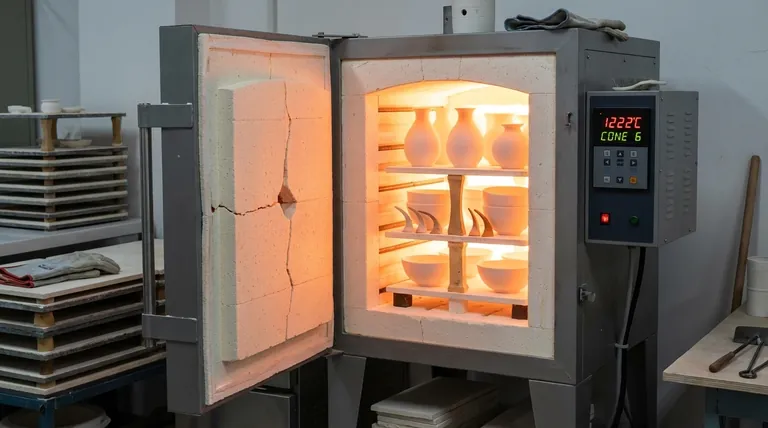
Porcelain requires a precise, high-temperature firing process to achieve its signature strength, density, and translucence. While the exact temperature varies by clay body formulation, a typical high-fire glaze firing for porcelain falls between Cone 6 (2232°F / 1222°C) and Cone 10 (2381°F / 1305°C). This is a multi-stage process, starting with a much lower temperature bisque firing.
The key to working with porcelain is not about hitting a single temperature, but about achieving full vitrification. This is the process where the clay particles fuse into a glass-like, non-porous state, which is accomplished through a carefully controlled firing schedule measured in cones, not just degrees.
Why Firing is More Than Just a Number
Understanding the principles behind the firing process is more important than memorizing a specific temperature. The final properties of your piece are determined by the interaction of heat and time.
The Role of Pyrometric Cones
In ceramics, professionals rely on pyrometric cones rather than just a thermometer (pyrometer). These are small, formulated clay pyramids designed to slump over at a specific combination of temperature and time.
Using cones measures "heatwork," which is a far more accurate gauge of how the ceramic has matured inside the kiln. Two different kilns reaching the same peak temperature but at different speeds will produce different results.
The Goal: Full Vitrification
Porcelain's defining characteristic is its hardness and non-porous nature, which comes from vitrification. At high temperatures, the feldspar in the clay body melts and acts as a flux, causing the other particles (kaolin and silica) to fuse together into a dense, glassy structure.
Under-firing prevents full vitrification, leaving the porcelain weak and porous.
Porcelain's Unique Composition
Porcelain demands high temperatures because of its pure ingredients. It is primarily made of kaolin, a very pure white clay with a high melting point.
Feldspar is added as a flux to lower the melting point enough for vitrification to occur, and silica (flint) helps form the strong, glassy matrix.
The Two-Stage Firing Process
Porcelain is almost always fired twice. Each stage serves a distinct and critical purpose.
Stage 1: The Bisque Firing
The first firing, or bisque firing, is done at a much lower temperature, typically between Cone 08 (1751°F / 955°C) and Cone 04 (1945°F / 1060°C).
This initial firing hardens the fragile "greenware" into a porous but durable state called "bisqueware." The porosity is essential, as it allows the piece to absorb water from the glaze solution evenly, ensuring a smooth coat.
Stage 2: The Glaze Firing
This is the high-temperature firing where the magic happens. During this stage, the clay body reaches full vitrification, and the applied glaze melts and matures into its final, glassy surface.
This is when the porcelain is taken up to its target cone, usually between Cone 6 and Cone 10, depending on the specific clay body you are using.
Understanding the Trade-offs
The specific cone you fire to is one of the most important decisions you will make, as it involves balancing tradition, equipment limitations, and desired results.
The Risk of Under-firing
If you don't reach the recommended temperature for your clay body, the piece will not fully vitrify. It will remain slightly porous, be more prone to chipping and breaking, and will lack the classic translucency of well-fired porcelain.
The Danger of Over-firing
Pushing the temperature too high or holding it for too long can be disastrous. An over-fired piece can warp, bloat, or even melt into a puddle on your kiln shelf. Precision is paramount.
The Cone 6 vs. Cone 10 Decision
Cone 10 is the traditional high-fire standard for porcelain, producing ware of maximum strength and durability. However, reaching these temperatures requires more energy and a kiln capable of sustaining them.
Cone 6 porcelain is a popular modern alternative. It vitrifies at a lower temperature, saving energy and putting less strain on kiln elements. There is also a vast commercial market for reliable and vibrant Cone 6 glazes, making it a more accessible choice for many studios.
Making the Right Choice for Your Goal
Always check the manufacturer's specifications for your specific porcelain clay body and glazes. They have been tested to mature at a precise cone rating.
- If your primary focus is maximum durability and traditional quality: Aiming for a Cone 10 firing with a compatible clay body is the classic approach for creating the strongest possible ware.
- If your primary focus is energy efficiency and glaze options: A Cone 6 porcelain body offers excellent results with less energy consumption and is compatible with a wider range of commercially available glazes.
- If you are a beginner: Start with a well-documented Cone 6 porcelain and follow its recommended firing schedule precisely to achieve consistent and successful results.
Ultimately, the correct temperature is the one that allows your specific clay and glaze to mature perfectly, transforming raw materials into a strong and beautiful finished piece.
Summary Table:
| Firing Stage | Temperature Range (°F) | Temperature Range (°C) | Key Purpose |
|---|---|---|---|
| Bisque Firing | 1751°F - 1945°F | 955°C - 1060°C | Harden greenware into porous bisqueware for glazing |
| Glaze Firing | 2232°F - 2381°F | 1222°C - 1305°C | Achieve full vitrification and mature glaze surface |
Ready to achieve perfect porcelain results? KINTEK specializes in high-performance laboratory kilns and equipment designed for precise temperature control from bisque to high-fire glaze stages. Whether you're working with Cone 6 or Cone 10 porcelain, our solutions help you achieve consistent vitrification and stunning finishes. Contact our experts today to find the ideal kiln for your studio's needs!
Visual Guide

Related Products
- Vacuum Dental Porcelain Sintering Furnace
- Dental Porcelain Zirconia Sintering Ceramic Vacuum Press Furnace
- Dental Porcelain Zirconia Sintering Ceramic Furnace Chairside with Transformer
- High Temperature Muffle Oven Furnace for Laboratory Debinding and Pre Sintering
- 2200 ℃ Graphite Vacuum Heat Treat Furnace
People Also Ask
- How do electronic controllers function in a furnace for sintering dental materials? The Key to Precision Sintering
- What temperature is a dental sintering furnace? Mastering the Material-Specific Thermal Cycle
- What is a sintering furnace for dental? The Key to Durable, High-Strength Ceramic Restorations
- What is sintering dentistry? The Key to Strong, Aesthetic Dental Restorations
- What is the primary function of a dental sintering furnace? Transform Zirconia into Durable Crowns & Bridges