Knowledge Vacuum Furnace What temperature is needed to braze aluminum? Master the Critical Thermal Window for Strong Joints
Author avatar

Tech Team · Kintek Solution

Updated 2 months ago

What temperature is needed to braze aluminum? Master the Critical Thermal Window for Strong Joints


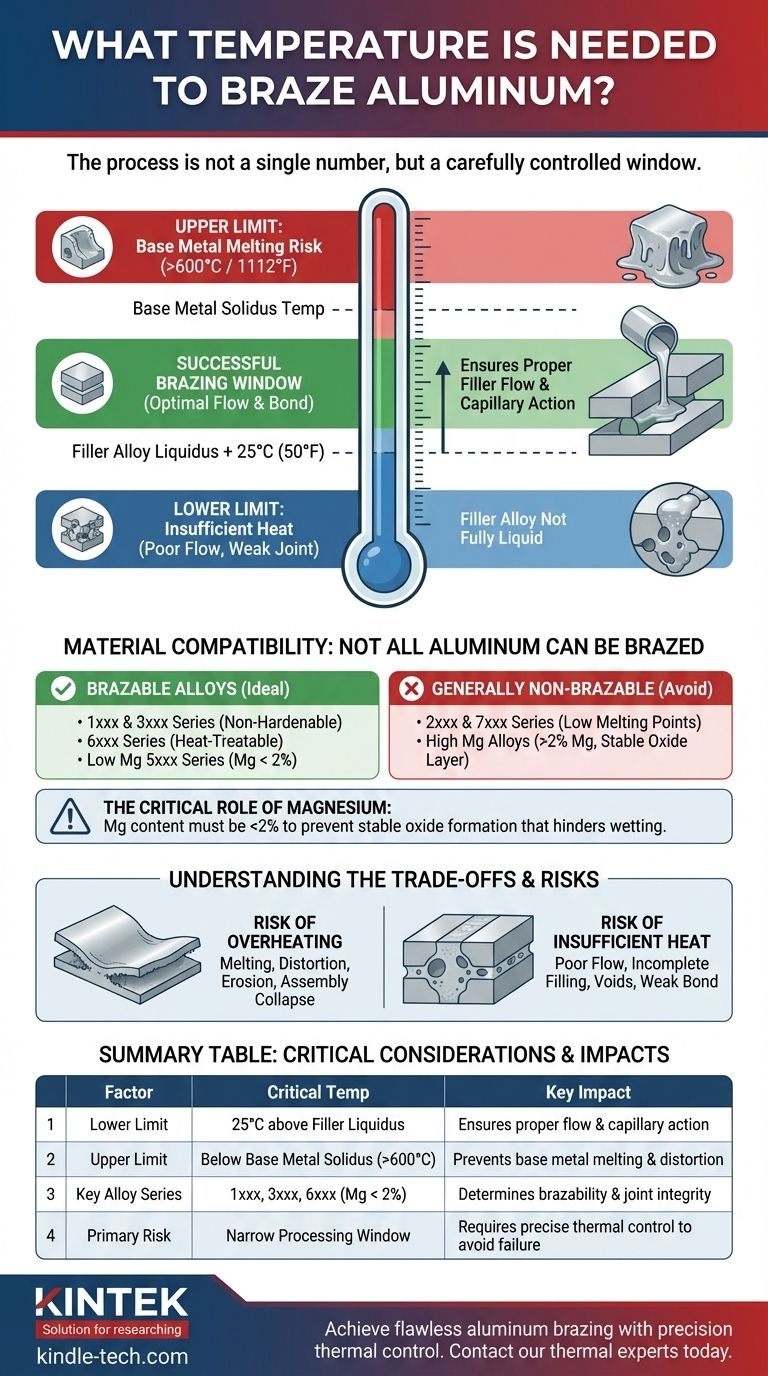
To successfully braze aluminum, the process temperature is not a single number but a carefully controlled window. The temperature must be high enough to melt the filler alloy but low enough to keep the base aluminum solid. Generally, the base aluminum alloy's solidus temperature must be above 600°C (1112°F) to be considered brazable.

The core challenge of aluminum brazing is maintaining a temperature that is slightly above the melting point of your filler material, yet safely below the melting point of the aluminum parts you are joining. This critical temperature window is the key to a strong, successful joint.
What temperature is needed to braze aluminum? Master the Critical Thermal Window for Strong Joints

The Core Principle: The Brazing Temperature Window

Successful brazing happens within a specific thermal range. Understanding the upper and lower limits of this window, defined by your materials, is essential for process control.

The Lower Limit: Melting the Filler Alloy

The minimum temperature for the process is dictated by the filler metal, also known as the braze alloy.

You must heat the assembly to at least 25°C (50°F) above the liquidus temperature of this filler alloy. The liquidus point is the temperature at which the alloy becomes completely liquid and can flow into the joint via capillary action.

The Upper Limit: Protecting the Base Metal

The maximum allowable temperature is determined by the aluminum parts being joined.

The solidus temperature of the base aluminum—the point at which it begins to melt—must be higher than the brazing temperature. This ensures the structural integrity of the parts is maintained throughout the process.

Material Compatibility: Not All Aluminum Can Be Brazed

The specific alloy of your base metal is the most important factor in determining if brazing is even possible. The key is a sufficiently high melting point and controlled magnesium content.

Brazable Aluminum Alloys

Alloys with a solidus temperature safely above the filler's liquidus point are ideal.

This includes most non-hardenable 1xxx and 3xxx series alloys, as well as heat-treatable 6xxx series alloys. Some 5xxx series alloys are also suitable, but only if their magnesium content is low.

Generally Non-Brazable Alloys

Many common high-strength alloys have melting points that are too low for conventional brazing methods.

This includes most 2xxx and 7xxx series alloys. Their solidus temperatures are often below the liquidus point of standard aluminum filler metals, creating an impossible processing window.

The Critical Role of Magnesium

Magnesium content must be carefully controlled, ideally below 2%.

Higher levels of magnesium form a very stable and tenacious oxide layer on the aluminum surface. This oxide film prevents the filler metal from wetting the surface and flowing into the joint, resulting in a failed bond.

Understanding the Trade-offs and Risks

Achieving the correct temperature is a balancing act. Deviating from the ideal window introduces significant risks that can compromise the entire assembly.

The Risk of Overheating

If the temperature is too high or held for too long, you risk melting the base metal.

This can lead to distortion of the parts, erosion at the joint, or even a complete collapse of the assembly. The margin for error can be quite small.

The Risk of Insufficient Heat

If the temperature is too low, the filler alloy will not become fully liquid.

This results in poor flow and incomplete filling of the joint, creating voids and weak spots. The resulting bond will be unreliable and will not meet its designed strength.

Making the Right Choice for Your Application

Selecting the right materials and controlling your process temperature are paramount. Your goal determines your material choice.

  • If your primary focus is structural integrity: Use brazable, heat-treatable alloys like the 6xxx series, which allow for post-braze strengthening.
  • If your primary focus is general fabrication or heat exchange: Use common non-hardenable alloys like the 1xxx or 3xxx series, which are known for their excellent brazability.
  • If your primary focus is avoiding failure: Always verify the specific alloy designation and confirm its magnesium content is below 2% before attempting to braze.

Ultimately, successful aluminum brazing depends on precise thermal control within the window defined by your specific materials.

Summary Table:

Factor Critical Temperature / Consideration Key Impact
Lower Limit 25°C (50°F) above filler alloy liquidus point Ensures proper filler metal flow and capillary action.
Upper Limit Below base aluminum alloy solidus temperature (>600°C / 1112°F) Prevents base metal melting and part distortion.
Key Alloy Series 1xxx, 3xxx, 6xxx (with Mg < 2%) Determines brazability and joint integrity.
Primary Risk Narrow processing window Requires precise temperature control to avoid failure.

Achieve flawless aluminum brazing with precision thermal control.

Navigating the narrow temperature window for aluminum brazing is critical for creating strong, reliable joints without damaging your components. The right equipment ensures the precise and uniform heating necessary for success.

KINTEK specializes in high-performance lab furnaces and thermal processing solutions designed for demanding applications like aluminum brazing. Our equipment delivers the accuracy and consistency your laboratory needs to avoid the risks of overheating or insufficient heat.

Let us help you optimize your brazing process. Contact our thermal experts today to discuss your specific application requirements and discover the ideal solution for your laboratory's needs.

Visual Guide
What temperature is needed to braze aluminum? Master the Critical Thermal Window for Strong Joints Visual Guide

Related Products

People Also Ask

Related Products

Vacuum Heat Treat Sintering Brazing Furnace

Vacuum Heat Treat Sintering Brazing Furnace

A vacuum brazing furnace is a type of industrial furnace used for brazing, a metalworking process that joins two pieces of metal using a filler metal that melts at a lower temperature than the base metals. Vacuum brazing furnaces are typically used for high-quality applications where a strong, clean joint is required.

High Temperature Alumina (Al2O3) Furnace Tube for Engineering Advanced Fine Ceramics

High Temperature Alumina (Al2O3) Furnace Tube for Engineering Advanced Fine Ceramics

High temperature alumina furnace tube combines the advantages of high hardness of alumina, good chemical inertness and steel, and has excellent wear resistance, thermal shock resistance and mechanical shock resistance.

Engineering Advanced Fine Alumina Al2O3 Ceramic Crucible for Laboratory Muffle Furnace

Engineering Advanced Fine Alumina Al2O3 Ceramic Crucible for Laboratory Muffle Furnace

Alumina ceramic crucibles are used in some materials and metal melting tools, and flat-bottomed crucibles are suitable for melting and processing larger batches of materials with better stability and uniformity.

1400℃ Laboratory High Temperature Tube Furnace with Alumina Tube

1400℃ Laboratory High Temperature Tube Furnace with Alumina Tube

Looking for a tube furnace for high-temperature applications? Our 1400℃ Tube Furnace with Alumina Tube is perfect for research and industrial use.

1700℃ Laboratory High Temperature Tube Furnace with Alumina Tube

1700℃ Laboratory High Temperature Tube Furnace with Alumina Tube

Looking for a high-temperature tube furnace? Check out our 1700℃ Tube Furnace with Alumina Tube. Perfect for research and industrial applications up to 1700C.

High Temperature Muffle Oven Furnace for Laboratory Debinding and Pre Sintering

High Temperature Muffle Oven Furnace for Laboratory Debinding and Pre Sintering

KT-MD High temperature debinding and pre-sintering furnace for ceramic materials with various molding processes. Ideal for electronic components such as MLCC and NFC.

Horizontal High Temperature Graphite Vacuum Graphitization Furnace

Horizontal High Temperature Graphite Vacuum Graphitization Furnace

Horizontal Graphitization Furnace: This type of furnace is designed with the heating elements placed horizontally, allowing for uniform heating of the sample. It's well-suited for graphitizing large or bulky samples that require precise temperature control and uniformity.

Mesh belt controlled atmosphere furnace

Mesh belt controlled atmosphere furnace

Discover our KT-MB mesh belt sintering furnace - perfect for high-temperature sintering of electronic components & glass insulators. Available for open air or controlled atmosphere environments.

Graphite Vacuum Furnace Bottom Discharge Graphitization Furnace for Carbon Materials

Graphite Vacuum Furnace Bottom Discharge Graphitization Furnace for Carbon Materials

Bottom-out graphitization furnace for carbon materials, ultra-high temperature furnace up to 3100°C, suitable for graphitization and sintering of carbon rods and carbon blocks. Vertical design, bottom discharging, convenient feeding and discharging, high temperature uniformity, low energy consumption, good stability, hydraulic lifting system, convenient loading and unloading.

Vacuum Heat Treat and Pressure Sintering Furnace for High Temperature Applications

Vacuum Heat Treat and Pressure Sintering Furnace for High Temperature Applications

Vacuum pressure sintering furnaces are designed for high temperature hot pressing applications in metal and ceramic sintering. Its advanced features ensure precise temperature control, reliable pressure maintenance, and a robust design for seamless operation.

2200 ℃ Tungsten Vacuum Heat Treat and Sintering Furnace

2200 ℃ Tungsten Vacuum Heat Treat and Sintering Furnace

Experience the ultimate refractory metal furnace with our Tungsten vacuum furnace. Capable of reaching 2200℃, perfect for sintering advanced ceramics and refractory metals. Order now for high-quality results.

600T Vacuum Induction Hot Press Furnace for Heat Treat and Sintering

600T Vacuum Induction Hot Press Furnace for Heat Treat and Sintering

Discover the 600T Vacuum Induction Hot Press Furnace, designed for high-temperature sintering experiments in vacuum or protected atmospheres. Its precise temperature and pressure control, adjustable working pressure, and advanced safety features make it ideal for nonmetal materials, carbon composites, ceramics, and metal powders.

Vacuum Heat Treat and Molybdenum Wire Sintering Furnace for Vacuum Sintering

Vacuum Heat Treat and Molybdenum Wire Sintering Furnace for Vacuum Sintering

A vacuum molybdenum wire sintering furnace is a vertical or bedroom structure, which is suitable for withdrawal, brazing, sintering and degassing of metal materials under high vacuum and high temperature conditions. It is also suitable for dehydroxylation treatment of quartz materials.

Non Consumable Vacuum Arc Induction Melting Furnace

Non Consumable Vacuum Arc Induction Melting Furnace

Explore the benefits of Non-Consumable Vacuum Arc Furnace with high melting point electrodes. Small, easy to operate & eco-friendly. Ideal for laboratory research on refractory metals & carbides.

Vacuum Arc Induction Melting Furnace

Vacuum Arc Induction Melting Furnace

Discover the power of Vacuum Arc Furnace for melting active & refractory metals. High-speed, remarkable degassing effect, and free of contamination. Learn more now!

Dental Porcelain Zirconia Sintering Ceramic Furnace Chairside with Transformer

Dental Porcelain Zirconia Sintering Ceramic Furnace Chairside with Transformer

Experience top-notch sintering with Chairside Sintering Furnace with Transformer. Easy to operate, noise-free pallet, and automatic temperature calibration. Order now!

Laboratory Muffle Oven Furnace Bottom Lifting Muffle Furnace

Laboratory Muffle Oven Furnace Bottom Lifting Muffle Furnace

Efficiently produce batches with excellent temperature uniformity using our Bottom Lifting Furnace. Features two electric lifting stages and advanced temperature control up to 1600℃.

1700℃ Controlled Atmosphere Furnace Nitrogen Inert Atmosphere Furnace

1700℃ Controlled Atmosphere Furnace Nitrogen Inert Atmosphere Furnace

KT-17A Controlled atmosphere furnace: 1700℃ heating, vacuum sealing technology, PID temperature control, and versatile TFT smart touch screen controller for laboratory and industrial use.

Engineering Advanced Fine Ceramics Alumina Al2O3 Crucible With Lid Cylindrical Laboratory Crucible

Engineering Advanced Fine Ceramics Alumina Al2O3 Crucible With Lid Cylindrical Laboratory Crucible

Cylindrical Crucibles Cylindrical crucibles are one of the most common crucible shapes, suitable for melting and processing a wide variety of materials, and are easy to handle and clean.

Lab-Scale Vacuum Induction Melting Furnace

Lab-Scale Vacuum Induction Melting Furnace

Get precise alloy composition with our Vacuum Induction Melting Furnace. Ideal for aerospace, nuclear energy, and electronic industries. Order now for effective smelting and casting of metals and alloys.


Leave Your Message