Knowledge Which is an example of chemical vapour deposition? The CVD Process for High-Performance Materials
Author avatar

Tech Team · Kintek Solution

Updated 5 days ago

Which is an example of chemical vapour deposition? The CVD Process for High-Performance Materials


A primary example of chemical vapor deposition (CVD) is its use in manufacturing the high-quality, large-area graphene sheets required for advanced electronics and sensors. This method is considered a leading approach because it can produce uniform, single-atom-thick layers with a very low number of defects.

Chemical Vapor Deposition is not simply a coating technique; it is a precision engineering process that builds solid materials, one molecular layer at a time, from a gas. This control is what allows it to create the foundational materials for much of our modern technology.
Which is an example of chemical vapour deposition? The CVD Process for High-Performance Materials

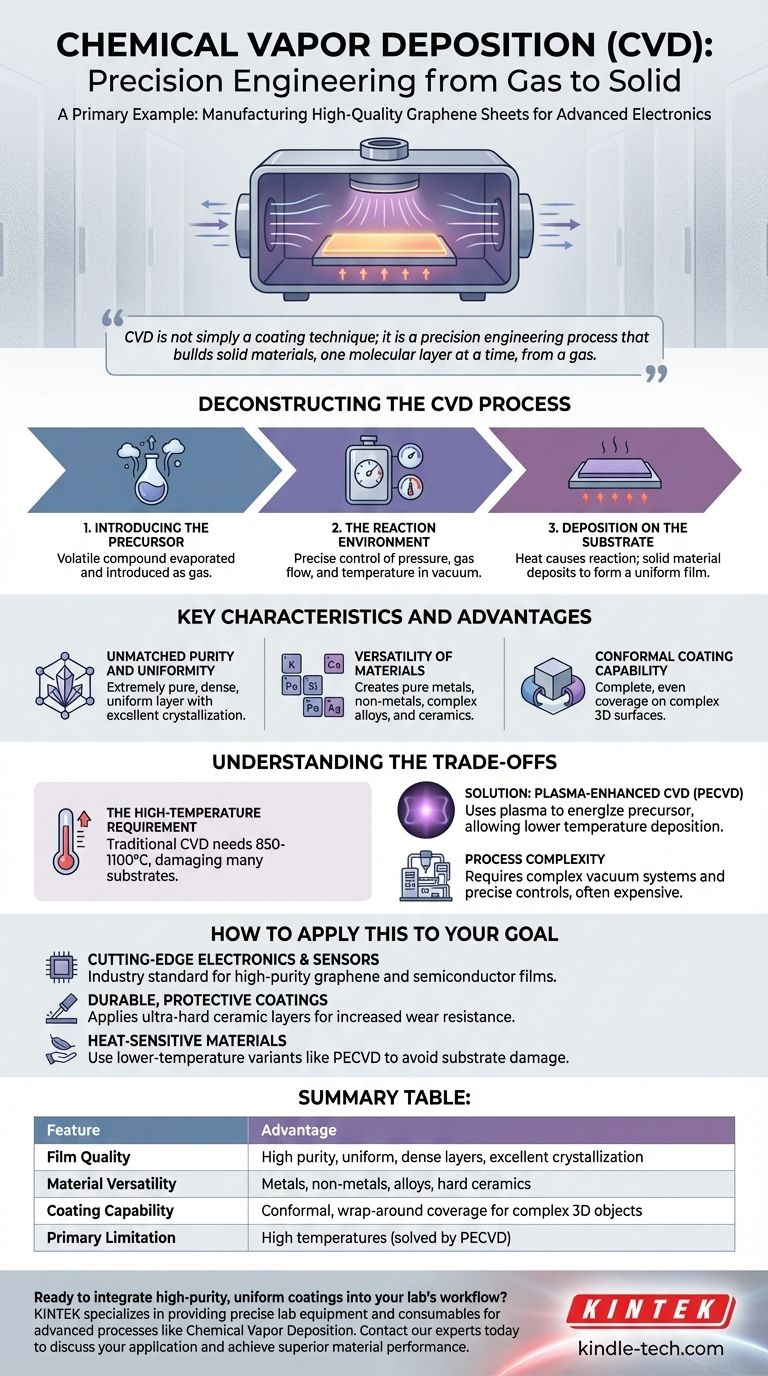
Deconstructing the CVD Process

At its core, Chemical Vapor Deposition is a method for creating a thin, solid film on a surface, known as a substrate. The entire process takes place under vacuum and relies on a precise sequence of events.

Step 1: Introducing the Precursor

A volatile compound, called a precursor, is the source material for the final film. This material is evaporated and introduced into a reaction chamber as a gas.

Step 2: The Reaction Environment

The precursor gas flows into a sealed chamber containing the substrate. The chamber's conditions—such as pressure, gas flow, and temperature—are meticulously controlled.

Step 3: Deposition on the Substrate

The substrate is heated to a specific reaction temperature. This energy causes the precursor gas to react or decompose, and the resulting solid material deposits onto the substrate's surface, forming a thin, uniform film.

Key Characteristics and Advantages

CVD is valued for its ability to produce films with specific, high-performance properties that are difficult to achieve with other methods.

Unmatched Purity and Uniformity

The controlled vacuum environment ensures the deposited film is extremely pure. Over time, the coating builds up evenly, resulting in a dense, uniform layer with excellent crystallization and low internal stress.

Versatility of Materials

CVD is incredibly versatile. The process can be adapted to create a wide variety of deposits, including pure metal films, non-metal films, complex alloys, and hard ceramic or compound layers.

Conformal Coating Capability

A key strength of CVD is its ability to create a "wrap-around" coating. The gaseous precursor can reach and deposit on all exposed surfaces of a complex, three-dimensional object, ensuring complete and even coverage.

Understanding the Trade-offs

While powerful, CVD is not without its limitations. Understanding these trade-offs is crucial for choosing the right manufacturing process.

The High-Temperature Requirement

Traditional thermal CVD often requires very high reaction temperatures, typically between 850-1100°C. Many substrate materials cannot withstand this level of heat without being damaged or melting.

The Solution: Lower-Temperature Variants

To overcome the heat limitation, specialized variants have been developed. Plasma-Enhanced CVD (PECVD), for example, uses plasma to energize the precursor gas, allowing the deposition to occur at much lower temperatures.

Process Complexity

The need for vacuum systems, precise temperature and gas flow control, and the handling of volatile precursor materials makes CVD a complex and often expensive process compared to simpler coating methods.

How to Apply This to Your Goal

Choosing the right deposition technique depends entirely on the desired outcome and the constraints of your material.

  • If your primary focus is cutting-edge electronics or sensors: CVD is the industry standard for producing the high-purity graphene and other semiconductor films essential for high-performance devices.
  • If your primary focus is creating durable, protective coatings: CVD is used to apply ultra-hard ceramic layers onto industrial tools and components, dramatically increasing their wear resistance and lifespan.
  • If your primary focus is working with heat-sensitive materials: You should investigate lower-temperature variants like PECVD to deposit high-quality films without damaging the underlying substrate.

Ultimately, chemical vapor deposition is a cornerstone technology that enables the fabrication of advanced materials from the atoms up.

Summary Table:

Feature Advantage
Film Quality High purity, uniform, dense layers with excellent crystallization
Material Versatility Deposits metals, non-metals, alloys, and hard ceramics
Coating Capability Conformal, wrap-around coverage for complex 3D objects
Primary Limitation Often requires high temperatures (solved by variants like PECVD)

Ready to integrate high-purity, uniform coatings into your lab's workflow?

KINTEK specializes in providing the precise lab equipment and consumables needed for advanced processes like Chemical Vapor Deposition. Whether you are developing cutting-edge electronics, creating durable protective coatings, or working with heat-sensitive materials, our solutions are designed to meet the demanding requirements of modern laboratories.

Contact our experts today to discuss how we can support your specific application and help you achieve superior material performance.

Visual Guide
Which is an example of chemical vapour deposition? The CVD Process for High-Performance Materials Visual Guide

Related Products

People Also Ask

Related Products

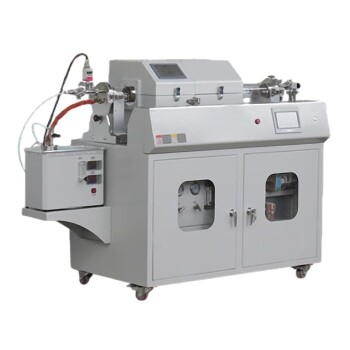
Inclined Rotary Plasma Enhanced Chemical Vapor Deposition PECVD Equipment Tube Furnace Machine

Inclined Rotary Plasma Enhanced Chemical Vapor Deposition PECVD Equipment Tube Furnace Machine

Upgrade your coating process with PECVD coating equipment. Ideal for LED, power semiconductors, MEMS and more. Deposits high-quality solid films at low temps.

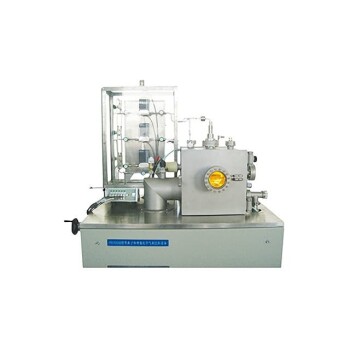
Chemical Vapor Deposition CVD Equipment System Chamber Slide PECVD Tube Furnace with Liquid Gasifier PECVD Machine

Chemical Vapor Deposition CVD Equipment System Chamber Slide PECVD Tube Furnace with Liquid Gasifier PECVD Machine

KT-PE12 Slide PECVD System: Wide power range, programmable temp control, fast heating/cooling with sliding system, MFC mass flow control & vacuum pump.

RF PECVD System Radio Frequency Plasma-Enhanced Chemical Vapor Deposition RF PECVD

RF PECVD System Radio Frequency Plasma-Enhanced Chemical Vapor Deposition RF PECVD

RF-PECVD is an acronym for "Radio Frequency Plasma-Enhanced Chemical Vapor Deposition." It deposits DLC (Diamond-like carbon film) on germanium and silicon substrates. It is utilized in the 3-12um infrared wavelength range.

Customer Made Versatile CVD Tube Furnace Chemical Vapor Deposition Chamber System Equipment

Customer Made Versatile CVD Tube Furnace Chemical Vapor Deposition Chamber System Equipment

Get your exclusive CVD furnace with KT-CTF16 Customer Made Versatile Furnace. Customizable sliding, rotating, and tilting functions for precise reactions. Order now!

Split Chamber CVD Tube Furnace with Vacuum Station Chemical Vapor Deposition System Equipment Machine

Split Chamber CVD Tube Furnace with Vacuum Station Chemical Vapor Deposition System Equipment Machine

Efficient split chamber CVD furnace with vacuum station for intuitive sample checking and quick cooling. Up to 1200℃ max temperature with accurate MFC mass flowmeter control.

Microwave Plasma Chemical Vapor Deposition MPCVD Machine System Reactor for Lab and Diamond Growth

Microwave Plasma Chemical Vapor Deposition MPCVD Machine System Reactor for Lab and Diamond Growth

Get high-quality diamond films with our Bell-jar Resonator MPCVD machine designed for lab and diamond growth. Discover how Microwave Plasma Chemical Vapor Deposition works for growing diamonds using carbon gas and plasma.

Cylindrical Resonator MPCVD Machine System Reactor for Microwave Plasma Chemical Vapor Deposition and Lab Diamond Growth

Cylindrical Resonator MPCVD Machine System Reactor for Microwave Plasma Chemical Vapor Deposition and Lab Diamond Growth

Learn about Cylindrical Resonator MPCVD Machine, the microwave plasma chemical vapor deposition method used for growing diamond gemstones and films in the jewelry and semi-conductor industries. Discover its cost-effective advantages over traditional HPHT methods.

Vacuum Hot Press Furnace Machine for Lamination and Heating

Vacuum Hot Press Furnace Machine for Lamination and Heating

Experience clean and precise lamination with Vacuum Lamination Press. Perfect for wafer bonding, thin-film transformations, and LCP lamination. Order now!

1200℃ Split Tube Furnace with Quartz Tube Laboratory Tubular Furnace

1200℃ Split Tube Furnace with Quartz Tube Laboratory Tubular Furnace

KT-TF12 split tube furnace: high-purity insulation, embedded heating wire coils, and max. 1200C. Widely used for new materials and chemical vapour deposition.

Vacuum Sealed Continuous Working Rotary Tube Furnace Rotating Tube Furnace

Vacuum Sealed Continuous Working Rotary Tube Furnace Rotating Tube Furnace

Experience efficient material processing with our vacuum-sealed rotary tube furnace. Perfect for experiments or industrial production, equipped with optional features for controlled feeding and optimized results. Order now.

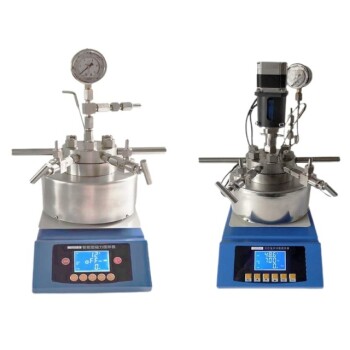
Mini SS High Pressure Autoclave Reactor for Laboratory Use

Mini SS High Pressure Autoclave Reactor for Laboratory Use

Mini SS High Pressure Reactor - Ideal for medicine, chemical, and scientific research industries. Programmed heating temp and stirring speed, up to 22Mpa pressure.

Customizable High Pressure Reactors for Advanced Scientific and Industrial Applications

Customizable High Pressure Reactors for Advanced Scientific and Industrial Applications

This laboratory-scale high-pressure reactor is a high-performance autoclave engineered for precision and safety in demanding research and development environments.

High Temperature Muffle Oven Furnace for Laboratory Debinding and Pre Sintering

High Temperature Muffle Oven Furnace for Laboratory Debinding and Pre Sintering

KT-MD High temperature debinding and pre-sintering furnace for ceramic materials with various molding processes. Ideal for electronic components such as MLCC and NFC.

High Pressure Laboratory Autoclave Reactor for Hydrothermal Synthesis

High Pressure Laboratory Autoclave Reactor for Hydrothermal Synthesis

Discover the applications of Hydrothermal Synthesis Reactor - a small, corrosion-resistant reactor for chemical labs. Achieve rapid digestion of insoluble substances in a safe and reliable way. Learn more now.

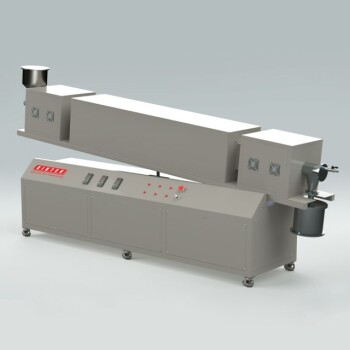
Laboratory Vacuum Tilt Rotary Tube Furnace Rotating Tube Furnace

Laboratory Vacuum Tilt Rotary Tube Furnace Rotating Tube Furnace

Discover the versatility of Laboratory Rotary Furnace: Ideal for calcination, drying, sintering, and high-temperature reactions. Adjustable rotating and tilting functions for optimal heating. Suitable for vacuum and controlled atmosphere environments. Learn more now!

Multi Zone Laboratory Quartz Tube Furnace Tubular Furnace

Multi Zone Laboratory Quartz Tube Furnace Tubular Furnace

Experience precise, efficient thermal testing with our Multi Zone Tube Furnace. Independent heating zones and temperature sensors allow for controlled high-temperature gradient heating fields. Order now for advanced thermal analysis!

Vacuum Heat Treat and Molybdenum Wire Sintering Furnace for Vacuum Sintering

Vacuum Heat Treat and Molybdenum Wire Sintering Furnace for Vacuum Sintering

A vacuum molybdenum wire sintering furnace is a vertical or bedroom structure, which is suitable for withdrawal, brazing, sintering and degassing of metal materials under high vacuum and high temperature conditions. It is also suitable for dehydroxylation treatment of quartz materials.

1800℃ Muffle Oven Furnace for Laboratory

1800℃ Muffle Oven Furnace for Laboratory

KT-18 muffle furnace with Japan Al2O3 polycrystalline fibe and Silicon Molybdenum heating element, up to 1900℃, PID temperature control and 7" smart touch screen. Compact design, low heat loss, and high energy efficiency. Safety interlock system and versatile functions.

1700℃ Controlled Atmosphere Furnace Nitrogen Inert Atmosphere Furnace

1700℃ Controlled Atmosphere Furnace Nitrogen Inert Atmosphere Furnace

KT-17A Controlled atmosphere furnace: 1700℃ heating, vacuum sealing technology, PID temperature control, and versatile TFT smart touch screen controller for laboratory and industrial use.

Vertical High Temperature Graphite Vacuum Graphitization Furnace

Vertical High Temperature Graphite Vacuum Graphitization Furnace

Vertical high temperature graphitization furnace for carbonization and graphitization of carbon materials up to 3100℃.Suitable for shaped graphitization of carbon fiber filaments and other materials sintered in a carbon environment.Applications in metallurgy, electronics, and aerospace for producing high-quality graphite products like electrodes and crucibles.


Leave Your Message