Knowledge vacuum induction melting furnace Which material is used in an induction furnace? The Critical Refractory Lining Guide
Author avatar

Tech Team · Kintek Solution

Updated 2 months ago

Which material is used in an induction furnace? The Critical Refractory Lining Guide


The most critical materials in an induction furnace are the refractories used for the lining, which contain the molten metal. These are primarily high-temperature ceramics like magnesia (MgO), dolomite, and alumina (Al₂O₃). The specific material is chosen based on its ability to withstand extreme heat and resist chemical reactions with the specific metal being melted.

The function of an induction furnace—to melt metal cleanly and efficiently—dictates its material composition. The choice of lining is not arbitrary; it is a precise engineering decision based on thermal resistance, chemical compatibility with the metal charge, and operational cost.
Which material is used in an induction furnace? The Critical Refractory Lining Guide

The Anatomy of an Induction Furnace

An induction furnace works by using powerful electromagnetic fields to heat and melt metal. Its construction materials are therefore chosen for two primary functions: containing extreme heat and interacting properly with these powerful fields.

The Heart of the Furnace: The Refractory Lining

The lining is the non-metallic ceramic layer that is in direct contact with the molten metal. Its job is to contain the liquid metal at temperatures that can exceed 1600°C (3000°F) and to thermally insulate the rest of the furnace structure.

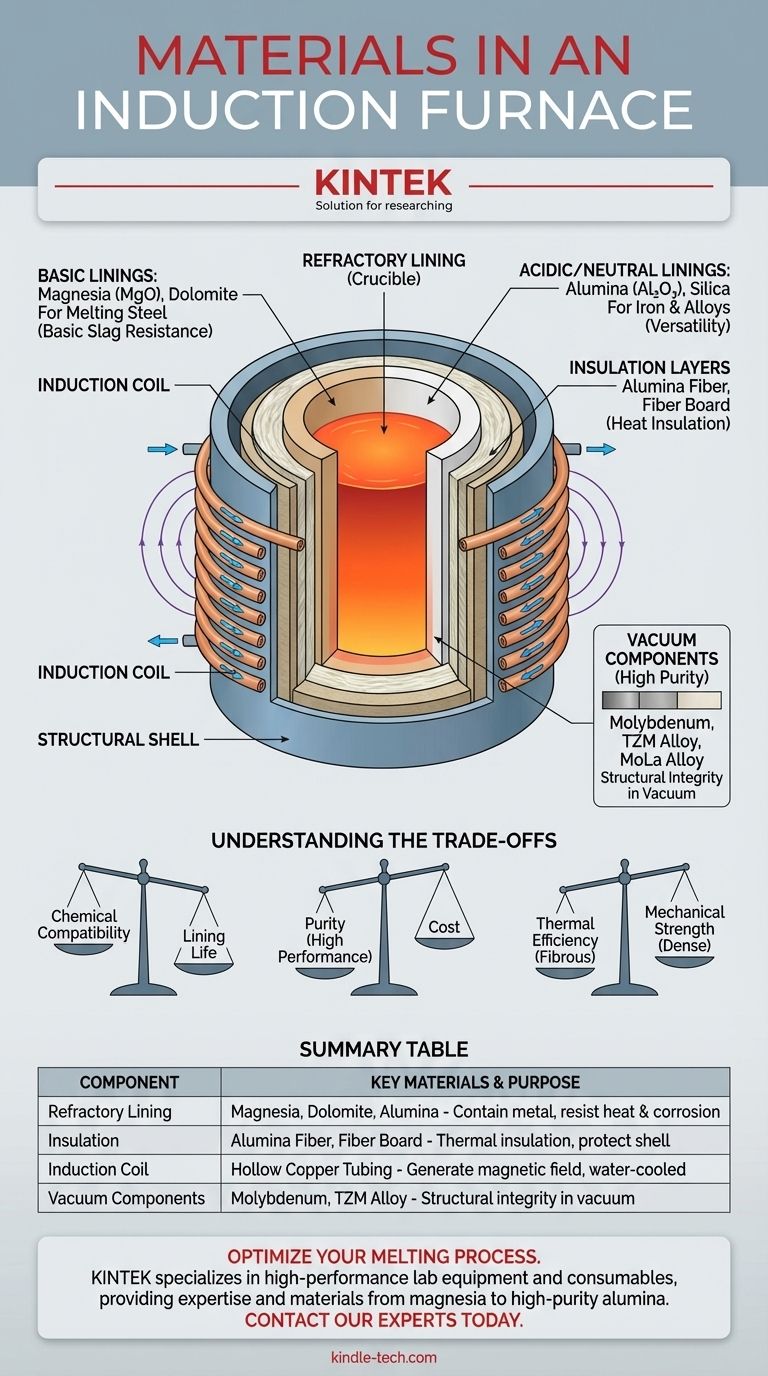
Basic Linings are used when melting steel. Materials like magnesia and dolomite are chemically "basic" and effectively resist the corrosive effects of the basic slag that forms on top of molten steel.

Acidic and Neutral Linings are used for other metals. High-purity alumina is a common neutral refractory used for a wide variety of ferrous and non-ferrous metals, including aluminum and copper alloys. Silica-based refractories are an "acidic" option often used for melting iron.

The Structural & Functional Components

Beyond the primary lining, other materials are essential for the furnace's operation and integrity.

Insulation Layers are typically found behind the main refractory lining. Materials like high-purity alumina fiber and vacuum-formed fiber board provide excellent thermal insulation. They have low heat storage, meaning the furnace can heat and cool more rapidly, and they protect the structural shell from the intense heat.

The Induction Coil is the component that generates the magnetic field. This is almost universally made from high-conductivity hollow copper tubing. Water is continuously circulated through the tubing to keep the coils from melting, as they are in close proximity to the intense heat of the charge. The refractory lining is what protects these vital coils.

Specialty Components for Vacuum Furnaces are required for high-purity melting applications. In a vacuum environment, certain structural elements might be made from metals with exceptionally high melting points, such as pure molybdenum, TZM (titanium-zirconium-molybdenum alloy), or molybdenum-lanthanum (MoLa) alloy.

Understanding the Trade-offs

Selecting the right materials involves balancing performance, lifespan, and cost. There is no single "best" material, only the most appropriate one for a specific task.

Chemical Compatibility vs. Lining Life

The most critical factor is the chemical interaction between the molten metal and the lining. Using an acidic lining (like silica) to melt a metal that produces a basic slag will result in rapid erosion and premature furnace failure. Matching the lining to the melt chemistry is non-negotiable for ensuring a reasonable campaign life.

Purity vs. Cost

High-purity refractory materials like fused magnesia or alumina offer superior performance and a longer lifespan but come at a significant cost. Lower-cost materials may be suitable for less demanding applications but will likely require more frequent maintenance and relining, leading to more downtime.

Thermal Efficiency vs. Mechanical Strength

Fibrous insulation materials are excellent at preventing heat loss but have no mechanical strength and cannot contain molten metal. Dense, sintered refractories provide the necessary strength and corrosion resistance but are less effective as insulators. A modern furnace uses a combination of both to achieve optimal performance.

Making the Right Choice for Your Application

Your choice of material should be driven entirely by the metal you are melting and your operational goals.

  • If your primary focus is melting steel: You must use a basic refractory lining, such as one based on magnesia (MgO), to withstand the basic slag.
  • If your primary focus is melting cast iron or non-ferrous alloys: An acidic (silica-based) or neutral (alumina-based) refractory will provide the best performance and lifespan.
  • If your primary focus is achieving maximum purity in a vacuum: You will need a high-quality neutral refractory lining and may require furnace components made from specialized metals like molybdenum or TZM.

Ultimately, the materials used in an induction furnace are a direct reflection of its intended purpose, engineered to control and contain one of the most extreme industrial processes.

Summary Table:

Component Key Materials & Their Purpose
Refractory Lining Magnesia (MgO), Dolomite, Alumina (Al₂O₃): Contain molten metal, resist extreme heat & chemical corrosion.
Insulation Alumina Fiber, Fiber Board: Provide thermal insulation, protect the furnace shell.
Induction Coil Hollow Copper Tubing: Generates the magnetic field; water-cooled to prevent melting.
Vacuum Components Molybdenum, TZM Alloy: Used in high-purity applications for structural integrity.

Optimize your melting process with the right materials. The correct refractory lining is critical for your induction furnace's efficiency, purity, and lifespan. KINTEK specializes in high-performance lab equipment and consumables, providing the expertise and materials—from basic magnesia to high-purity alumina linings—to meet your specific laboratory melting needs.

Contact our experts today to discuss the best furnace lining solution for your application.

Visual Guide
Which material is used in an induction furnace? The Critical Refractory Lining Guide Visual Guide

Related Products

People Also Ask

Related Products

600T Vacuum Induction Hot Press Furnace for Heat Treat and Sintering

600T Vacuum Induction Hot Press Furnace for Heat Treat and Sintering

Discover the 600T Vacuum Induction Hot Press Furnace, designed for high-temperature sintering experiments in vacuum or protected atmospheres. Its precise temperature and pressure control, adjustable working pressure, and advanced safety features make it ideal for nonmetal materials, carbon composites, ceramics, and metal powders.

Lab-Scale Vacuum Induction Melting Furnace

Lab-Scale Vacuum Induction Melting Furnace

Get precise alloy composition with our Vacuum Induction Melting Furnace. Ideal for aerospace, nuclear energy, and electronic industries. Order now for effective smelting and casting of metals and alloys.

Non Consumable Vacuum Arc Induction Melting Furnace

Non Consumable Vacuum Arc Induction Melting Furnace

Explore the benefits of Non-Consumable Vacuum Arc Furnace with high melting point electrodes. Small, easy to operate & eco-friendly. Ideal for laboratory research on refractory metals & carbides.

Vacuum Arc Induction Melting Furnace

Vacuum Arc Induction Melting Furnace

Discover the power of Vacuum Arc Furnace for melting active & refractory metals. High-speed, remarkable degassing effect, and free of contamination. Learn more now!

Controlled Nitrogen Inert Hydrogen Atmosphere Furnace

Controlled Nitrogen Inert Hydrogen Atmosphere Furnace

KT-AH Hydrogen atmosphere furnace - induction gas furnace for sintering/annealing with built-in safety features, dual housing design, and energy-saving efficiency. Ideal for lab and industrial use.

1700℃ Controlled Atmosphere Furnace Nitrogen Inert Atmosphere Furnace

1700℃ Controlled Atmosphere Furnace Nitrogen Inert Atmosphere Furnace

KT-17A Controlled atmosphere furnace: 1700℃ heating, vacuum sealing technology, PID temperature control, and versatile TFT smart touch screen controller for laboratory and industrial use.

1200℃ Controlled Atmosphere Furnace Nitrogen Inert Atmosphere Furnace

1200℃ Controlled Atmosphere Furnace Nitrogen Inert Atmosphere Furnace

Discover our KT-12A Pro Controlled atmosphere furnace - high precision, heavy duty vacuum chamber, versatile smart touch screen controller, and excellent temperature uniformity up to 1200C. Ideal for both laboratory and industrial application.

1400℃ Controlled Atmosphere Furnace with Nitrogen and Inert Atmosphere

1400℃ Controlled Atmosphere Furnace with Nitrogen and Inert Atmosphere

Achieve precise heat treatment with KT-14A controlled atmosphere furnace. Vacuum sealed with a smart controller, it's ideal for lab and industrial use up to 1400℃.

High Temperature Muffle Oven Furnace for Laboratory Debinding and Pre Sintering

High Temperature Muffle Oven Furnace for Laboratory Debinding and Pre Sintering

KT-MD High temperature debinding and pre-sintering furnace for ceramic materials with various molding processes. Ideal for electronic components such as MLCC and NFC.

Graphite Vacuum Furnace High Thermal Conductivity Film Graphitization Furnace

Graphite Vacuum Furnace High Thermal Conductivity Film Graphitization Furnace

The high thermal conductivity film graphitization furnace has uniform temperature, low energy consumption and can operate continuously.

1200℃ Split Tube Furnace with Quartz Tube Laboratory Tubular Furnace

1200℃ Split Tube Furnace with Quartz Tube Laboratory Tubular Furnace

KT-TF12 split tube furnace: high-purity insulation, embedded heating wire coils, and max. 1200C. Widely used for new materials and chemical vapour deposition.

Vertical High Temperature Graphite Vacuum Graphitization Furnace

Vertical High Temperature Graphite Vacuum Graphitization Furnace

Vertical high temperature graphitization furnace for carbonization and graphitization of carbon materials up to 3100℃.Suitable for shaped graphitization of carbon fiber filaments and other materials sintered in a carbon environment.Applications in metallurgy, electronics, and aerospace for producing high-quality graphite products like electrodes and crucibles.

Ultra-High Temperature Graphite Vacuum Graphitization Furnace

Ultra-High Temperature Graphite Vacuum Graphitization Furnace

The ultra-high temperature graphitization furnace utilizes medium frequency induction heating in a vacuum or inert gas environment. The induction coil generates an alternating magnetic field, inducing eddy currents in the graphite crucible, which heats up and radiates heat to the workpiece, bringing it to the desired temperature. This furnace is primarily used for graphitization and sintering of carbon materials, carbon fiber materials, and other composite materials.

Vacuum Heat Treat and Pressure Sintering Furnace for High Temperature Applications

Vacuum Heat Treat and Pressure Sintering Furnace for High Temperature Applications

Vacuum pressure sintering furnaces are designed for high temperature hot pressing applications in metal and ceramic sintering. Its advanced features ensure precise temperature control, reliable pressure maintenance, and a robust design for seamless operation.

Large Vertical Graphite Vacuum Graphitization Furnace

Large Vertical Graphite Vacuum Graphitization Furnace

A large vertical high-temperature graphitization furnace is a type of industrial furnace used for the graphitization of carbon materials, such as carbon fiber and carbon black. It is a high-temperature furnace that can reach temperatures of up to 3100°C.

Mesh belt controlled atmosphere furnace

Mesh belt controlled atmosphere furnace

Discover our KT-MB mesh belt sintering furnace - perfect for high-temperature sintering of electronic components & glass insulators. Available for open air or controlled atmosphere environments.

Laboratory Muffle Oven Furnace Bottom Lifting Muffle Furnace

Laboratory Muffle Oven Furnace Bottom Lifting Muffle Furnace

Efficiently produce batches with excellent temperature uniformity using our Bottom Lifting Furnace. Features two electric lifting stages and advanced temperature control up to 1600℃.

Horizontal High Temperature Graphite Vacuum Graphitization Furnace

Horizontal High Temperature Graphite Vacuum Graphitization Furnace

Horizontal Graphitization Furnace: This type of furnace is designed with the heating elements placed horizontally, allowing for uniform heating of the sample. It's well-suited for graphitizing large or bulky samples that require precise temperature control and uniformity.

Vertical Laboratory Tube Furnace

Vertical Laboratory Tube Furnace

Elevate your experiments with our Vertical Tube Furnace. Versatile design allows for operation under various environments and heat treatment applications. Order now for precise results!

Graphite Vacuum Furnace Bottom Discharge Graphitization Furnace for Carbon Materials

Graphite Vacuum Furnace Bottom Discharge Graphitization Furnace for Carbon Materials

Bottom-out graphitization furnace for carbon materials, ultra-high temperature furnace up to 3100°C, suitable for graphitization and sintering of carbon rods and carbon blocks. Vertical design, bottom discharging, convenient feeding and discharging, high temperature uniformity, low energy consumption, good stability, hydraulic lifting system, convenient loading and unloading.


Leave Your Message



















