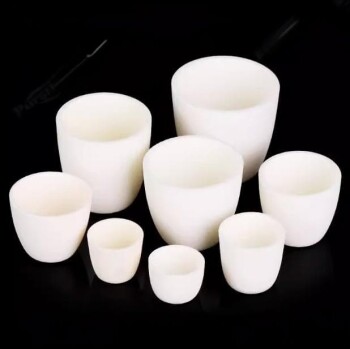
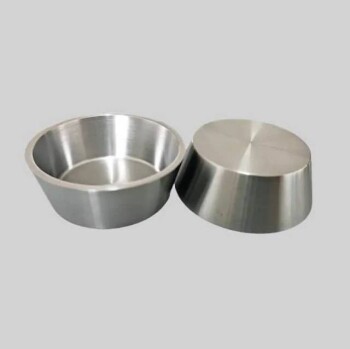
The combination of alumina crucibles and vertical electric furnaces provides the essential stability and inertness required for processing lithium borate (Li3BO3). Alumina withstands the corrosive nature of molten salts at 900°C to prevent contamination, while the vertical furnace delivers the thermal uniformity necessary to fully melt the material for glass precursor synthesis.
The success of this process relies on pairing chemical inertness with a stable temperature field. This setup guarantees the complete, impurity-free melting required to prepare materials for rapid quenching.
Why Alumina Crucibles are Essential
Withstanding Corrosive Environments
Molten salts like lithium borate are highly corrosive during the melting phase. Alumina crucibles are selected for their excellent high-temperature resistance, allowing them to safely contain these materials at processing temperatures around 900°C.
Preventing Sample Contamination
The primary goal in chemical synthesis is maintaining the integrity of the raw ingredients. Alumina is chosen for its chemical inertness, ensuring that no impurities from the crucible walls dissolve into the molten material.
The Function of the Vertical Electric Furnace
Providing a Stable Temperature Field
Consistency is critical during the heating process. A vertical electric furnace maintains a highly stable temperature field, which minimizes thermal gradients that could lead to uneven processing.
Achieving Complete Melting
For the synthesis to be successful, the raw materials must be fully melted. The precise thermal control of the vertical furnace ensures the entire batch reaches the liquid state, a necessary condition for chemical synthesis.
The Downstream Impact: Rapid Quenching
Preparing Glass Precursors
The ultimate objective of this specific melting process is the preparation of glass precursors. The heating phase is the prerequisite step that enables the material to be shaped or transformed later.
Enabling the Quench Phase
Successful rapid quenching demands a completely homogenized, liquid melt. The combination of the crucible and furnace ensures the material is in the exact physical state required to survive this rapid cooling process without defects.
Understanding the Process Criticalities
The Risk of Incomplete Melting
If the temperature field is unstable, the raw materials may not melt completely. This prevents the chemical synthesis from finishing, making the subsequent rapid quenching step impossible or ineffective.
The Consequence of Reactive Vessels
Using a crucible with lower resistance than alumina would likely lead to failure at 900°C. This would introduce impurities into the corrosive molten salt, ruining the chemical composition of the final glass precursor.
Making the Right Choice for Your Goal
To ensure the success of your lithium borate synthesis, align your equipment choices with your specific process requirements:
- If your primary focus is Chemical Purity: Rely on the inertness of alumina crucibles to prevent foreign impurities from degrading the molten salt.
- If your primary focus is Glass Preparation: Prioritize the stable temperature field of the vertical furnace to ensure the full melting required for effective rapid quenching.
By securing both chemical integrity and thermal stability, this equipment configuration creates the ideal foundation for synthesizing high-quality lithium borate glass precursors.
Summary Table:
| Component | Key Feature | Primary Role in Li3BO3 Melting |
|---|---|---|
| Alumina Crucible | Chemical Inertness | Prevents contamination from corrosive molten salts |
| Vertical Furnace | Stable Temperature Field | Ensures complete melting and thermal uniformity |
| Process Goal | Rapid Quenching | Prepares high-quality homogenized glass precursors |
| Operating Temp | 900°C Resistance | Maintains structural integrity under high heat |
Elevate Your Materials Research with KINTEK Precision
Achieving the perfect glass precursor requires equipment that stands up to the most corrosive environments. KINTEK specializes in high-performance laboratory solutions tailored for advanced chemical synthesis. From our ultra-stable vertical electric furnaces and muffle furnaces to high-purity alumina crucibles and ceramics, we provide the tools necessary for impurity-free lithium borate processing.
Whether you are scaling battery research with our high-pressure reactors or refining powders using our milling and sieving systems, KINTEK delivers the durability and thermal precision your lab demands.
Ready to optimize your melting and quenching workflows? Contact our technical experts today to find the perfect furnace and consumable configuration for your specific application.
Related Products
- Engineering Advanced Fine Ceramics Alumina Crucibles (Al2O3) for Thermal Analysis TGA DTA
- Engineering Advanced Fine Alumina Al2O3 Ceramic Crucible for Laboratory Muffle Furnace
- Engineering Advanced Fine Ceramics Alumina Al2O3 Crucible With Lid Cylindrical Laboratory Crucible
- Alumina Al2O3 Ceramic Crucible Semicircle Boat with Lid for Engineering Advanced Fine Ceramics
- Arc-Shaped Alumina Ceramic Crucible High Temperature Resistant for Engineering Advanced Fine Ceramics
People Also Ask
- Why Use Alumina Crucibles for TGA of Bicyclic Carbonates? Ensure Data Purity & Chemical Inertness
- Why are alumina crucibles and mother powder essential for LATP sintering? Optimize Your Solid Electrolyte Performance
- Why are high-purity alumina crucibles used for liquid lead corrosion experiments? Ensure Data Accuracy at 550°C
- What is the primary purpose of using alumina crucibles for LLTO ceramics? Optimize Your High-Temperature Sintering
- Why Use Alumina Crucibles & Powder Burial for NaSICON? Ensure Phase Purity and Prevent Elemental Volatilization