External pressure devices are fundamental components in the engineering of all-solid-state lithium-sulfur batteries, serving as the mechanical backbone for both assembly and operation.
These devices are necessary to apply continuous stack pressure that counteracts the significant volume expansion and contraction of the sulfur cathode during charge and discharge cycles. Without this external force, the solid electrode would physically separate from the solid electrolyte, severing ion transport channels and causing rapid battery failure.
The Core Insight In liquid batteries, the electrolyte naturally flows to fill gaps; in solid-state batteries, physical contact must be mechanically forced. External pressure is the only mechanism available to maintain the "solid-solid" interface required for ions to move between the cathode and anode, especially given the dynamic volume changes of sulfur.
The Physical Challenge of Solid-State Li-S
Managing Volume Expansion
Unlike stable intercalation materials, sulfur cathodes undergo drastic physical changes during cycling. As the battery charges and discharges, the active materials expand and contract significantly.
Without external constraint, this "breathing" creates void spaces. Pressure fixtures apply a counter-force to ensure the stack remains compact despite these fluctuations.
Preventing Delamination
When the sulfur cathode contracts, it tends to pull away from the solid electrolyte. This leads to delamination—a physical gap between layers.
Pressure cells maintain a tight squeeze on the stack. This prevents these gaps from forming, ensuring the layers remain effectively glued together by mechanical force.
Maintaining Ion Transport Channels
Lithium ions cannot travel through empty space (voids); they require a continuous solid path.
By minimizing microscopic voids at the interfaces, pressure devices reduce interfacial contact resistance. This ensures efficient ion transport across the rigid solid-solid boundary.
The Role of Pressure Across the Lifecycle
During Assembly: High-Pressure Densification
Before the battery is ever cycled, pressure is required to fabricate the cell components.
A laboratory hydraulic press is often used to apply very high pressure (up to 360 MPa) to electrode and electrolyte powders. This compresses them into dense, monolithic pellets, eliminating initial porosity and establishing the baseline contact required for the battery to function.
During Testing: Continuous "Stack" Pressure
Once assembled, the testing phase requires a different, sustained pressure strategy.
Test cells must maintain a constant, but often lower, pressure (typically 7–25 MPa, though ranges vary) throughout the cycling process. This dynamic pressure accommodates the structural changes of the sulfur without crushing the components.
Understanding the Trade-offs
The Risk of Lithium Creep
While pressure is vital, more is not always better.
Excessive pressure during operation can force the lithium metal anode to deform plastically, a phenomenon known as "creep." This can cause the lithium to penetrate the electrolyte layer, leading to internal short circuits and immediate cell failure.
Balancing Contact vs. Integrity
The engineering challenge lies in finding the "Goldilocks" zone.
You must apply enough pressure to maintain low contact resistance at the cathode, but low enough pressure to prevent lithium creep at the anode. Adjustable pressure fixtures are essential to fine-tune this balance.
Making the Right Choice for Your Goal
To maximize the performance of your all-solid-state lithium-sulfur prototypes, align your equipment with your specific process stage:
- If your primary focus is Cell Fabrication: Prioritize a hydraulic press capable of high-tonnage force (up to 360 MPa) to achieve maximum density and pore elimination in your powder pellets.
- If your primary focus is Cycle Life Testing: Prioritize adjustable pressure test cells that can maintain a consistent, moderate holding pressure (e.g., 5–25 MPa) to preserve interfacial contact without inducing short circuits.
Success in solid-state batteries is ultimately defined by your ability to mechanically stabilize the interface against the dynamic forces of chemistry.
Summary Table:
| Feature | Assembly Stage (Fabrication) | Testing Stage (Cycling) |
|---|---|---|
| Primary Goal | Powder Densification & Pore Removal | Interface Maintenance & Volume Management |
| Pressure Range | High (up to 360 MPa) | Moderate (7–25 MPa) |
| Device Type | Hydraulic Pellet Press | Adjustable Pressure Test Cells |
| Critical Risk | Insufficient Pellet Density | Lithium Creep & Short Circuits |
Elevate Your Battery Research with KINTEK Precision
Stabilizing the solid-solid interface is the greatest challenge in all-solid-state Li-S battery development. KINTEK provides the specialized engineering tools you need to master this mechanical hurdle. From high-tonnage hydraulic pellet presses for dense powder compaction to specialized pressure test cells for stable cycling, our equipment is designed for precision.
Whether you are focusing on high-temperature high-pressure reactors or refining battery consumables, our comprehensive range of laboratory solutions ensures your prototypes achieve peak performance. Contact KINTEK today to discuss how our crushing, milling, and pressing systems can optimize your battery assembly and testing workflow.
Related Products
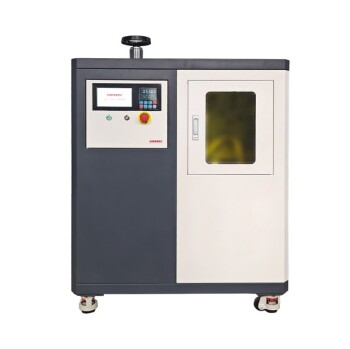
- Warm Isostatic Press for Solid State Battery Research
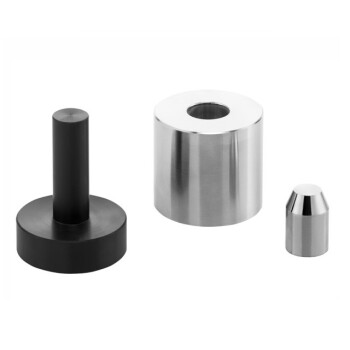
- Button Battery Tablet Press Sealing Mold for Lab Use
- Laboratory Hydraulic Press Lab Pellet Press for Button Battery
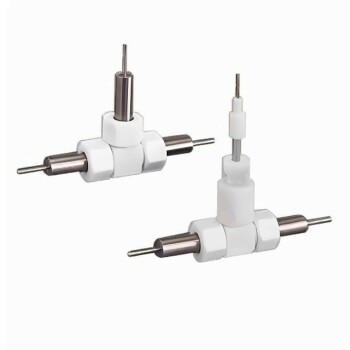
- Customizable Swagelok Type Test Cells for Advanced Battery Research Electrochemical Analysis
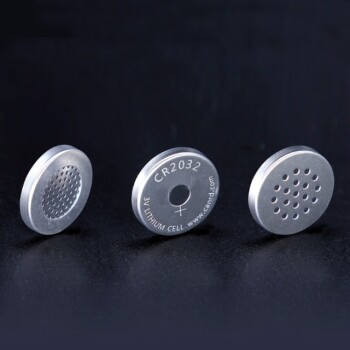
- Li-Air Battery Case for Battery Lab Applications
People Also Ask
- What is the temperature of a warm isostatic press? Achieve Optimal Densification for Your Materials
- What is the function of a Warm Isostatic Press (WIP) in all-solid-state pouch cells? Optimize Battery Density
- Why are Warm Isostatic Presses (WIP) necessary for solid-state batteries? Achieve Atomic-Level Contact
- What advantages does a warm isostatic press offer over a traditional uniaxial press for Li6PS5Cl electrolyte sheets?
- How do warm isostatic presses improve dry electrode performance? Enhance ASSB Conductivity with Heat & Pressure