Knowledge Why are high-precision vacuum sintering furnaces preferred over traditional methods for biofunctional dental ceramics?
Author avatar

Tech Team · Kintek Solution

Updated 1 day ago

Why are high-precision vacuum sintering furnaces preferred over traditional methods for biofunctional dental ceramics?


High-precision vacuum sintering furnaces are the definitive choice for processing biofunctional dental ceramics because they simultaneously optimize structural density and chemical purity. By operating in an extremely low-pressure environment, these furnaces eliminate microscopic voids that weaken traditional ceramics and prevent the oxidation that compromises bioactive coatings.

The core advantage is the ability to resolve the conflict between strength and biology. Vacuum sintering maximizes mechanical reliability without degrading the delicate bioactive properties required for tissue integration.

The Critical Role of Atmosphere Control

Eliminating Microstructural Defects

Traditional sintering often traps pockets of gas between ceramic powder particles as they fuse. Vacuum sintering actively removes these gases, preventing the formation of residual bubbles and voids. This results in a material with near-theoretical density, which is essential for dental implants that must endure years of cyclic mechanical stress without fracturing.

Protecting Chemical Phase Purity

Biofunctional materials, such as hydroxyapatite or bioactive glass coatings, are chemically sensitive. In a standard atmosphere, these materials can suffer from oxidation or undesirable reactions with impurities. The vacuum environment acts as a shield, ensuring high phase purity. This preserves the material's biocompatibility and osteoconductivity (the ability to support bone growth), which are critical for clinical success.

Superior Mechanical Properties

Inhibiting Grain Growth

A major limitation of traditional "cold-press-sinter-repress" methods is grain coarsening, where grains can grow to 5–50 μm, weakening the material. Vacuum sintering, particularly when combined with hot pressing, effectively inhibits this growth. It maintains grain sizes in the nanometric range (20–400 nm), which significantly enhances wear resistance.

Enhanced Hardness and Durability

The control over grain size directly correlates to mechanical strength. By keeping the microstructure fine and uniform, vacuum processing can double the material's nanohardness (e.g., increasing from ~2.68 GPa to ~5.37 GPa). This ensures the dental restoration resists wear and tear in the harsh oral environment.

Lower Temperatures, Higher Density

Advanced vacuum techniques often utilize simultaneous mechanical pressure. This forces powder particles into a plastic state, filling internal pores more efficiently. Consequently, sintering can occur at lower temperatures and with shorter holding times, reducing thermal stress on the component while achieving superior densification compared to pressureless methods.

Understanding the Trade-offs

Capital Cost vs. Clinical Value

Traditional atmosphere furnaces have the lowest initial capital cost and are excellent for high-volume, less critical components. Vacuum furnaces represent a significantly higher investment. However, for biofunctional dental applications, the "cost" of traditional methods is paid in lower reliability and compromised biological performance.

Complexity vs. Simplicity

Traditional equipment utilizes well-understood variables and simple batch designs. Vacuum systems feature high mechatronic integration and require more sophisticated operation. While this increases complexity, it offers more accurate temperature measurement and process control, which is non-negotiable for medical-grade materials.

Making the Right Choice for Your Project

While traditional methods serve high-volume industrial needs, dental ceramics demand the specific environment that only vacuum sintering provides.

  • If your primary focus is Clinical Longevity: Choose vacuum sintering to maximize density and nanohardness, ensuring the implant survives decades of biting force.
  • If your primary focus is Biological Integration: Rely on vacuum processing to prevent oxidation of bioactive coatings like hydroxyapatite, ensuring successful bone bonding.
  • If your primary focus is Mass Production of Non-Critical Parts: Traditional atmosphere furnaces may suffice due to lower costs, provided the mechanical and biological demands are low.

Summary: Vacuum sintering transforms dental ceramics from simple solids into bioactive, structural components by eliminating the microscopic defects and impurities that lead to failure.

Summary Table:

Feature Traditional Sintering High-Precision Vacuum Sintering
Atmosphere Ambient/Protective Gas High Vacuum/Low Pressure
Microstructure Prone to residual voids/bubbles Near-theoretical density; no voids
Grain Size Control Higher risk of grain coarsening Inhibited growth (nanometric range)
Chemical Purity Risk of oxidation/contamination Shielded environment; high phase purity
Nanohardness Standard (~2.68 GPa) Significantly enhanced (~5.37 GPa)
Clinical Value Medium (Non-critical parts) High (Implants & biofunctional coatings)

Elevate Your Dental Material Standards with KINTEK

Don't compromise on the clinical longevity of your dental restorations. KINTEK specializes in advanced laboratory equipment, providing the high-precision vacuum and dental sintering furnaces required to achieve superior nanohardness and biological integration.

Our extensive portfolio—from dental and muffle furnaces to high-pressure reactors and ceramics—is designed to meet the rigorous demands of medical-grade material processing.

Ready to optimize your sintering process? Contact our experts today to find the perfect solution for your laboratory's needs!

Related Products

People Also Ask

Related Products

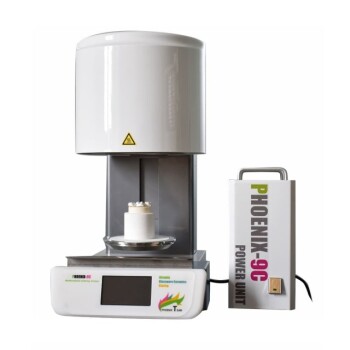
Vacuum Dental Porcelain Sintering Furnace

Vacuum Dental Porcelain Sintering Furnace

Get precise and reliable results with KinTek's Vacuum Porcelain Furnace. Suitable for all porcelain powders, it features hyperbolic ceramic furnace function, voice prompt, and automatic temperature calibration.

Dental Porcelain Zirconia Sintering Ceramic Vacuum Press Furnace

Dental Porcelain Zirconia Sintering Ceramic Vacuum Press Furnace

Get precise dental results with Dental Vacuum Press Furnace. Automatic temperature calibration, low noise tray, and touch screen operation. Order now!

Vacuum Heat Treat and Molybdenum Wire Sintering Furnace for Vacuum Sintering

Vacuum Heat Treat and Molybdenum Wire Sintering Furnace for Vacuum Sintering

A vacuum molybdenum wire sintering furnace is a vertical or bedroom structure, which is suitable for withdrawal, brazing, sintering and degassing of metal materials under high vacuum and high temperature conditions. It is also suitable for dehydroxylation treatment of quartz materials.

Vacuum Heat Treat and Sintering Furnace with 9MPa Air Pressure

Vacuum Heat Treat and Sintering Furnace with 9MPa Air Pressure

The air pressure sintering furnace is a high-tech equipment commonly used for the sintering of advanced ceramic materials. It combines vacuum sintering and pressure sintering techniques to achieve high-density and high-strength ceramics.

Vacuum Hot Press Furnace Heated Vacuum Press Machine Tube Furnace

Vacuum Hot Press Furnace Heated Vacuum Press Machine Tube Furnace

Reduce forming pressure & shorten sintering time with Vacuum Tube Hot Press Furnace for high-density, fine-grain materials. Ideal for refractory metals.

Vacuum Heat Treat Sintering Brazing Furnace

Vacuum Heat Treat Sintering Brazing Furnace

A vacuum brazing furnace is a type of industrial furnace used for brazing, a metalworking process that joins two pieces of metal using a filler metal that melts at a lower temperature than the base metals. Vacuum brazing furnaces are typically used for high-quality applications where a strong, clean joint is required.

High Pressure Laboratory Vacuum Tube Furnace Quartz Tubular Furnace

High Pressure Laboratory Vacuum Tube Furnace Quartz Tubular Furnace

KT-PTF High Pressure Tube Furnace: Compact split tube furnace with strong positive pressure resistance. Working temp up to 1100°C and pressure up to 15Mpa. Also works under controller atmosphere or high vacuum.

Laboratory Vacuum Tilt Rotary Tube Furnace Rotating Tube Furnace

Laboratory Vacuum Tilt Rotary Tube Furnace Rotating Tube Furnace

Discover the versatility of Laboratory Rotary Furnace: Ideal for calcination, drying, sintering, and high-temperature reactions. Adjustable rotating and tilting functions for optimal heating. Suitable for vacuum and controlled atmosphere environments. Learn more now!

Ultra-High Temperature Graphite Vacuum Graphitization Furnace

Ultra-High Temperature Graphite Vacuum Graphitization Furnace

The ultra-high temperature graphitization furnace utilizes medium frequency induction heating in a vacuum or inert gas environment. The induction coil generates an alternating magnetic field, inducing eddy currents in the graphite crucible, which heats up and radiates heat to the workpiece, bringing it to the desired temperature. This furnace is primarily used for graphitization and sintering of carbon materials, carbon fiber materials, and other composite materials.

Vacuum Heat Treat Furnace with Ceramic Fiber Liner

Vacuum Heat Treat Furnace with Ceramic Fiber Liner

Vacuum furnace with polycrystalline ceramic fiber insulation liner for excellent heat insulation and uniform temperature field. Choose from 1200℃ or 1700℃ max. working temperature with high vacuum performance and precise temperature control.

2200 ℃ Graphite Vacuum Heat Treat Furnace

2200 ℃ Graphite Vacuum Heat Treat Furnace

Discover the power of the KT-VG Graphite Vacuum Furnace - with a maximum working temperature of 2200℃, it's perfect for vacuum sintering of various materials. Learn more now.

600T Vacuum Induction Hot Press Furnace for Heat Treat and Sintering

600T Vacuum Induction Hot Press Furnace for Heat Treat and Sintering

Discover the 600T Vacuum Induction Hot Press Furnace, designed for high-temperature sintering experiments in vacuum or protected atmospheres. Its precise temperature and pressure control, adjustable working pressure, and advanced safety features make it ideal for nonmetal materials, carbon composites, ceramics, and metal powders.

Mesh belt controlled atmosphere furnace

Mesh belt controlled atmosphere furnace

Discover our KT-MB mesh belt sintering furnace - perfect for high-temperature sintering of electronic components & glass insulators. Available for open air or controlled atmosphere environments.

Horizontal High Temperature Graphite Vacuum Graphitization Furnace

Horizontal High Temperature Graphite Vacuum Graphitization Furnace

Horizontal Graphitization Furnace: This type of furnace is designed with the heating elements placed horizontally, allowing for uniform heating of the sample. It's well-suited for graphitizing large or bulky samples that require precise temperature control and uniformity.

2200 ℃ Tungsten Vacuum Heat Treat and Sintering Furnace

2200 ℃ Tungsten Vacuum Heat Treat and Sintering Furnace

Experience the ultimate refractory metal furnace with our Tungsten vacuum furnace. Capable of reaching 2200℃, perfect for sintering advanced ceramics and refractory metals. Order now for high-quality results.

Vacuum Hot Press Furnace Machine Heated Vacuum Press

Vacuum Hot Press Furnace Machine Heated Vacuum Press

Discover the advantages of Vacuum Hot Press Furnace! Manufacture dense refractory metals & compounds, ceramics, and composites under high temp and pressure.

Graphite Vacuum Furnace Bottom Discharge Graphitization Furnace for Carbon Materials

Graphite Vacuum Furnace Bottom Discharge Graphitization Furnace for Carbon Materials

Bottom-out graphitization furnace for carbon materials, ultra-high temperature furnace up to 3100°C, suitable for graphitization and sintering of carbon rods and carbon blocks. Vertical design, bottom discharging, convenient feeding and discharging, high temperature uniformity, low energy consumption, good stability, hydraulic lifting system, convenient loading and unloading.

Graphite Vacuum Furnace High Thermal Conductivity Film Graphitization Furnace

Graphite Vacuum Furnace High Thermal Conductivity Film Graphitization Furnace

The high thermal conductivity film graphitization furnace has uniform temperature, low energy consumption and can operate continuously.

Small Vacuum Heat Treat and Tungsten Wire Sintering Furnace

Small Vacuum Heat Treat and Tungsten Wire Sintering Furnace

The small vacuum tungsten wire sintering furnace is a compact experimental vacuum furnace specially designed for universities and scientific research institutes. The furnace features a CNC welded shell and vacuum piping to ensure leak-free operation. Quick-connect electrical connections facilitate relocation and debugging, and the standard electrical control cabinet is safe and convenient to operate.

Molybdenum Vacuum Heat Treat Furnace

Molybdenum Vacuum Heat Treat Furnace

Discover the benefits of a high-configuration molybdenum vacuum furnace with heat shield insulation. Ideal for high-purity, vacuum environments like sapphire crystal growth and heat treatment.


Leave Your Message