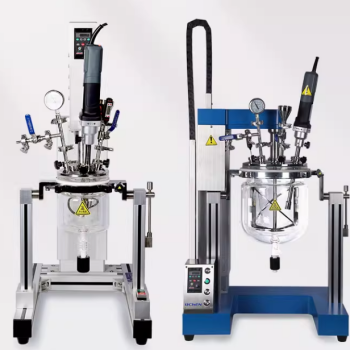
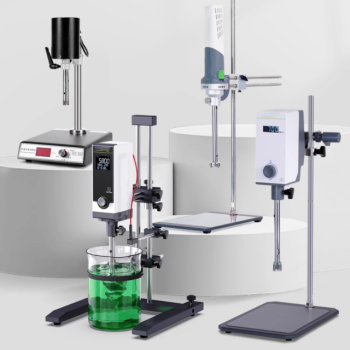
Uniform dispersion is the critical success factor when preparing composite photosensitive resins. Industrial homogenizers or ultrasonic dispersion devices are required because fillers—such as carbon nanotubes, ceramic particles, or bioactive materials—naturally tend to clump together. These devices apply extreme shear forces to break these agglomerates, preventing processing failures and ensuring the final material performs as intended.
Core Insight: Without high-energy homogenization, composite resins suffer from particle agglomeration that causes nozzle clogging and unpredictable print failures. Proper dispersion is the only way to achieve the uniform micro-distribution necessary for reliable electrical, thermal, and mechanical performance.
The Challenge of Particle Agglomeration
The Natural Tendency to Clump
Composite resins are rarely simple mixtures. They often contain advanced fillers like carbon nanotubes or ceramic particles.
These materials have a high surface energy, causing them to stick together to form clusters or "agglomerates" rather than floating freely.
Impact on Viscosity and Equipment
When these clumps remain in the resin, they cause significant viscosity fluctuations. The liquid becomes inconsistent, flowing easily in some areas and resisting flow in others.
In additive manufacturing contexts, these agglomerates are a primary cause of nozzle clogging, which can instantly halt production and damage expensive equipment.
The Role of High-Shear Processing
Applying Extreme Force
Simple stirring is insufficient for these advanced materials. Industrial homogenizers use extreme shear forces to physically tear particle clusters apart.
This process ensures that the fillers are broken down to their intended scale and distributed evenly throughout the liquid matrix.
Enhancing Resin Stability
The goal of this intense processing is resin stability.
By thoroughly dispersing the particles, the device creates a suspension that remains consistent over time, rather than separating back into layers of filler and resin.
Achieving Isotropic Properties
Uniform Micro-Distribution
For a printed part to work correctly, the material must be the same throughout. This is known as uniform micro-distribution.
If the filler is bunched up in one corner of the part, the rest of the part lacks the intended reinforcement.
Consistent Performance in All Directions
Homogenization ensures the printed parts exhibit isotropic properties.
Whether you are aiming for electrical conductivity, thermal conductivity, or mechanical reinforcement, the property will be consistent regardless of the direction in which it is measured.
Understanding the Trade-offs
The Necessity of "Extreme" Force
The primary reference notes that "extreme shear forces" are required. This indicates that standard mixing equipment will likely result in failure.
However, users must understand that this is a high-energy process. It is the only way to overcome the natural attraction between filler particles.
The Risk of Inadequate Dispersion
Attempting to bypass this step does not just lower quality; it often makes the material unprintable.
The trade-off is an investment in specialized equipment (homogenizers) versus the high cost of failed prints and clogged nozzles due to poor material preparation.
Making the Right Choice for Your Goal
To ensure your composite resin project succeeds, align your preparation method with your specific performance targets:
- If your primary focus is Process Reliability: Prioritize homogenization to eliminate agglomerates that cause viscosity fluctuations and nozzle clogging.
- If your primary focus is Material Performance: Use high-shear dispersion to guarantee the isotropic electrical, thermal, or mechanical properties required for the final application.
Ultimately, the stability of your resin and the quality of your final part are directly defined by the uniformity of your dispersion.
Summary Table:
| Feature | Impact of High-Shear Dispersion | Consequence of Poor Dispersion |
|---|---|---|
| Particle State | Uniform micro-distribution | Agglomeration and clumping |
| Viscosity | Stable and consistent | Fluctuating and unpredictable |
| Equipment Safety | Smooth flow, no clogging | Nozzle clogging and hardware damage |
| Material Properties | Isotropic (consistent in all directions) | Weak spots and performance failure |
| Resin Stability | Long-term suspension stability | Rapid phase separation |
Elevate Your Resin Performance with KINTEK Advanced Dispersion Solutions
Don't let particle agglomeration compromise your additive manufacturing results. KINTEK specializes in high-performance laboratory and industrial equipment designed for precision material science. Our industrial homogenizers, ultrasonic dispersion tools, and crushing and milling systems provide the extreme shear forces necessary to ensure your composite resins achieve perfect stability and isotropic properties.
From high-temperature furnaces and vacuum systems to specialized high-pressure reactors and homogenizers, KINTEK provides the comprehensive tools needed for advanced material research and production.
Ready to eliminate nozzle clogging and enhance material reliability?
Contact KINTEK today to find the perfect dispersion solution for your lab
References
- Lisa Jiaying Tan, Kun Zhou. Recent Progress on Polymer Materials for Additive Manufacturing. DOI: 10.1002/adfm.202003062
This article is also based on technical information from Kintek Solution Knowledge Base .
Related Products
- High Performance Lab Homogenizer for Pharma Cosmetics and Food R&D
- High Shear Homogenizer for Pharmaceutical and Cosmetic Applications
- Lab Sterile Slapping Type Homogenizer for Tissue Mashing and Dispersing
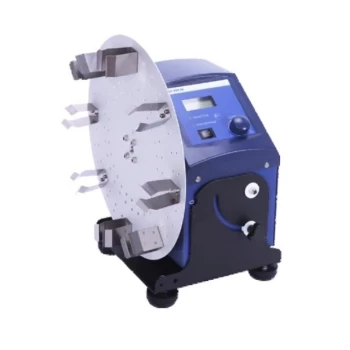
- Laboratory Disc Rotary Mixer for Efficient Sample Mixing and Homogenization
- Laboratory High Throughput Tissue Grinding Mill Grinder
People Also Ask
- Why is a high-performance homogenizer essential for Fe3O4@C9 anode slurries? Boost Battery Performance & Stability.
- What is the primary function of high-performance homogenizers for SAPO-34 MMMs? Ensure Superior Gas Separation Efficiency
- How do lab stirrers & homogenizers ensure uniform distribution? Optimize Your Complex Multiphase Chemical Mixing
- What role does a laboratory homogenizer play in radioactive cesium detection? Ensure Accuracy in Wildlife Sampling
- How does a laboratory automatic masticator or homogenizer facilitate the processing of biofilm samples? Optimize Accuracy