Knowledge Why are platinum-rhodium crucibles required for iron-substituted manganese oxide experiments? Ensure Precise Data
Author avatar

Tech Team · Kintek Solution

Updated 17 hours ago

Why are platinum-rhodium crucibles required for iron-substituted manganese oxide experiments? Ensure Precise Data


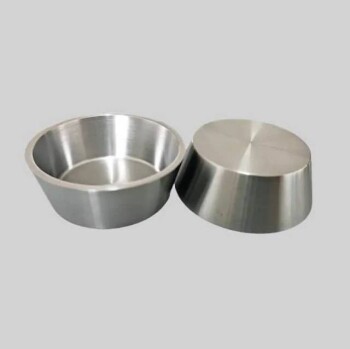
Platinum-rhodium crucibles are mandatory to ensure data integrity during high-temperature thermogravimetric experiments involving iron-substituted manganese oxide. These crucibles are required because they possess an extremely high melting point and superior chemical inertness, allowing them to withstand temperatures up to 1050 °C without reacting with the sample or corroding in an oxidizing atmosphere.

The use of platinum-rhodium eliminates container-related interference during data collection. By preventing reactions between the crucible and the sample, you ensure that any measured mass change is solely due to the oxygen exchange of the iron-substituted manganese oxide, guaranteeing the validity of your kinetic analysis.

The Necessity of Chemical Inertness

Preventing Sample Contamination

When dealing with reactive metal oxides like iron-substituted manganese oxide, the choice of container is critical. Standard crucibles may react chemically with the sample at elevated temperatures.

Platinum-rhodium crucibles are chemically inert in these specific conditions. They do not react with the metal oxide samples, preserving the chemical stoichiometry of the material you are trying to study.

Withstanding High-Temperature Oxidation

The experiment requires temperatures reaching 1050 °C in an oxidizing environment. Many materials will degrade or corrode under this thermal stress.

Platinum-rhodium is selected specifically for its ability to resist corrosion under these harsh conditions. It maintains its structural integrity where other alloys might fail or introduce impurities into the melt.

Ensuring Accurate Kinetic Analysis

Isolating the Redox Reaction

The primary goal of these thermogravimetric experiments is to measure the redox reactions of the sample. This is observed through changes in mass.

If the crucible reacts with the oxygen or the sample, it introduces "phantom" mass changes. Platinum-rhodium ensures the measured mass changes are attributed solely to the sample's oxygen exchange.

Eliminating Experimental Noise

Kinetic analysis relies on precise data to model reaction rates. Any interference from the container creates noise that invalidates the results.

By using a crucible that remains inert at 1050 °C, you eliminate variables. This allows for a pure analysis of the iron-substituted manganese oxide's behavior without the need to correct for container reactivity.

Understanding the Trade-offs

Material Compatibility vs. Cost

While platinum-rhodium is the gold standard for high-temperature (1050 °C) reactive oxides, it is a significant investment. It is chosen only when absolute inertness at extreme heat is required.

Context-Dependent Selection

It is crucial not to over-specify equipment for every experiment. For example, lower-temperature processes (such as heat-treating NMC powders at 673 K) may only require high-purity alumina crucibles.

Alumina provides sufficient inertness for lower-temperature applications (approx. 400 °C) and prevents contamination of amorphous coatings. However, for the specific rigor of iron-substituted manganese oxide at 1050 °C, alumina may not offer the same level of performance as platinum-rhodium, highlighting the need to match the crucible exactly to the thermal and chemical demands of the experiment.

Making the Right Choice for Your Goal

When designing your thermal analysis experiment, select your crucible based on the specific interaction between temperature and sample reactivity.

  • If your primary focus is high-temperature redox kinetics (1050 °C): Use platinum-rhodium crucibles to prevent corrosion and ensure mass changes are caused strictly by oxygen exchange in the sample.
  • If your primary focus is moderate-temperature treatment (e.g., 673 K): Use high-purity alumina crucibles to provide a chemically inert environment that preserves sample purity without the expense of platinum alloys.

By aligning your crucible material with your thermal requirements, you ensure that your data reflects the true behavior of your sample, not the limitations of your equipment.

Summary Table:

Feature Platinum-Rhodium Crucible High-Purity Alumina Crucible
Max Operating Temp Up to 1600°C+ (Used at 1050°C) Typically up to 1700°C (Used at <700°C)
Chemical Inertness Superior (Resists metal oxide reactions) High (Ideal for non-reactive coatings)
Oxidation Resistance Excellent in oxidizing atmospheres Good
Primary Application High-temp redox kinetics & mass change Moderate-temp treatment (e.g., NMC powders)
Cost Profile High Investment / Premium Economical / Standard

Precision in thermal analysis begins with the right materials. KINTEK provides high-performance laboratory solutions tailored to your specific research needs. From specialized platinum-rhodium and high-purity alumina crucibles to advanced high-temperature furnaces (muffle, vacuum, and CVD) and high-pressure reactors, we empower researchers to achieve superior data integrity. Whether you are conducting complex battery research or kinetic studies on metal oxides, our expert team is ready to support your laboratory setup. Contact KINTEK today to optimize your experimental results!

References

  1. Nobuyuki Gokon, Fumiya Ohashi. Long-Term Thermal Cycling Test and Heat-Charging Kinetics of Fe-Substituted Mn2O3 for Next-Generation Concentrated Solar Power Using Thermochemical Energy Storage at High Temperatures. DOI: 10.3390/en15134812

This article is also based on technical information from Kintek Solution Knowledge Base .

Related Products

People Also Ask

Related Products

Alumina Al2O3 Ceramic Crucible Semicircle Boat with Lid for Engineering Advanced Fine Ceramics

Alumina Al2O3 Ceramic Crucible Semicircle Boat with Lid for Engineering Advanced Fine Ceramics

Crucibles are containers widely used for melting and processing various materials, and semicircular boat-shaped crucibles are suitable for special smelting and processing requirements. Their types and uses vary by material and shape.

Electron Beam Evaporation Coating Tungsten Crucible and Molybdenum Crucible for High Temperature Applications

Electron Beam Evaporation Coating Tungsten Crucible and Molybdenum Crucible for High Temperature Applications

Tungsten and molybdenum crucibles are commonly used in electron beam evaporation processes due to their excellent thermal and mechanical properties.

Arc-Shaped Alumina Ceramic Crucible High Temperature Resistant for Engineering Advanced Fine Ceramics

Arc-Shaped Alumina Ceramic Crucible High Temperature Resistant for Engineering Advanced Fine Ceramics

In the journey of scientific exploration and industrial production, every detail is crucial. Our arc-shaped alumina ceramic crucibles, with their excellent high temperature resistance and stable chemical properties, have become a powerful assistant in laboratories and industrial fields. They are made of high-purity alumina materials and manufactured through precision processes to ensure excellent performance in extreme environments.

Custom Machined and Molded PTFE Teflon Parts Manufacturer with PTFE Crucible and Lid

Custom Machined and Molded PTFE Teflon Parts Manufacturer with PTFE Crucible and Lid

PTFE crucibles, made from pure Teflon, offer chemical inertness and resistance from -196°C to 280°C, ensuring compatibility with a wide range of temperatures and chemicals. These crucibles feature machine-finished surfaces for easy cleaning and prevention of contamination, making them ideal for precise laboratory applications.

Evaporation Crucible for Organic Matter

Evaporation Crucible for Organic Matter

An evaporation crucible for organic matter, referred to as an evaporation crucible, is a container for evaporating organic solvents in a laboratory environment.

Engineering Advanced Fine Alumina Al2O3 Ceramic Crucible for Laboratory Muffle Furnace

Engineering Advanced Fine Alumina Al2O3 Ceramic Crucible for Laboratory Muffle Furnace

Alumina ceramic crucibles are used in some materials and metal melting tools, and flat-bottomed crucibles are suitable for melting and processing larger batches of materials with better stability and uniformity.

Engineering Advanced Fine Ceramics Alumina Crucibles (Al2O3) for Thermal Analysis TGA DTA

Engineering Advanced Fine Ceramics Alumina Crucibles (Al2O3) for Thermal Analysis TGA DTA

TGA/DTA thermal analysis vessels are made of aluminum oxide (corundum or aluminum oxide). It can withstand high temperature and is suitable for analyzing materials that require high temperature testing.

Electron Beam Evaporation Coating Gold Plating Tungsten Molybdenum Crucible for Evaporation

Electron Beam Evaporation Coating Gold Plating Tungsten Molybdenum Crucible for Evaporation

These crucibles act as containers for the gold material evaporated by the electron evaporation beam while precisely directing the electron beam for precise deposition.

Laboratory Vacuum Tilt Rotary Tube Furnace Rotating Tube Furnace

Laboratory Vacuum Tilt Rotary Tube Furnace Rotating Tube Furnace

Discover the versatility of Laboratory Rotary Furnace: Ideal for calcination, drying, sintering, and high-temperature reactions. Adjustable rotating and tilting functions for optimal heating. Suitable for vacuum and controlled atmosphere environments. Learn more now!

Platinum Auxiliary Electrode for Laboratory Use

Platinum Auxiliary Electrode for Laboratory Use

Optimize your electrochemical experiments with our Platinum Auxiliary Electrode. Our high-quality, customizable models are safe and durable. Upgrade today!

Electron Beam Evaporation Coating Oxygen-Free Copper Crucible and Evaporation Boat

Electron Beam Evaporation Coating Oxygen-Free Copper Crucible and Evaporation Boat

Electron Beam Evaporation Coating Oxygen-Free Copper Crucible enables precise co-deposition of various materials. Its controlled temperature and water-cooled design ensure pure and efficient thin film deposition.

Platinum Sheet Electrode for Laboratory and Industrial Applications

Platinum Sheet Electrode for Laboratory and Industrial Applications

Elevate your experiments with our Platinum Sheet Electrode. Crafted with quality materials, our safe and durable models can be tailored to fit your needs.

1400℃ Controlled Atmosphere Furnace with Nitrogen and Inert Atmosphere

1400℃ Controlled Atmosphere Furnace with Nitrogen and Inert Atmosphere

Achieve precise heat treatment with KT-14A controlled atmosphere furnace. Vacuum sealed with a smart controller, it's ideal for lab and industrial use up to 1400℃.

Platinum Sheet Electrode for Battery Lab Applications

Platinum Sheet Electrode for Battery Lab Applications

Platinum sheet is composed of platinum, which is also one of the refractory metals. It is soft and can be forged, rolled and drawn into rod, wire, plate, tube and wire.

Laboratory Jaw Crusher

Laboratory Jaw Crusher

Discover the small jaw crusher for efficient, flexible, and affordable crushing in labs and small mines. Ideal for coal, ores, and rocks. Learn more now!

Boron Nitride (BN) Crucible for Phosphorous Powder Sintered

Boron Nitride (BN) Crucible for Phosphorous Powder Sintered

Phosphorus powder sintered boron nitride (BN) crucible has a smooth surface, dense, pollution-free and long service life.

Electron Beam Evaporation Coating Conductive Boron Nitride Crucible BN Crucible

Electron Beam Evaporation Coating Conductive Boron Nitride Crucible BN Crucible

High-purity and smooth conductive boron nitride crucible for electron beam evaporation coating, with high temperature and thermal cycling performance.

Small Vacuum Heat Treat and Tungsten Wire Sintering Furnace

Small Vacuum Heat Treat and Tungsten Wire Sintering Furnace

The small vacuum tungsten wire sintering furnace is a compact experimental vacuum furnace specially designed for universities and scientific research institutes. The furnace features a CNC welded shell and vacuum piping to ensure leak-free operation. Quick-connect electrical connections facilitate relocation and debugging, and the standard electrical control cabinet is safe and convenient to operate.

Laboratory Oscillating Orbital Shaker

Laboratory Oscillating Orbital Shaker

Mixer-OT orbital shaker uses brushless motor, which can run for a long time. It is suitable for vibration tasks of culture dishes, flasks and beakers.

Desktop Fast Laboratory Autoclave Sterilizer 35L 50L 90L for Lab Use

Desktop Fast Laboratory Autoclave Sterilizer 35L 50L 90L for Lab Use

The desktop fast steam sterilizer is a compact and reliable device used for rapid sterilization of medical, pharmaceutical, and research items. It efficiently sterilizes surgical instruments, glassware, medicines, and resistant materials, making it suitable for various applications.


Leave Your Message