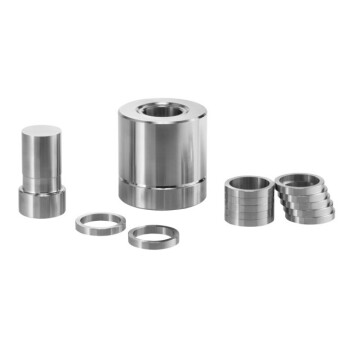
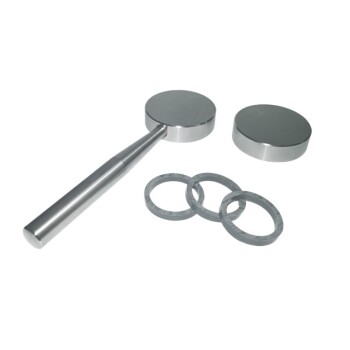
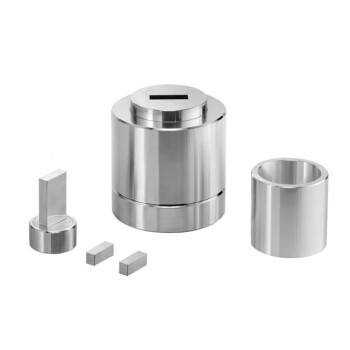
Precision powder pellet dies and hydraulic presses are required to transform loose Magnéli phase titanium oxide nano-powders into dense, cohesive disc-shaped specimens. By applying specific, controlled pressure—typically around 50 MPa—these tools create the necessary physical foundation for accurate analysis and enhanced material performance.
The mechanical compression provided by these tools is not merely about shaping the sample; it is a critical pretreatment that maximizes particle contact. This densification is essential for eliminating measurement errors and unlocking the material's full conductive potential during subsequent processing.
The Role of Compaction in Data Accuracy
The primary function of the hydraulic press and die assembly is to solve the physical limitations of raw nano-powders. Without significant compression, these powders exist as loose aggregates with substantial void space.
Increasing Physical Contact
The application of 50 MPa of pressure forces individual nano-particles into close proximity. This creates a dense, solid disc where particles are physically touching rather than being separated by air gaps.
Reducing Contact Resistance
For resistivity testing to be valid, the electrical current must flow through the material, not the voids between particles. High compression significantly reduces contact resistance between the powder grains. This ensures that subsequent resistivity data reflects the intrinsic properties of the titanium oxide, rather than the artifacts of a loosely packed sample.
Enhancing Material Properties During Heat Treatment
Beyond simple measurement accuracy, the granulation process plays a vital role in the chemical and physical evolution of the material during vacuum heat treatment.
Facilitating Structural Reorganization
The densification achieved by the press prepares the internal structure of the material for thermal processing. A compacted specimen allows for more efficient internal structural reorganization when exposed to heat, compared to a loose powder.
Promoting Electron Delocalization
Magnéli phase titanium oxide is valued for its conductivity, which relies on the movement of electrons. The dense packing of the specimen promotes electron delocalization. By minimizing the distance between atoms and grains, the process effectively enhances the overall conductivity of the material after the thermal treatment is complete.
Understanding the Precision Requirement
While the concept of pressing powder seems simple, the use of precision dies and controlled hydraulic pressure is non-negotiable.
The Importance of Specific Pressure
The reference specifically notes a pressure of 50 MPa. Applying random or uneven pressure would lead to inconsistent density across the specimen. This inconsistency would result in variable conductivity readings and incomplete structural reorganization, rendering the experiment unreliable.
Making the Right Choice for Your Goal
To achieve the best results with Magnéli phase titanium oxide, you must view the pressing stage as a fundamental part of the synthesis workflow, not just sample prep.
- If your primary focus is Data Integrity: Ensure your hydraulic press is calibrated to deliver consistent pressure (e.g., 50 MPa) to minimize contact resistance and noise in your resistivity readings.
- If your primary focus is Maximum Conductivity: Prioritize high-density compaction to facilitate the electron delocalization and structural changes necessary during vacuum heat treatment.
Controlled densification is the bridge between a raw powder and a high-performance conductive material.
Summary Table:
| Feature | Requirement | Benefit to Magnéli Phase Titanium Oxide |
|---|---|---|
| Applied Pressure | ~50 MPa | Ensures uniform densification and particle proximity |
| Tooling Type | Precision Powder Dies | Creates cohesive disc specimens for consistent measurement |
| Particle Contact | High Compression | Minimizes voids and reduces electrical contact resistance |
| Structural Impact | Densification | Facilitates electron delocalization and structural reorganization |
| Process Goal | Granulation | Prepares material for optimized vacuum heat treatment |
Elevate Your Material Research with KINTEK Precision
Precision is the foundation of breakthrough material science. At KINTEK, we specialize in providing the high-performance laboratory equipment necessary to transform raw nano-powders into high-performance conductive materials.
Whether you are working with Magnéli phase titanium oxide or advanced ceramics, our comprehensive range of manual and automatic hydraulic presses (pellet, hot, and isostatic) and precision powder pellet dies ensure the exact pressure control—like the 50 MPa required for your research—needed to minimize contact resistance and maximize data integrity.
Beyond compaction, KINTEK supports your entire workflow with:
- High-Temperature Furnaces: Muffle, tube, vacuum, and atmosphere furnaces for critical thermal treatments.
- Sample Preparation: Crushing, milling, and sieving systems for perfect powder consistency.
- Advanced Reactors: High-temperature high-pressure reactors and autoclaves for complex synthesis.
- Specialized Consumables: High-purity ceramics, crucibles, and PTFE products.
Ready to eliminate measurement errors and unlock the full potential of your materials? Contact KINTEK today to find the perfect pressing solution for your lab!
References
- Aditya Farhan Arif, Kikuo Okuyama. Highly conductive nano-sized Magnéli phases titanium oxide (TiOx). DOI: 10.1038/s41598-017-03509-y
This article is also based on technical information from Kintek Solution Knowledge Base .
Related Products
- Laboratory Hydraulic Press Lab Pellet Press Machine for Glove Box
- Automatic Laboratory Hydraulic Press for XRF & KBR Pellet Press
- Automatic Laboratory Hydraulic Pellet Press Machine for Lab Use
- Laboratory Hydraulic Pellet Press for XRF KBR FTIR Lab Applications
- kbr pellet press 2t
People Also Ask
- What is the function of a laboratory hydraulic press in W-Cu composites? Control Porosity and Material Ratio
- What is the role of a laboratory hydraulic press in the initial stages of Li6PS5Cl preparation? Key to Green Pellets
- What role does a laboratory hydraulic press play in triboelectric testing? Achieve Precision Alloy Sample Prep
- How can a laboratory hydraulic press be applied to chitosan for wastewater treatment? Optimize Pores & Strength
- How do a precision laboratory hydraulic press and specialized molds contribute to the fabrication of spherical ceramic samples? Achieving High-Density Material Precision