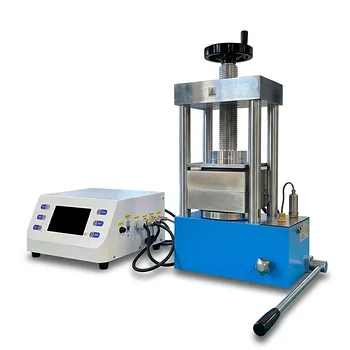
Specialized battery research tools are the critical bridge between raw material recovery and commercial validation. These instruments, such as hydraulic pellet presses and coin cell crimpers, are necessary because they allow researchers to fabricate standardized half-cells or full-cells with repeatable precision. Without the controlled pressure and hermetic sealing these tools provide, it is impossible to accurately measure specific capacity or cycle life, rendering the evaluation of regenerated graphite unreliable.
To prove that recycled graphite is viable, you must eliminate variables introduced by inconsistent fabrication. Specialized equipment ensures that any variation in performance is due to the graphite quality itself, not the testing method, allowing for a quantitative evaluation of the recycling process.
The Role of Precision in Fabrication
Achieving Uniform Electrode Density
To test regenerated graphite, it must first be formed into an electrode. Precision hydraulic pellet presses are essential for this step because they allow for the exact control of pressing pressure.
If the pressure is inconsistent, the density of the graphite electrode will vary across the sample. This inconsistency leads to skewed data regarding how well the material conducts ions, making it impossible to benchmark against virgin graphite.
Ensuring Chemical Integrity
Once the electrode is formed, it is assembled into a coin cell. Coin cell crimpers are used to mechanically seal the battery casing.
A precise crimp is vital to maintain the integrity of the cell seal. A compromised seal allows electrolyte to leak out or air to leak in, which causes immediate failure or accelerated degradation that has nothing to do with the quality of the recycled graphite.
Quantifying Performance Metrics
Measuring Specific Capacity
The ultimate goal of recycling graphite is to restore its energy storage capability. Multi-channel battery testing systems allow researchers to charge and discharge these cells repeatedly to measure specific capacity.
This data tells you exactly how much lithium the regenerated graphite can store. Without high-precision cycling equipment, you cannot detect the subtle capacity losses that distinguish high-quality recycled material from industrial waste.
Assessing Cycle Life and Rate Performance
Recovered materials must prove they can last. Testing systems monitor the cycle life, tracking how the graphite performs over hundreds of charge-discharge cycles.
They also measure rate performance, which indicates how well the graphite handles rapid charging. These quantitative metrics are the only way to objectively validate the reliability of the regeneration process.
Controlling Variables with Consumables
Isolating the Variable
To evaluate graphite, you must ensure it is the only variable changing in the experiment. This requires the use of high-purity consumables, such as lithium metal chips and standardized separators.
Eliminating False Negatives
Using substandard consumables introduces "noise" into the data. By using high-purity components alongside specialized tools, researchers ensure that if a cell fails, it is due to the regenerated graphite, not a defective separator or impure counter-electrode.
Understanding the Trade-offs
Lab-Scale vs. Production Reality
While coin cells are the industry standard for R&D, they represent a "best-case" scenario. Coin cells do not perfectly replicate the mechanical stresses of large-format EV batteries.
Data derived from these tools should be viewed as a material validation, not necessarily a full system validation.
Precision vs. Throughput
High-precision tools like hydraulic presses and multi-channel testers are time-consuming and often limit throughput. You trade speed for accuracy.
Attempting to rush this process by using manual methods or lower-precision tools will increase the error margin, potentially invalidating the proof of concept for the recycling technology.
Validating Your Recycling Process
Reliable data is the product of controlled variables. By investing in the right tooling, you move from theoretical recovery to proven performance.
- If your primary focus is Material Characterization: Prioritize the hydraulic pellet press to ensure uniform density and accurate specific capacity readings.
- If your primary focus is Long-Term Reliability: Prioritize high-quality crimpers and multi-channel testers to ensure seal integrity during extended cycle life testing.
Standardization in the lab is the only way to predict performance in the field.
Summary Table:
| Equipment Category | Specific Tool | Critical Role in Graphite Evaluation |
|---|---|---|
| Electrode Fabrication | Hydraulic Pellet Press | Ensures uniform electrode density for accurate ion conductivity benchmarking. |
| Cell Assembly | Coin Cell Crimper | Provides hermetic sealing to prevent electrolyte leakage and atmospheric contamination. |
| Performance Testing | Battery Testing System | Measures specific capacity, cycle life, and rate performance with quantitative precision. |
| Material Isolation | High-Purity Consumables | Eliminates external variables using standardized Li-metal chips, spacers, and separators. |
Elevate Your Battery Recycling Research with KINTEK
Transition from theoretical recovery to proven commercial performance with KINTEK’s specialized laboratory equipment. Our precision-engineered hydraulic pellet presses, coin cell assembly tools, and multi-channel battery testers are designed to eliminate fabrication variables, ensuring your regenerated graphite meets industry standards.
From high-temperature furnaces for graphite purification to homogenizers and high-purity consumables, KINTEK provides the comprehensive toolkit necessary for advanced material characterization.
Ready to validate your recycling process with repeatable, high-accuracy data? Contact KINTEK Today to Consult with Our Experts
References
- Yu Qiao, Yong Lei. Recycling of graphite anode from spent lithium‐ion batteries: Advances and perspectives. DOI: 10.1002/eom2.12321
This article is also based on technical information from Kintek Solution Knowledge Base .
Related Products
- Laboratory Hydraulic Pellet Press for XRF KBR FTIR Lab Applications
- Automatic Laboratory Hydraulic Pellet Press Machine for Lab Use
- Laboratory Manual Hydraulic Pellet Press for Lab Use
- Automatic Laboratory Hydraulic Press for XRF & KBR Pellet Press
- Laboratory Manual Hydraulic Pellet Press for Lab Use
People Also Ask
- What is the role of a laboratory hydraulic pellet press and stainless steel molds in the fabrication of RuO2/NbC anodes?
- How does a laboratory hydraulic pellet press contribute to SiCw/2024 aluminum composite preforms? Optimize Densification
- What is the necessity of using a laboratory hydraulic pellet press in the preparation of biomass fuel pellets? Guide
- What is the significance of applying 200 MPa of pressure with a laboratory hydraulic pellet press for composite ceramics?
- What key role does a laboratory pellet press play in FTIR analysis? Master KBr Sample Preparation Excellence