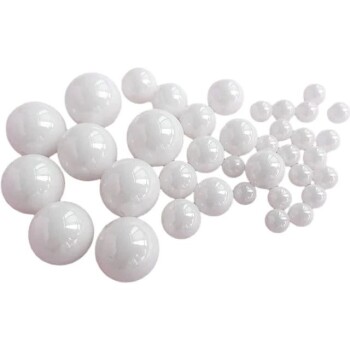
Zirconia grinding media are non-negotiable for this application because they uniquely solve the dual challenge of high-energy impact and chemical purity. Unlike stainless steel or softer ceramics, zirconia provides the necessary density to drive the mechanochemical reaction while acting as an inert barrier against metallic contamination that would otherwise ruin the electrolyte.
The mechanochemical synthesis of sulfide solid-state electrolytes requires a specific balance: enough force to induce a chemical reaction, but zero chemical interference. Zirconia is the industry standard because it delivers high impact energy through its density and hardness, while its chemical inertness prevents the introduction of conductive metal impurities that degrade ionic conductivity.
The Critical Need for Chemical Purity
Preventing Metallic Contamination
Sulfide solid electrolytes are extremely sensitive to impurities. Standard steel grinding jars shed microscopic metallic wear debris during high-energy milling.
These metallic particles are electrically conductive. If introduced into the electrolyte, they can cause internal short circuits or facilitate undesirable electron transport, ruining the material's function as a pure ion conductor.
Ensuring Chemical Inertness
Zirconia (ZrO2) is a chemically stable ceramic. It does not react with highly active sulfide precursors (such as Li2S or P2S5), even under the heat and pressure of milling.
This inertness ensures that the precursors react only with each other, rather than the container walls. This preserves the stoichiometry of the final compound and ensures consistent electrochemical stability.
Maintaining Ionic Conductivity
The primary goal of solid-state electrolytes is high lithium-ion conductivity. Impurities introduced during synthesis act as "roadblocks" to ion movement.
By using high-wear-resistant zirconia, you minimize the volume of foreign material entering the batch. This results in a purer final phase, directly translating to higher ionic conductivity.
Delivering Mechanical Energy
High Density for Effective Impact
Mechanochemistry relies on kinetic energy transfer ($E=1/2mv^2$) to break chemical bonds and form new compounds.
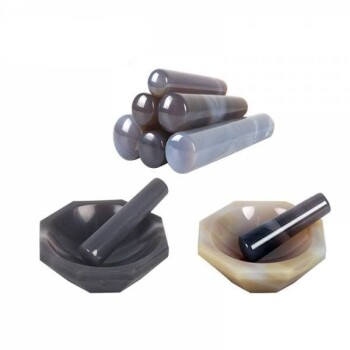
Zirconia is significantly denser than other ceramics like agate or alumina. This high density means the grinding balls carry more momentum, delivering the intense impact energy required to pulverize hard precursors.
Driving Amorphization
Many sulfide electrolytes require the formation of a glass or glass-ceramic phase to achieve optimal performance.
The extreme hardness of zirconia allows the media to withstand the intense, prolonged milling required to destroy the crystalline structure of precursors. This process, known as amorphization, creates the disordered structures often needed for fast ion transport.
Shortening Reaction Times
Because zirconia balls transfer energy so efficiently, they facilitate solid-phase reactions much faster than lighter media.
For complex syntheses like Li6PS5Cl, this efficiency is critical to ensure the reaction goes to completion without requiring excessive processing times.
Understanding the Trade-offs
Wear is Reduced, Not Eliminated
While zirconia has superior wear resistance, "wear resistant" does not mean "wear proof."
Under extreme high-energy conditions, minute amounts of zirconia may still abrade into the mixture. However, unlike steel, zirconia is an electrical insulator, making this contamination significantly less detrimental to the electrolyte's performance.
Cost vs. Necessity
High-quality, polished zirconia jars and balls are significantly more expensive than stainless steel or alumina.
However, in the context of sulfide electrolytes, this is not a flexible cost. The performance penalty of using cheaper alternatives (due to contamination or insufficient energy) renders the resulting material useless for high-performance battery applications.
Making the Right Choice for Your Goal
When setting up your synthesis protocol, consider your specific priorities:
- If your primary focus is Electrochemical Stability: Rely on zirconia's inertness to prevent metal doping, which creates leakage currents and reduces the voltage window.
- If your primary focus is Reaction Efficiency: Leverage the high density of zirconia balls to maximize impact energy, ensuring complete amorphization of precursors like Li2S and P2S5.
- If your primary focus is Material Purity: Use zirconia to eliminate the risk of side reactions between the milling media and reactive sulfide compounds.
Zirconia is the enabling tool that transforms raw chemical precursors into high-performance, conductive solid electrolytes without compromising their delicate chemical structure.
Summary Table:
| Feature | Zirconia (ZrO2) | Stainless Steel | Alumina (Al2O3) |
|---|---|---|---|
| Electrical Property | Insulator (Safe) | Conductive (Shorts) | Insulator (Safe) |
| Density | ~6.0 g/cm³ (High) | ~7.8 g/cm³ (High) | ~3.9 g/cm³ (Low) |
| Contamination Risk | Minimal/Non-conductive | High Metallic Debris | Medium Ceramic Wear |
| Chemical Inertness | High (Sulfide stable) | Low (Reacts with S) | Medium |
| Primary Benefit | Purity + High Energy | High Energy Only | Purity Only |
Optimize Your Battery Material Synthesis with KINTEK
Don't let metallic contamination compromise your solid-state electrolyte performance. KINTEK specializes in high-performance laboratory equipment and consumables designed for the most demanding research environments.
Our high-density zirconia grinding jars and balls provide the mechanical energy needed for amorphization while maintaining the chemical purity essential for ionic conductivity. Beyond milling, we offer a complete range of tools for advanced material science, including:
- High-Temperature Furnaces (Muffle, Tube, Vacuum, CVD/PECVD) for precise sintering.
- Hydraulic Presses (Pellet, Hot, Isostatic) for electrolyte pellet preparation.
- High-Pressure Reactors & Autoclaves for chemical synthesis.
- Battery Research Tools and specialized consumables like ceramic crucibles and PTFE products.
Ready to elevate your research results? Contact our technical experts today to find the perfect milling and thermal processing solution for your lab.
Related Products
- Laboratory Jar Ball Mill with Alumina Zirconia Grinding Jar and Balls
- Precision Machined Zirconia Ceramic Ball for Engineering Advanced Fine Ceramics
- Laboratory Jar Mill with Agate Grinding Jar and Balls
- Laboratory Ball Mill Jar Mill with Metal Alloy Grinding Jar and Balls
- Laboratory Micro Tissue Grinding Mill Grinder
People Also Ask
- What are the primary functions of using a ball mill for BZCY72 powder? Achieve High Purity and Enhanced Sintering
- In what way does a laboratory ball mill affect material properties when modifying PHBV/pulp fiber composites?
- Why is a laboratory ball mill required for ultra-fine fly ash? Unlock Nano-Scale Adsorption Power
- What is the function of a laboratory ball mill in the preparation of AMMCs? Optimize Dispersion & Grain Refinement
- What is the function of a laboratory ball mill in the pretreatment of waste tire char (WTC)? Optimize Material Reactivity