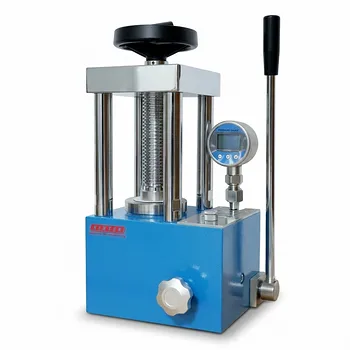
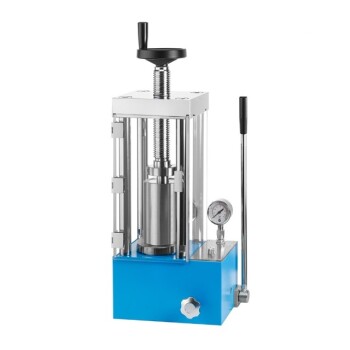
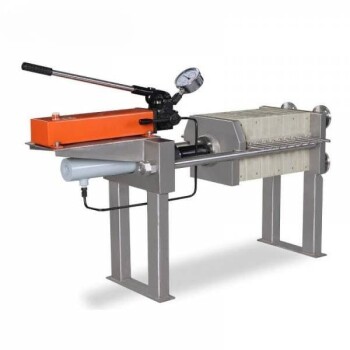
The application of 400 MPa is critical for overcoming inter-particle friction to achieve high green body density. For Zr2Al-GNS specifically, this high-pressure environment forces powder particles to rearrange, significantly reducing internal porosity. This creates the necessary physical structure to support the subsequent manufacturing steps without failure.
Core Takeaway Achieving a pressure of 400 MPa is not merely about shaping the material; it is the prerequisite for successful solid-phase diffusion. Without this high initial density, the material is liable to suffer from weak particle bonding, leading to deformation or cracking during sintering.
The Mechanics of Densification
Overcoming Mechanical Friction
Powder particles naturally resist tight packing due to surface friction.
A laboratory manual hydraulic press provides the necessary force to overcome this resistance. By applying 400 MPa, the press compels the particles to slide past one another and reorganize into a tighter configuration.
Reducing Internal Porosity
The primary physical result of this rearrangement is the significant reduction of void space.
High pressure eliminates large pores that would otherwise act as weak points in the material structure. This results in a green body with maximized density before heat is ever applied.
Facilitating the Sintering Process
Enabling Solid-Phase Diffusion
The success of the subsequent pressureless sintering phase relies entirely on particle proximity.
The 400 MPa pressing step ensures that particles are in tight, intimate contact. This proximity is vital for solid-phase diffusion, the mechanism by which the particles bond at the atomic level during heating.
Structural Stability During Heating
A dense green body is more dimensionally stable than a porous one.
Because the particles are already tightly packed, the ceramic is less likely to undergo drastic shrinkage or warping. This stability prevents the material from deforming or cracking as temperatures rise.
Understanding the Trade-offs
Equipment Requirements vs. Material Quality
Achieving 400 MPa requires robust laboratory equipment capable of delivering consistent force.
While lower pressures might be easier to achieve with standard equipment, they often fail to eliminate enough porosity. This can lead to a "green body" that is too fragile to handle or that fails to densify fully during sintering.
The Risk of Density Gradients
While high pressure increases overall density, friction against the mold walls can sometimes create uneven density distributions.
It is essential to ensure the press applies force uniformly. If density variations occur within the green body, they can lead to differential shrinkage and internal stresses during the sintering phase.
Making the Right Choice for Your Goal
To ensure the structural integrity of Zr2Al-GNS composites, consider the following priorities:
- If your primary focus is mechanical strength: Prioritize reaching the full 400 MPa to maximize particle contact and ensure effective solid-phase diffusion.
- If your primary focus is dimensional accuracy: Monitor the pressing speed and uniformity to prevent density gradients that could cause warping during sintering.
The precise application of high pressure is the foundational step that determines whether the final ceramic will be dense and durable or porous and brittle.
Summary Table:
| Parameter | Requirement | Role in Process |
|---|---|---|
| Target Pressure | 400 MPa | Overcomes particle friction and minimizes porosity |
| Material System | Zr2Al-GNS | Requires high densification for subsequent sintering |
| Key Mechanism | Solid-Phase Diffusion | Enabled by intimate particle contact under high pressure |
| Equipment Type | Manual Hydraulic Press | Provides robust, consistent force for structural integrity |
| Outcome | Dense Green Body | Prevents cracking, warping, and deformation during heating |
Maximize Your Material Density with KINTEK Precision
At KINTEK, we understand that the success of your Zr2Al-GNS composites depends on the precision and power of your initial pressing. Our robust range of laboratory hydraulic presses (pellet, hot, and isostatic) is engineered to deliver consistent pressures up to and beyond 400 MPa, ensuring your green bodies achieve the structural integrity needed for advanced sintering.
Whether you are working on battery research, advanced ceramics, or metallurgical applications, KINTEK provides a comprehensive suite of laboratory solutions—from high-temperature furnaces and milling systems to specialized autoclaves and electrolytic cells.
Ready to elevate your lab’s research capabilities? Contact our technical experts today to find the perfect pressing and sintering solution for your high-performance materials.
References
- Dumooa R. Hussein, Ahmed Al-Ghaban. Synthesizinge a novel Zr2Al-GNS MAX phase ceramic with superior electrical properties using pressureless sintering technique. DOI: 10.55730/1300-0527.3577
This article is also based on technical information from Kintek Solution Knowledge Base .
Related Products
- Laboratory Manual Hydraulic Pellet Press for Lab Use
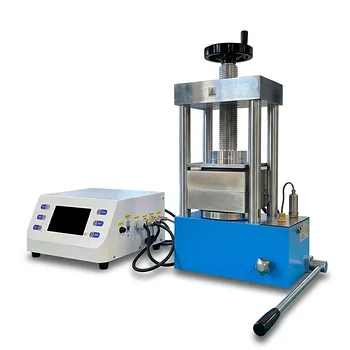
- Manual High Temperature Heated Hydraulic Press Machine with Heated Plates for Lab
- Laboratory Manual Hydraulic Pellet Press for Lab Use
- Manual Heated Hydraulic Press Machine with Heated Plates for Laboratory Hot Press
- Manual Lab Heat Press
People Also Ask
- What is the role of a laboratory hydraulic pellet press and stainless steel molds in the fabrication of RuO2/NbC anodes?
- What is the necessity of using a laboratory hydraulic pellet press in the preparation of biomass fuel pellets? Guide
- What is the significance of applying 200 MPa of pressure with a laboratory hydraulic pellet press for composite ceramics?
- How does a laboratory hydraulic pellet press contribute to SiCw/2024 aluminum composite preforms? Optimize Densification
- Why use laboratory manual hydraulic presses for semiconductor pellets? Optimize Annealing & Crystalline Quality