Knowledge Why is a ceramic crucible with a lid used for g-C3N4? Maximize Yield & Purity in Graphitic Carbon Nitride Synthesis
Author avatar

Tech Team · Kintek Solution

Updated 10 hours ago

Why is a ceramic crucible with a lid used for g-C3N4? Maximize Yield & Purity in Graphitic Carbon Nitride Synthesis


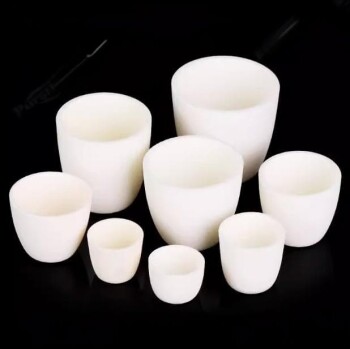
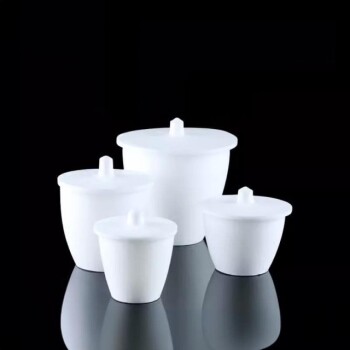
The use of a lidded ceramic crucible is a critical process control in the synthesis of graphitic carbon nitride (g-C3N4). By physically creating a semi-enclosed micro-atmosphere, the lid restricts the flow of oxygen to the precursor, preventing the material from burning away completely at high temperatures. Furthermore, it acts as a vapor barrier, retaining volatile intermediates to significantly improve the final yield and purity of the semiconductor.

The lid serves a dual purpose: it limits oxygen entry to prevent the precursor from combusting into ash, and it traps volatile byproducts to ensure a high-yield polymerization process.

Managing the Reaction Atmosphere

To understand the necessity of the lid, one must understand the volatility of the precursors used for g-C3N4, such as urea or melamine.

Creating a Self-Regulating Micro-Atmosphere

The primary function of the lid is to establish a closed micro-atmosphere within the crucible.

As the temperature rises, the precursor materials begin to decompose and release gases.

The lid traps these gases, allowing them to displace the ambient air inside the crucible. This creates a specific environment conducive to polymerization rather than combustion.

Preventing Oxidative Combustion

If exposed to the open air at pyrolysis temperatures (typically 500°C–600°C), organic precursors react aggressively with oxygen.

Without a lid, the excessive entry of oxygen leads to complete oxidative combustion.

Instead of forming the desired graphitic polymer, the precursor would simply burn off, leaving behind useless ash or converting entirely into gaseous oxides (like CO2 and NOx).

Optimizing Yield and Purity

Beyond preventing combustion, the lid plays a mechanical role in mass transfer, directly influencing how much product you recover.

Reducing Volatilization Loss

Many g-C3N4 precursors sublime or vaporize easily before they fully polymerize.

The lid physically acts as a baffle, reducing the volatilization loss of these reaction byproducts.

By keeping these vapors contained within the hot zone, the material has more time to react and condense into the solid graphitic structure.

Enhancing Product Purity

Open crucibles are susceptible to atmospheric contaminants and inconsistent airflow.

By stabilizing the internal environment, the lid ensures a more uniform heat distribution and reaction pathway.

This consistency results in a final product with higher purity, free from the defects caused by uncontrolled oxidation.

Understanding the Trade-offs

While using a lid is standard practice, it is important to understand the nuance of the "seal."

The Importance of Non-Hermetic Sealing

The goal is to restrict airflow, not to create a pressure vessel.

Ceramic crucibles generally have loose-fitting lids that allow excess pressure to escape while preventing turbulent air exchange.

A completely air-tight seal could lead to dangerous pressure buildup or inhibit the release of ammonia gases necessary for the condensation process.

Making the Right Choice for Your Goal

The configuration of your crucible is a simple variable that dictates the success of your synthesis.

  • If your primary focus is Maximizing Yield: Ensure the lid is properly seated to trap volatile intermediates and force them to participate in the reaction.
  • If your primary focus is Chemical Purity: Use the lid to shield the reaction from ambient oxygen, preventing surface oxidation and carbon burnout.

The lid is not merely a cover; it is a tool that shifts the thermodynamics of the system from combustion to polymerization, ensuring the successful formation of graphitic carbon nitride.

Summary Table:

Feature Function in g-C3N4 Synthesis Benefit to Final Product
Micro-Atmosphere Traps decomposition gases to displace oxygen Prevents oxidative combustion into ash
Vapor Barrier Reduces volatilization loss of precursors Significantly increases final material yield
Thermal Stability Ensures uniform heat and reaction pathways Enhances chemical purity and crystallinity
Non-Hermetic Seal Allows ammonia/pressure release Prevents pressure buildup during condensation

Elevate Your Materials Research with KINTEK Precision

Achieving the perfect graphitic carbon nitride synthesis requires more than just high temperatures—it requires the right environment. KINTEK specializes in providing high-performance laboratory solutions, from durable ceramic crucibles and lids to advanced high-temperature muffle and tube furnaces designed for precise pyrolysis control.

Whether you are focusing on battery research, photocatalysis, or advanced semiconductor development, our comprehensive range of crushing and milling systems, hydraulic presses, and specialized ceramics ensures your lab achieves repeatable, high-purity results.

Ready to optimize your synthesis yields? Contact our technical experts today to find the perfect equipment and consumables for your research goals!

References

  1. Chubraider Xavier, Eduardo Bessa Azevedo. Using a Surface-Response Approach to Optimize the Photocatalytic Activity of rGO/g-C3N4 for Bisphenol A Degradation. DOI: 10.3390/catal13071069

This article is also based on technical information from Kintek Solution Knowledge Base .

Related Products

People Also Ask

Related Products

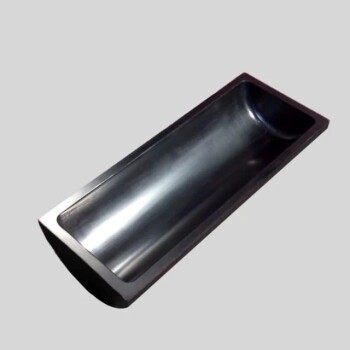
Arc-Shaped Alumina Ceramic Crucible High Temperature Resistant for Engineering Advanced Fine Ceramics

Arc-Shaped Alumina Ceramic Crucible High Temperature Resistant for Engineering Advanced Fine Ceramics

In the journey of scientific exploration and industrial production, every detail is crucial. Our arc-shaped alumina ceramic crucibles, with their excellent high temperature resistance and stable chemical properties, have become a powerful assistant in laboratories and industrial fields. They are made of high-purity alumina materials and manufactured through precision processes to ensure excellent performance in extreme environments.

Alumina Al2O3 Ceramic Crucible Semicircle Boat with Lid for Engineering Advanced Fine Ceramics

Alumina Al2O3 Ceramic Crucible Semicircle Boat with Lid for Engineering Advanced Fine Ceramics

Crucibles are containers widely used for melting and processing various materials, and semicircular boat-shaped crucibles are suitable for special smelting and processing requirements. Their types and uses vary by material and shape.

Engineering Advanced Fine Ceramics Alumina Al2O3 Crucible With Lid Cylindrical Laboratory Crucible

Engineering Advanced Fine Ceramics Alumina Al2O3 Crucible With Lid Cylindrical Laboratory Crucible

Cylindrical Crucibles Cylindrical crucibles are one of the most common crucible shapes, suitable for melting and processing a wide variety of materials, and are easy to handle and clean.

Engineering Advanced Fine Ceramics Alumina Crucibles (Al2O3) for Thermal Analysis TGA DTA

Engineering Advanced Fine Ceramics Alumina Crucibles (Al2O3) for Thermal Analysis TGA DTA

TGA/DTA thermal analysis vessels are made of aluminum oxide (corundum or aluminum oxide). It can withstand high temperature and is suitable for analyzing materials that require high temperature testing.

Engineering Advanced Fine Alumina Al2O3 Ceramic Crucible for Laboratory Muffle Furnace

Engineering Advanced Fine Alumina Al2O3 Ceramic Crucible for Laboratory Muffle Furnace

Alumina ceramic crucibles are used in some materials and metal melting tools, and flat-bottomed crucibles are suitable for melting and processing larger batches of materials with better stability and uniformity.

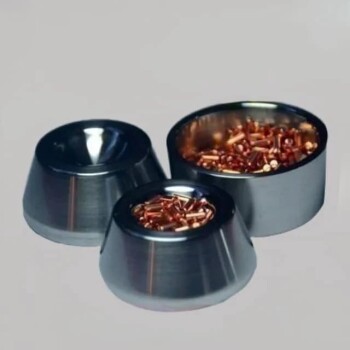
Electron Beam Evaporation Coating Tungsten Crucible and Molybdenum Crucible for High Temperature Applications

Electron Beam Evaporation Coating Tungsten Crucible and Molybdenum Crucible for High Temperature Applications

Tungsten and molybdenum crucibles are commonly used in electron beam evaporation processes due to their excellent thermal and mechanical properties.

Boron Nitride (BN) Crucible for Phosphorous Powder Sintered

Boron Nitride (BN) Crucible for Phosphorous Powder Sintered

Phosphorus powder sintered boron nitride (BN) crucible has a smooth surface, dense, pollution-free and long service life.

Custom Machined and Molded PTFE Teflon Parts Manufacturer with PTFE Crucible and Lid

Custom Machined and Molded PTFE Teflon Parts Manufacturer with PTFE Crucible and Lid

PTFE crucibles, made from pure Teflon, offer chemical inertness and resistance from -196°C to 280°C, ensuring compatibility with a wide range of temperatures and chemicals. These crucibles feature machine-finished surfaces for easy cleaning and prevention of contamination, making them ideal for precise laboratory applications.

Evaporation Crucible for Organic Matter

Evaporation Crucible for Organic Matter

An evaporation crucible for organic matter, referred to as an evaporation crucible, is a container for evaporating organic solvents in a laboratory environment.

Electron Beam Evaporation Coating Gold Plating Tungsten Molybdenum Crucible for Evaporation

Electron Beam Evaporation Coating Gold Plating Tungsten Molybdenum Crucible for Evaporation

These crucibles act as containers for the gold material evaporated by the electron evaporation beam while precisely directing the electron beam for precise deposition.

Electron Beam Evaporation Coating Conductive Boron Nitride Crucible BN Crucible

Electron Beam Evaporation Coating Conductive Boron Nitride Crucible BN Crucible

High-purity and smooth conductive boron nitride crucible for electron beam evaporation coating, with high temperature and thermal cycling performance.

Electron Beam Evaporation Coating Oxygen-Free Copper Crucible and Evaporation Boat

Electron Beam Evaporation Coating Oxygen-Free Copper Crucible and Evaporation Boat

Electron Beam Evaporation Coating Oxygen-Free Copper Crucible enables precise co-deposition of various materials. Its controlled temperature and water-cooled design ensure pure and efficient thin film deposition.

Glassy Carbon Electrochemical Electrode

Glassy Carbon Electrochemical Electrode

Upgrade your experiments with our Glassy Carbon Electrode. Safe, durable, and customizable to fit your specific needs. Discover our complete models today.

Molybdenum Disilicide (MoSi2) Thermal Elements Electric Furnace Heating Element

Molybdenum Disilicide (MoSi2) Thermal Elements Electric Furnace Heating Element

Discover the power of Molybdenum Disilicide (MoSi2) Heating Element for high-temperature resistance. Unique oxidation resistance with stable resistance value. Learn more about its benefits now!

Graphite Disc Rod and Sheet Electrode Electrochemical Graphite Electrode

Graphite Disc Rod and Sheet Electrode Electrochemical Graphite Electrode

High-quality graphite electrodes for electrochemical experiments. Complete models with acid and alkali resistance, safety, durability, and customization options.

Glassy Carbon Sheet RVC for Electrochemical Experiments

Glassy Carbon Sheet RVC for Electrochemical Experiments

Discover our Glassy Carbon Sheet - RVC. Perfect for your experiments, this high-quality material will elevate your research to the next level.

Custom PTFE Teflon Parts Manufacturer for Hydrothermal Synthesis Reactor Polytetrafluoroethylene Carbon Paper and Carbon Cloth Nano-growth

Custom PTFE Teflon Parts Manufacturer for Hydrothermal Synthesis Reactor Polytetrafluoroethylene Carbon Paper and Carbon Cloth Nano-growth

Acid and alkali resistant polytetrafluoroethylene experimental fixtures meet different requirements. The material is made of brand new polytetrafluoroethylene material, which has excellent chemical stability, corrosion resistance, airtightness, high lubricity and non-stickiness, electrical corrosion and good anti-aging ability, and can work for a long time at temperatures from -180℃ to +250℃.

Metal Disc Electrode Electrochemical Electrode

Metal Disc Electrode Electrochemical Electrode

Elevate your experiments with our Metal Disk Electrode. High-quality, acid and alkali resistant, and customizable to fit your specific needs. Discover our complete models today.

Twin Screw Extruder Plastic Granulation Machine

Twin Screw Extruder Plastic Granulation Machine

Twin screw extruder plastic granulation machine is designed for the mixing and processing experiments of engineering plastics, modified plastics, waste plastics and masterbatches.

Custom PTFE Teflon Parts Manufacturer for PTFE Mesh F4 Sieve

Custom PTFE Teflon Parts Manufacturer for PTFE Mesh F4 Sieve

PTFE mesh sieve is a specialized test sieve designed for particle analysis in various industries, featuring a non-metallic mesh woven from PTFE filament. This synthetic mesh is ideal for applications where metal contamination is a concern . PTFE sieves are crucial for maintaining the integrity of samples in sensitive environments, ensuring accurate and reliable results in particle size distribution analysis.


Leave Your Message