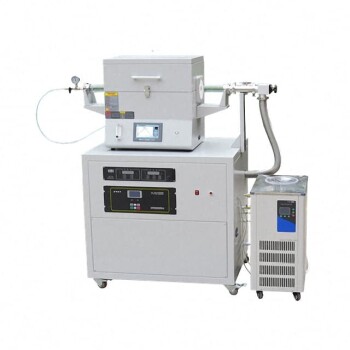
A differential tube reactor is utilized primarily to establish a highly controlled environment essential for precise iron nitride annealing. It allows for the rigorous regulation of flowing atmospheres—specifically pure nitrogen or hydrogen—and maintains distinct pressure levels ranging from 200 Pa to atmospheric pressure.
By simulating industrial conditions with high fidelity, this reactor type enables the accurate study of iron nitride phase transformation kinetics, ensuring that experimental results are both repeatable and directly applicable to real-world processing.
The Critical Role of Environmental Control
Precise Atmospheric Regulation
The chemical stability of iron nitride layers is heavily dependent on the surrounding gas composition.
A differential tube reactor allows researchers to introduce pure nitrogen or hydrogen into the annealing chamber.
This flowing atmosphere is critical for preventing unwanted oxidation or controlling specific reduction reactions during the experiment.
Variable Pressure Management
Investigating phase transformations requires testing under various pressure conditions.
The reactor offers the flexibility to operate at specific pressures, such as 200 Pa, or up to full atmospheric pressure.
This capability allows for a comprehensive understanding of how pressure variances influence the kinetics of the layer formation.
Ensuring Scientific Rigor
Thermal Stability
Accurate kinetic data depends on maintaining a consistent temperature throughout the annealing process.
The differential tube reactor provides a highly stable thermal environment.
This stability minimizes thermal gradients that could skew data regarding the rate of phase transformations.
Reliability and Repeatability
For research to be valuable, it must be reproducible.
The precise control over flow, pressure, and temperature ensures that experiments yield repeatable results.
This reliability is essential for defining the exact parameters required for successful iron nitride treatments.
Understanding the Trade-offs
Research Precision vs. Throughput
While this reactor is ideal for studying kinetics and phase transformations, it is a research-grade instrument.
It is designed to simulate industrial environments for analysis rather than to process high volumes of material.
The focus is on the fidelity of the simulation and data accuracy, prioritizing depth of understanding over mass production speed.
Making the Right Choice for Your Goal
To leverage a differential tube reactor effectively, align your experimental setup with your specific research objectives.
- If your primary focus is Fundamental Research: Utilize the pressure controls (e.g., 200 Pa) to isolate specific kinetic behaviors of iron nitride phase transformations.
- If your primary focus is Industrial Simulation: Configure the flowing atmosphere (N2 or H2) to mirror full-scale processing conditions to validate parameters before scaling up.
This apparatus is the definitive tool for researchers seeking to bridge the gap between theoretical kinetics and reliable industrial application.
Summary Table:
| Feature | Benefit for Iron Nitride Annealing |
|---|---|
| Atmospheric Control | Allows pure N2 or H2 flow to prevent oxidation and manage reduction. |
| Pressure Range | Flexible operation from 200 Pa to atmospheric for diverse kinetic testing. |
| Thermal Stability | Minimizes gradients to ensure accurate phase transformation data. |
| Simulation Fidelity | High-fidelity industrial environment simulation for repeatable research results. |
Elevate Your Material Research with KINTEK Precision
Ready to achieve unmatched scientific rigor in your annealing experiments? KINTEK specializes in advanced laboratory solutions designed for precision. Whether you are studying iron nitride kinetics or industrial phase transformations, our comprehensive range of high-temperature tube and vacuum furnaces, high-pressure reactors, and crushing and milling systems provide the reliability your research demands.
From PTFE consumables to isostatic hydraulic presses, we offer the tools needed to bridge the gap between theoretical kinetics and industrial application. Contact us today to optimize your lab's thermal processing capabilities!
References
- T. Frączek, Justyna Owczarek. Phase Transformations of Iron Nitrides during Annealing in Nitrogen and Hydrogen Atmosphere. DOI: 10.3390/coatings13111882
This article is also based on technical information from Kintek Solution Knowledge Base .
Related Products
- Customer Made Versatile CVD Tube Furnace Chemical Vapor Deposition Chamber System Equipment
- Split Chamber CVD Tube Furnace with Vacuum Station Chemical Vapor Deposition System Equipment Machine
- Multi Heating Zones CVD Tube Furnace Machine Chemical Vapor Deposition Chamber System Equipment
- Multi-zone Laboratory Tube Furnace
- Vertical Laboratory Tube Furnace
People Also Ask
- What is a CVD tube furnace? A Complete Guide to Thin-Film Deposition
- What is the function of a high-temperature CVD tube furnace in 3D graphene foam prep? Master 3D Nanomaterial Growth
- How does a CVD tube furnace inhibit the sintering of silver supports? Boost Membrane Durability and Performance
- What is the function of a tube furnace in CVD SiC synthesis? Achieving Ultra-Pure Silicon Carbide Powders
- What is the difference between hot wall CVD and cold wall CVD? Choose the Right System for Your Process