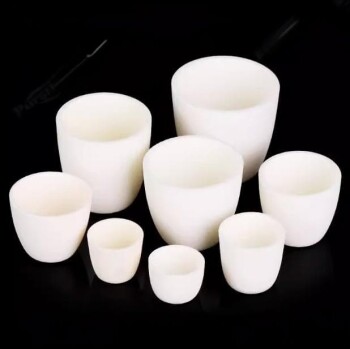
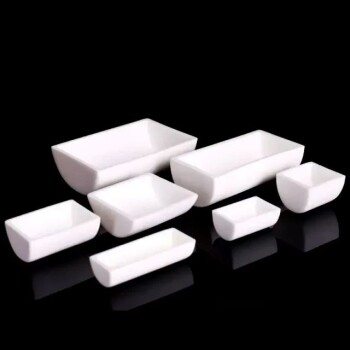
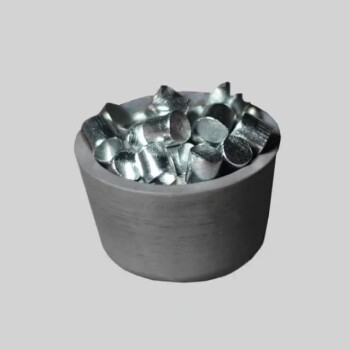
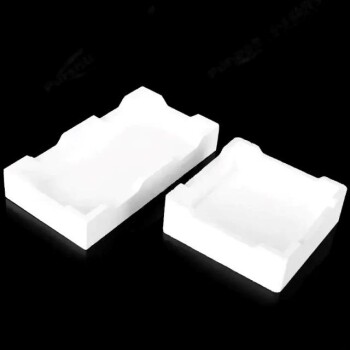
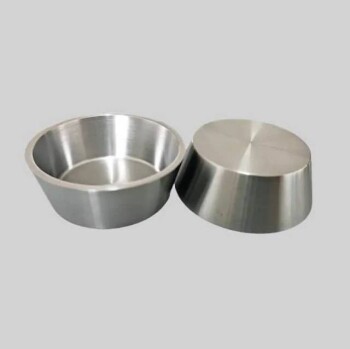
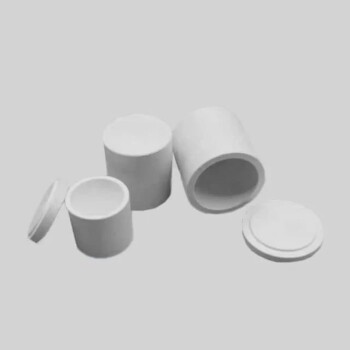
A fully closed alumina crucible is mandatory for this process primarily to prevent the evaporation of volatile raw materials while withstanding the 600°C calcination environment. Without a sealed vessel, material loss would alter the chemical composition of the mixture, making it impossible to achieve the necessary stoichiometric stability and accurate synthetic phases.
The core purpose of the closed crucible is to create a controlled micro-environment that strictly preserves the ratio of ingredients, ensuring the final Wollastonite/Colemanite compound is chemically pure and phase-accurate.
The Critical Role of Containment
Preventing Volatilization
At calcination temperatures of 600°C, specific components within the Wollastonite/Colemanite mixture are prone to evaporation.
If the crucible is left open, these volatile substances escape into the furnace atmosphere.
A fully closed lid physically traps these vapors, ensuring they remain available for the solid-state reaction.
Maintaining Stoichiometry
Stoichiometry refers to the precise quantitative relationship between reactants.
Because the synthesis relies on a specific ratio of Wollastonite to Colemanite, the loss of even a small amount of material through evaporation upsets this balance.
Using a closed crucible locks the "recipe" in place, preventing the final product from deviating from the intended chemical formula.
Enabling Accurate Phase Formation
The ultimate goal of calcination is to synthesize specific crystalline phases.
If the chemical composition shifts due to evaporation, the material may form unwanted secondary phases or fail to react completely.
The sealed environment ensures that the powder evolves into the correct single-phase compound.
Why Alumina is the Material of Choice
Thermal Resilience
Alumina (aluminum oxide) is selected for its exceptional ability to withstand high temperatures.
While this specific process occurs at 600°C, alumina remains stable well beyond 1000°C, providing a significant safety margin during the heating cycle.
Chemical Inertness
In solid-state synthesis, the vessel must not become part of the reaction.
Alumina is highly chemically stable, meaning it will not react with the Wollastonite or Colemanite powders.
This prevents the crucible walls from introducing impurities into the mix, ensuring the high purity of the final ceramic powder.
Understanding the Trade-offs
The Risk of "Open" Calcination
Using an open or loosely covered crucible is a common pitfall in stoichiometry-sensitive synthesis.
While it allows for easier gas release (like CO2 decomposition), in this specific context, the loss of volatile reactants outweighs the benefits of airflow.
An open vessel at 600°C effectively guarantees a deviation from the target phase composition.
Thermal Expansion Considerations
While a "fully closed" system is required, one must be aware of pressure buildup.
However, in standard powder calcination at 600°C, the fit of an alumina lid is generally sufficient to prevent massive pressure accumulation while still stopping bulk evaporation.
Making the Right Choice for Your Goal
To ensure the success of your Wollastonite/Colemanite synthesis, apply the following guidelines:
- If your primary focus is Phase Purity: Ensure the crucible lid creates a tight seal to maintain the exact stoichiometric ratio of the precursors.
- If your primary focus is Contamination Control: Verify you are using high-purity alumina to prevent diffusion of impurities from the crucible wall into the powder.
Precision in containment is the difference between a successful synthesis and a failed experiment.
Summary Table:
| Feature | Importance in Calcination at 600°C |
|---|---|
| Fully Closed Lid | Prevents evaporation of volatile materials and preserves stoichiometry. |
| Alumina Material | Offers high chemical inertness and thermal stability up to 1000°C+. |
| Micro-environment | Ensures accurate single-phase formation by locking in the chemical 'recipe'. |
| Contamination Control | Prevents crucible-powder reactions, ensuring high chemical purity. |
Elevate Your Material Synthesis with KINTEK Precision
Achieve uncompromising phase purity and stoichiometric stability in your lab. KINTEK specializes in high-performance laboratory equipment and consumables, providing the essential tools for advanced material research. Whether you need high-purity alumina crucibles, precision muffle or tube furnaces, or specialized high-pressure reactors, our solutions are designed to withstand rigorous thermal environments.
From battery research tools to crushing and milling systems, we empower researchers with the accuracy they demand. Contact KINTEK today to find the perfect equipment for your synthesis goals!
References
- Ethem İlhan Şahin, Mehriban Emek. Wollastanit/PANI/Kolemanit Kompozitlerin Elektromanyetik Kalkanlama Etkinliği. DOI: 10.31590/ejosat.816145
This article is also based on technical information from Kintek Solution Knowledge Base .
Related Products
- Arc-Shaped Alumina Ceramic Crucible High Temperature Resistant for Engineering Advanced Fine Ceramics
- Alumina Al2O3 Ceramic Crucible Semicircle Boat with Lid for Engineering Advanced Fine Ceramics
- Engineering Advanced Fine Ceramics Alumina Al2O3 Crucible With Lid Cylindrical Laboratory Crucible
- Engineering Advanced Fine Ceramics Alumina Crucibles (Al2O3) for Thermal Analysis TGA DTA
- Engineering Advanced Fine Alumina Al2O3 Ceramic Crucible for Laboratory Muffle Furnace
People Also Ask
- Why Use Alumina Crucibles & Powder Burial for NaSICON? Ensure Phase Purity and Prevent Elemental Volatilization
- What is the primary purpose of using alumina crucibles for LLTO ceramics? Optimize Your High-Temperature Sintering
- Why are alumina crucibles and mother powder essential for LATP sintering? Optimize Your Solid Electrolyte Performance
- Why are high-purity alumina crucibles used for liquid lead corrosion experiments? Ensure Data Accuracy at 550°C
- Primary considerations for choosing alumina crucibles and quartz tubes in indium intercalation: Ensure Material Purity