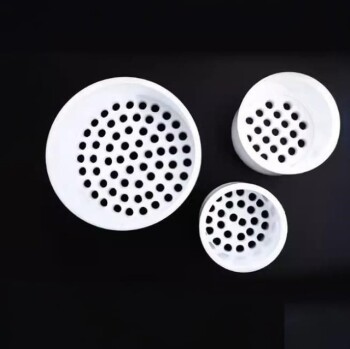
The use of a high-mesh microporous sieve is fundamentally about enforcing a strict upper limit on particle size, specifically to keep particles under 2 micrometers. This mechanical refinement dramatically increases the material's specific surface area, which is the primary driver for enhancing chemical reactivity and physical interaction within the composite.
By restricting particle size to the microscopic level, you maximize the exposure of active adsorption sites. This creates a material with significantly higher interception efficiency and faster kinetic response speeds against contaminants.
The Mechanics of Performance Enhancement
Controlling Particle Size Distribution
The primary function of the sieve is to ensure precision.
By filtering out any particles larger than 2 µm, the process guarantees a narrow and uniform particle size distribution. This uniformity is critical for predicting how the material will behave during application.
Maximizing Specific Surface Area
As particle size decreases, the specific surface area increases exponentially.
A high-mesh sieve breaks down the material geometry, ensuring that the maximum amount of surface is available for interaction. This is the physical foundation for all subsequent performance gains.
Exposing Active Adsorption Sites
The increased surface area directly correlates to a higher number of active sites.
In the context of geomaterials, these sites are responsible for "grabbing" target molecules. More exposed sites mean the material can capture a greater volume of contaminants, such as tetracycline, per unit of weight.
Improving Kinetic Response Speed
Small particles react faster than large ones.
Because the sieve ensures a fine powder, the distance contaminants must travel to reach an active site is minimized. This results in a rapid kinetic response, allowing the material to intercept pollutants almost immediately upon contact.
The Role of Uniformity in Composites
Removing Large Agglomerates
Fine powders have a natural tendency to clump together.
Using a high-mesh sieve acts as a quality control step to break up or remove these agglomerates. This ensures that the powder remains free-flowing and reactive, rather than locking active surface area inside a clump.
Ensuring Homogeneous Dispersion
For a composite material to function correctly, the active ingredients must be spread evenly.
Sieving ensures that the powder achieves highly uniform dispersion throughout the composite matrix. This prevents "hot spots" or weak zones, creating a consistent network that maximizes the material's overall efficiency.
Understanding the Trade-offs
Processing Throughput
Using a sieve with pores smaller than 2 µm significantly restricts flow rate.
This creates a bottleneck in manufacturing, requiring longer processing times to achieve the desired volume of powder. It often requires specialized vibration or air-flow mechanisms to prevent the sieve itself from clogging.
Handling and Aggregation Risks
Ironically, the finer you grind a powder, the more it wants to stick together.
While the sieve removes existing agglomerates, the resulting < 2 µm powder is highly susceptible to re-agglomeration due to Van der Waals forces. These materials must be stored and handled carefully to maintain their dispersed state.
Making the Right Choice for Your Goal
When designing a powder processing workflow for composite geomaterials, your specific performance targets should dictate your sieving strategy.
- If your primary focus is Adsorption Efficiency: Prioritize the smallest practical mesh size (< 2 µm) to maximize specific surface area and the number of active sites for contaminant interception.
- If your primary focus is Composite Structural Integrity: Focus on the removal of large agglomerates to ensure uniform dispersion and the formation of a consistent internal network.
Ultimately, the sieve is not just a filter; it is a tool for geometric optimization that defines the chemical potential of your final material.
Summary Table:
| Feature | Performance Impact of < 2 µm Sieving |
|---|---|
| Particle Size Distribution | Ensures narrow, uniform distribution for predictable behavior |
| Specific Surface Area | Increases exponentially, maximizing exposure of active sites |
| Adsorption Capacity | Dramatically improves interception of target contaminants |
| Kinetic Response | Minimizes diffusion distance for near-instant chemical reactions |
| Dispersion Quality | Removes agglomerates to ensure homogeneous matrix integration |
Elevate Your Material Science with KINTEK Precision
Precision in particle size is the foundation of high-performance composite geomaterials. KINTEK specializes in advanced laboratory equipment designed to meet the rigorous demands of powder processing. From high-precision sieving equipment and crushing and milling systems to high-temperature furnaces (muffle, vacuum, CVD) and isostatic hydraulic presses, we provide the tools necessary to achieve superior material uniformity.
Whether you are optimizing adsorption kinetics or ensuring homogeneous dispersion in your composite matrix, KINTEK’s comprehensive portfolio—including PTFE consumables, ceramics, and high-pressure reactors—is engineered to support your research and production goals.
Ready to optimize your powder processing workflow? Contact KINTEK today to discuss your equipment needs!
References
- Souhila Ait Hamoudi, Jocelyne Brendlé. Tetracycline Removal from Water by Adsorption on Geomaterial, Activated Carbon and Clay Adsorbents. DOI: 10.2478/eces-2021-0021
This article is also based on technical information from Kintek Solution Knowledge Base .
Related Products
- Custom PTFE Teflon Parts Manufacturer for PTFE Mesh F4 Sieve
- Three-dimensional electromagnetic sieving instrument
People Also Ask
- What are the primary reasons for selecting PTFE as a matrix? Enhance Composites with Carbon Nanotube Reinforcement
- How is PTFE utilized for insulation in Alloy 22 corrosion setups? Ensure Signal Purity & Accuracy
- Is PTFE corrosion resistant? Discover the Ultimate Chemical Resistance for Your Lab
- What are the specific applications of PTFE in micro-batch slug flow systems? Enhance Your Microfluidic Reaction Purity
- What is the mesh size of a sieve? A Guide to Particle Size and Sieve Selection