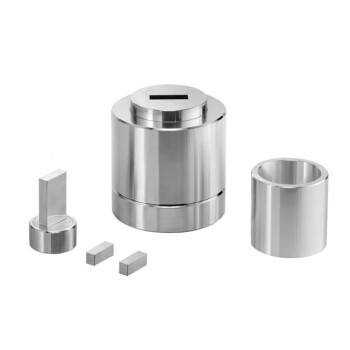
High-precision laboratory hydraulic pellet presses are essential for FTIR spectroscopy because they physically transform opaque powder mixtures into semi-transparent, uniform pellets. This process, known as high-pressure molding, facilitates the plastic flow of potassium bromide (KBr) to eliminate internal voids and air bubbles. By creating a dense, bubble-free medium, the press ensures that the infrared beam can pass through the sample with minimal light scattering, resulting in clear, reproducible, and quantitative spectral data.
A high-precision hydraulic press is the bridge between a raw powder sample and a valid infrared spectrum. It provides the stable, high-intensity pressure required to create a uniform optical path, which is the fundamental prerequisite for accurate functional group analysis and stable baselines.
The Physics of Plastic Flow and Transparency
Converting Powder to a Solid Optical Window
To obtain a usable FTIR spectrum, the sample must be thin enough—typically around 0.3mm—to allow the infrared beam to penetrate it. A hydraulic press applies significant force (often reaching 5 tons or more) to a mixture of the sample and spectroscopic-grade KBr. This pressure forces the KBr to undergo plastic flow, filling the gaps between particles and creating a standardized, translucent pellet.
Eliminating Light Scattering
When a sample is not properly compressed, the infrared beam hits air pockets and particle boundaries, causing the light to scatter in multiple directions. This scattering results in significant energy loss and a "noisy" spectrum. High-precision pressing eliminates these internal voids, ensuring the infrared beam passes through the sample uniformly to produce high signal-to-noise ratios.
Ensuring Quantitative Accuracy and Consistency
Maintaining a Uniform Optical Path
For quantitative analysis, such as measuring aromatic vibrations or aliphatic branching, the optical pathlength must be consistent across the entire pellet. A precision press ensures that the die remains perfectly level and the pressure remains stable during the compression cycle. This results in a pellet of uniform thickness, which is vital for producing absorbance curves that accurately reflect the molecular structure.
Achieving Stable Baselines
Irregularities in pellet density or surface finish can lead to baseline drift, making it difficult to identify specific characteristic peaks. High-precision molding produces highly transparent pellets with smooth surfaces. This stability allows for the clear identification of subtle vibrational shifts, such as those used to confirm the embedding of ions in catalysts or chemical interactions in polymers.
Understanding the Trade-offs and Pitfalls
The Risk of Pressure Instability
If a press cannot maintain a stable, high-pressure load, the resulting pellet may be "cloudy" or opaque. This usually indicates incomplete plastic flow, where air is still trapped within the KBr matrix. Inconsistent pressure often leads to fragile pellets that crack easily upon removal from the die, wasting both time and expensive sample material.
Sample-to-KBr Ratio Sensitivities
While the press provides the physical force, the ratio of the sample to the KBr (often 1:100) is equally critical. If the sample concentration is too high, even the best hydraulic press cannot achieve transparency because the sample particles will block the light path. Conversely, a pellet that is pressed too thin may become too fragile to handle without specialized equipment.
How to Optimize Your FTIR Sample Preparation
Choosing the Right Approach for Your Research
Selecting the appropriate pressing technique depends entirely on the nature of your material and the level of detail required in your spectral analysis.
- If your primary focus is quantitative structural analysis: Use a high-precision press with a digital pressure gauge to ensure repeatable pellet thickness and density for every sample.
- If your primary focus is identifying unknown functional groups: Ensure your sample is finely ground and dried before pressing to minimize water interference and maximize the signal-to-noise ratio.
- If your primary focus is analyzing delicate nanoparticles or catalysts: Use a press that allows for a slow, controlled release of pressure to prevent the pellet from shattering due to sudden decompression.
By utilizing a high-precision hydraulic press, you ensure that the physical state of your sample never compromises the integrity of your chemical data.
Summary Table:
| Feature | Importance for FTIR Sample Prep | Benefit to Analysis |
|---|---|---|
| High-Pressure Load | Forces KBr plastic flow to fill voids | Creates a transparent, solid optical window |
| Precision Die Leveling | Ensures perfectly uniform pellet thickness | Maintains a consistent optical pathlength |
| Void Elimination | Removes air pockets and particle boundaries | Minimizes light scattering for higher SNR |
| Stable Load Control | Prevents internal cracks and cloudiness | Guarantees reproducible quantitative data |
Elevate Your Spectroscopy with KINTEK Precision
Achieving the perfect FTIR pellet requires more than just force—it requires the stability and precision of a KINTEK hydraulic pellet press. As specialists in laboratory equipment, KINTEK offers a comprehensive range of hydraulic presses (including pellet, hot, and isostatic models), along with the precision crushing and milling systems needed for flawless sample preparation.
Our value to your laboratory:
- Unmatched Accuracy: Stable pressure control ensures uniform thickness and maximum transparency for every KBr pellet.
- Complete Solutions: Beyond presses, we provide high-temperature furnaces, reactors, and essential consumables like PTFE products and crucibles.
- Research Reliability: Our tools are designed to meet the rigorous demands of quantitative structural analysis and functional group identification.
Don't let poor sample prep compromise your research integrity. Contact KINTEK today to find the ideal pressing solution for your laboratory!
References
- Meng Wu, Lele Feng. The Effect of Temperature on Molecular Structure of Medium-Rank Coal via Fourier Transform Infrared Spectroscopy. DOI: 10.3390/ma16206746
This article is also based on technical information from Kintek Solution Knowledge Base .
Related Products
- Laboratory Hydraulic Pellet Press for XRF KBR FTIR Lab Applications
- Automatic Laboratory Hydraulic Pellet Press Machine for Lab Use
- Automatic Laboratory Hydraulic Press for XRF & KBR Pellet Press
- Laboratory Manual Hydraulic Pellet Press for Lab Use
- Laboratory Manual Hydraulic Pellet Press for Lab Use
People Also Ask
- What is the role of a laboratory hydraulic pellet press and stainless steel molds in the fabrication of RuO2/NbC anodes?
- What is the necessity of using a laboratory hydraulic pellet press in the preparation of biomass fuel pellets? Guide
- How does a laboratory hydraulic pellet press contribute to SiCw/2024 aluminum composite preforms? Optimize Densification
- What is the significance of applying 200 MPa of pressure with a laboratory hydraulic pellet press for composite ceramics?
- What key role does a laboratory pellet press play in FTIR analysis? Master KBr Sample Preparation Excellence