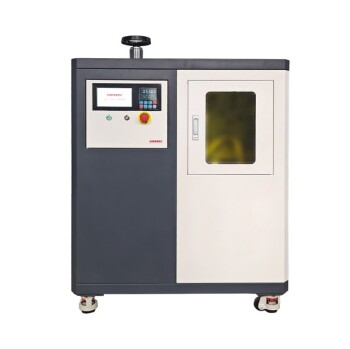
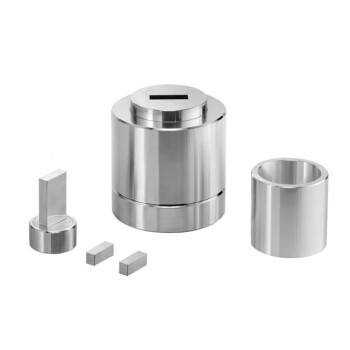
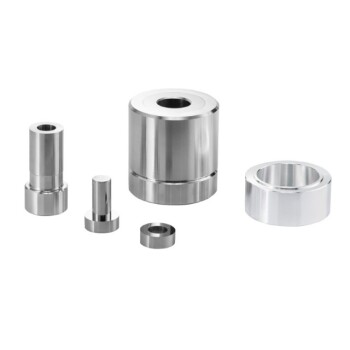
High-pressure consolidation is the critical enabling step for functional solid-state batteries. A laboratory hydraulic press is required to apply massive force—often reaching 360 MPa—to solid electrolyte powders and electrode materials. This pressure induces plastic deformation to eliminate porosity and forces rigid components into intimate physical contact, which is the only way to ensure efficient ion transport and low electrical resistance.
The core challenge in solid-state battery fabrication is overcoming the natural resistance at the interface of two solid materials. High-pressure pressing mechanically forces these materials together to minimize microscopic voids, creating a dense, unified structure that facilitates ion movement and acts as a barrier against internal short circuits.
Achieving Critical Densification
Inducing Plastic Deformation
To function correctly, solid-state electrolyte powders cannot simply be packed together; they must undergo plastic deformation.
A high-pressure press applies sufficient force (such as 360 MPa) to permanently reshape the powder particles. This deformation eliminates the air gaps and pores that naturally exist between loose particles.
Creating Defect-Free Layers
The removal of pores creates a dense, defect-free solid layer.
Without this high level of densification, the electrolyte layer would remain porous. These pores would disrupt ion flow and severely limit the battery's efficiency and capacity.
Optimizing Electrochemical Performance
Reducing Interfacial Impedance
The primary enemy of solid-state battery performance is interfacial impedance—the resistance ions face when moving from the cathode to the electrolyte.
Because both materials are rigid solids, they do not naturally form good contact like a liquid electrolyte would. The hydraulic press forces tight physical contact between the buffer layer, cathode, and electrolyte, drastically reducing this contact resistance.
Minimizing Microscopic Voids
Even smoothened solid surfaces have microscopic irregularities that create voids at the interface.
Continuous stacking pressure minimizes these voids. By eliminating these gaps, the press establishes a continuous pathway for ions to travel across the solid-solid interface.
Enhancing Safety and Longevity
Inhibiting Dendrite Growth
High densification serves a critical safety function beyond just performance.
A highly compacted, dense electrolyte layer acts as a physical barrier. This barrier inhibits the nucleation and expansion of lithium dendrites—needle-like structures that can puncture the electrolyte and cause internal short circuits.
Understanding Process Nuances
The Importance of Stepwise Pressing
Achieving the right interface often requires more than a single press cycle; it demands a stepwise process.
For example, a cathode mixture may be pre-pressed at a lower pressure (e.g., 3 tons) before adding the electrolyte powder. This is followed by a final co-pressing event at higher pressure (e.g., 8 tons) to create a bilayer pellet.
Balancing Pressure and Integrity
While high pressure is necessary, the application must be controlled to ensure the structural integrity of the pellet.
The goal is to achieve tight contact without crushing the active materials or creating stress fractures within the layers. This requires precision in how pressure is ramped and maintained during the stacking process.
Making the Right Choice for Your Goal
When selecting or utilizing a hydraulic press for solid-state battery research, align your parameters with your specific fabrication objectives:
- If your primary focus is maximizing ion conductivity: Prioritize pressures high enough (e.g., 360 MPa) to induce full plastic deformation and eliminate pore-related resistance.
- If your primary focus is safety and durability: Ensure your pressing protocol achieves maximum density to create a robust physical barrier against lithium dendrite formation.
- If your primary focus is layer integration: Utilize a stepwise pressing method (pre-press followed by co-press) to ensure uniform adhesion between the cathode and electrolyte layers.
High-pressure processing is not merely a shaping step; it is the fundamental mechanism that transforms loose powder into a cohesive, conductive electrochemical system.
Summary Table:
| Key Requirement | Impact on Battery Performance | Mechanism |
|---|---|---|
| Plastic Deformation | Eliminates porosity and air gaps | High-pressure consolidation (up to 360 MPa) |
| Interfacial Contact | Reduces electrical resistance/impedance | Forced physical contact between rigid solids |
| High Densification | Inhibits lithium dendrite growth | Creates a dense, defect-free physical barrier |
| Stepwise Pressing | Ensures uniform layer adhesion | Sequential pre-pressing and co-pressing cycles |
Revolutionize Your Solid-State Battery Research with KINTEK
Precise densification is the cornerstone of high-performance solid-state batteries. KINTEK specializes in advanced laboratory equipment, offering high-pressure manual, electric, and isostatic hydraulic presses specifically designed to meet the rigorous demands of battery material research.
Whether you are working on inducing plastic deformation in electrolytes or optimizing cathode-to-electrolyte interfaces, our solutions provide the precision and force needed to eliminate microscopic voids and enhance ion conductivity. Beyond pelletizing, our portfolio includes high-temperature furnaces, battery research tools, and specialized consumables like PTFE and ceramics to support your entire workflow.
Ready to achieve superior pellet density and electrochemical performance? Contact KINTEK today to find the perfect hydraulic press for your lab!
Related Products
- Laboratory Hydraulic Press Lab Pellet Press for Button Battery
- kbr pellet press 2t
- Warm Isostatic Press for Solid State Battery Research
- Automatic Laboratory Hydraulic Pellet Press Machine for Lab Use
- Automatic Laboratory Hydraulic Press for XRF & KBR Pellet Press
People Also Ask
- Why use a lab hydraulic press for 380 MPa Ti-Al alloy compaction? Unlock superior density and structural integrity.
- Why is a high-precision laboratory hydraulic press necessary for radiation-shielding? Ensure Data Accuracy & Density
- What is the function of a laboratory hydraulic press in preparing La2FeCrO6? Ensure High-Density Ceramic Pellets
- Why is a laboratory hydraulic press required during the preparation of Ti3AlC2 precursor pellets?
- How does the laboratory hydraulic press contribute to the preparation of solid targets for laser ablation?