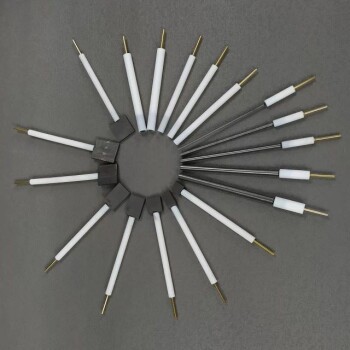
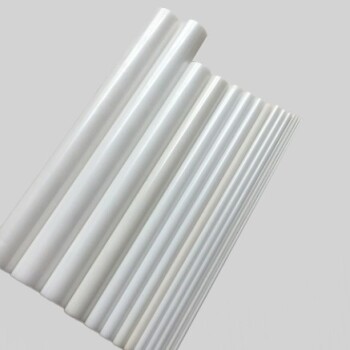
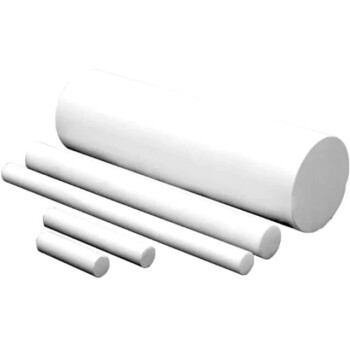
High-purity Graphite rods are primarily selected as counter electrodes in Electrochemical Impedance Spectroscopy (EIS) because they possess high electrical conductivity while remaining chemically inert within the test environment. By completing the electrical circuit without reacting with the electrolyte, they ensure the measured response comes solely from the stressing corrosion of the sample, not the electrode itself.
Core Takeaway To obtain accurate EIS data, the counter electrode must act as a transparent conduit for current, not a participant in the reaction. High-purity Graphite provides a stable current distribution and a reliable impedance baseline, making it essential for validating complex measurements like Electrochemical Noise (EN).
The Fundamental Role of Graphite
Chemical Inertness
The most critical requirement for a counter electrode in stress corrosion studies is stability.
High-purity Graphite is chemically inert, meaning it does not dissolve or participate in the oxidation-reduction reactions during testing.
This ensures the chemical composition of the electrolyte remains constant and the corrosion state of the working electrode is not artificially altered.
High Electrical Conductivity
EIS involves applying a small AC signal to measure the impedance of a system.
Graphite offers excellent electrical conductivity, allowing it to facilitate current flow with minimal resistance.
This efficient transfer of electrons is vital for maintaining a stable electrical circuit with the working electrode.
Ensuring Measurement Accuracy
Stable Current Distribution
For polarization curves to accurately reflect surface corrosion, the current applied must be uniform.
Graphite rods provide a consistent and stable current distribution across the electrochemical system.
This prevents localized anomalies that could skew the impedance characteristic (|Z|) data.
Benchmarking and Validation
In advanced corrosion studies, researchers often use multiple methods, such as Electrochemical Noise (EN) or Electrochemical Emission Spectroscopy (EES).
The characteristic impedance obtained via EIS using a Graphite rod acts as a "ground truth" or benchmark.
Researchers use this stable baseline to evaluate the accuracy of noise resistance (Rn) and spectral impedance (Zn) calculated from other fluctuation-based techniques.
Critical Considerations and Trade-offs
The Necessity of "High Purity"
Not all graphite is suitable for electrochemical testing.
The reference specifically mandates high-purity Graphite.
Impurities in lower-grade graphite can leach into the solution, altering the corrosive environment and introducing noise that invalidates the EIS spectrum.
Comparison to Platinum
While Platinum (Pt) is also used for its inertness and conductivity (as noted in supplementary contexts), Graphite is often favored for specific impedance applications.
However, users must ensure the Graphite rod maintains its structural integrity and surface cleanliness over time, as it can be more porous than Platinum sheets.
Making the Right Choice for Your Goal
To maximize the reliability of your stress corrosion data, align your electrode selection with your specific analytical needs.
- If your primary focus is establishing a reliable baseline: Use a high-purity Graphite rod to capture standard characteristic impedance (|Z|) without chemical interference.
- If your primary focus is validating new measurement techniques: Use the Graphite EIS data to cross-reference and verify calculations derived from Electrochemical Noise (EN).
Success in EIS testing relies not just on the sample you are testing, but on the invisibility of the tools you use to test it.
Summary Table:
| Feature | Benefit in EIS Testing | Importance for Stress Corrosion |
|---|---|---|
| Chemical Inertness | Prevents electrode-electrolyte reactions | Ensures data reflects only the sample's corrosion |
| High Conductivity | Facilitates seamless current flow | Maintains a stable AC signal for impedance accuracy |
| Uniform Distribution | Provides stable current density | Prevents localized anomalies in polarization curves |
| High Purity | Eliminates leaching of contaminants | Prevents noise and invalidation of the EIS spectrum |
| Reliable Baseline | Acts as a "ground truth" benchmark | Essential for validating EN and EES measurement techniques |
Elevate Your Electrochemical Research with KINTEK
Precise corrosion analysis demands high-purity materials that won't compromise your data. KINTEK specializes in premium laboratory equipment and consumables designed for the most rigorous testing environments. Whether you are conducting Electrochemical Impedance Spectroscopy (EIS) or advanced battery research, we provide the tools you need for success.
Our extensive portfolio includes:
- High-Purity Graphite & Platinum Electrodes for stable electrochemical measurements.
- Electrolytic Cells & Specialized Consumables including PTFE products, ceramics, and crucibles.
- Advanced High-Temperature Systems, from muffle and tube furnaces to CVD and vacuum systems.
- Precision Sample Prep tools like hydraulic presses, crushing/milling systems, and sieving equipment.
Don't let impurities skew your results. Trust KINTEK for reliable, high-performance lab solutions that empower your discoveries. Contact our technical experts today to find the perfect components for your lab!
References
- Andrés Carmona-Hernández, Ricardo Galván-Martínez. Electrochemical Noise Analysis of the X70 Pipeline Steel under Stress Conditions Using Symmetrical and Asymmetrical Electrode Systems. DOI: 10.3390/met12091545
This article is also based on technical information from Kintek Solution Knowledge Base .
Related Products
- Graphite Disc Rod and Sheet Electrode Electrochemical Graphite Electrode
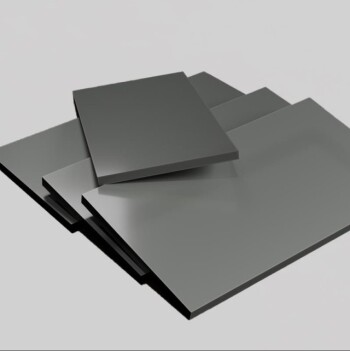
- Carbon Graphite Plate Manufactured by Isostatic Pressing Method
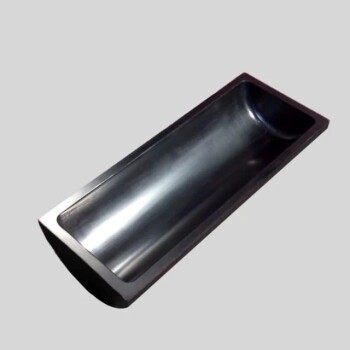
- High Purity Pure Graphite Crucible for Evaporation
- Carbon Graphite Boat -Laboratory Tube Furnace with Cover
- High Purity Pure Graphite Crucible for Electron Beam Evaporation
People Also Ask
- Why is a graphite electrode used as a counter electrode? Achieve Pure Electrochemical Reduction with KINTEK
- What is the correct procedure for installing and connecting a graphite electrode during an experiment? Ensure Accurate Electrochemical Results
- What are the potential risks when using a graphite electrode in electrochemical tests? Avoid Decomposition and Contamination
- What are the key precautions for handling graphite electrodes? Ensure Safety & Maximize Performance
- Why are Dimensionally Stable Anodes (DSA) preferred for indium electrowinning? Ensure High-Purity Results.