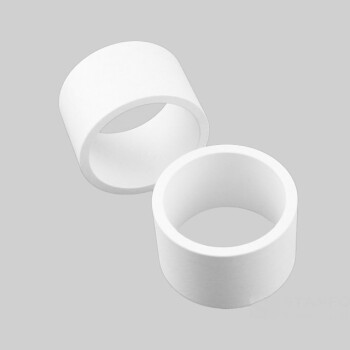
High-purity quartz tubes are the linchpin of stability in Dielectric Barrier Discharge (DBD) systems, serving a function far more complex than simple containment. They act as a specialized electrical barrier that prevents electrode arcing while enabling the formation of a stable, uniform cold plasma field necessary for separating carbon dioxide from methane.
The quartz tube functions not just as a vessel, but as an active component that mediates the electrical discharge. Its superior dielectric strength and chemical inertness allow for the precise polarization of carbon dioxide molecules, directly driving the efficiency of the separation process.
The Physics of the Dielectric Barrier
Preventing Direct Arc Discharge
In a plasma system, high voltage is applied between electrodes. Without a barrier, this energy would naturally jump the gap as a single, intense spark, known as an arc discharge.
The quartz tube blocks this direct path. By acting as a dielectric barrier, it forces the electrical energy to distribute itself over the entire surface area rather than concentrating at a single point.
Creating Uniform Cold Plasma
By preventing arcing, the quartz tube enables the generation of cold plasma.
This plasma creates a uniform zone of charged particles across the gas flow. This uniformity is essential for ensuring that the entire gas mixture—not just small pockets—is exposed to the separation forces.
Why High-Purity Quartz is Required
Superior Dielectric Properties
Standard glass or lower-grade ceramics often lack the dielectric strength required for these systems.
High-purity quartz possesses superior dielectric properties, allowing it to withstand the high voltages needed to generate plasma without breaking down or allowing current to leak through the barrier.
Chemical Inertness
Plasma environments are chemically active and can be corrosive.
Quartz is chosen for its chemical inertness. It does not react with the ionized gases or degradation products, ensuring the tube does not corrode over time or introduce contaminants that would skew the separation results.
Driving Separation Efficiency
Inducing Polarization Effects
The ultimate goal of the system is to separate gases based on how they react to the electrical field.
The stability provided by the quartz barrier allows the plasma to stably induce polarization effects in carbon dioxide molecules. Because CO2 polarizes differently than methane, this electrical manipulation is the primary mechanism that separates the two gases.
Supporting Sub-Atmospheric Conditions
These separation processes often occur under sub-atmospheric pressure to optimize plasma formation.
High-purity quartz provides the structural integrity to maintain these vacuum conditions safely while simultaneously managing the electrical stress of the plasma generation.
Operational Considerations and Trade-offs
The Cost of Purity
While high-purity quartz is technically superior, it represents a significant material cost compared to standard borosilicate glass.
Engineers must justify this cost against the requirement for separation efficiency. Lower-grade materials may save money upfront but will likely lead to inconsistent plasma fields and reduced separation purity.
Fragility and System Design
Despite its chemical resistance, quartz is brittle and mechanically fragile.
Designing a reactor requires careful consideration of mounting and vibration control. A fracture in the dielectric barrier will immediately result in arc discharge, halting the separation process and potentially damaging the power supply.
Making the Right Choice for Your Goal
To maximize the effectiveness of your DBD plasma system, consider how the material properties align with your specific objectives:
- If your primary focus is Separation Efficiency: Prioritize the highest available purity of quartz to ensure maximum dielectric strength and the most stable polarization of CO2 molecules.
- If your primary focus is System Longevity: Ensure the physical design protects the quartz tube from mechanical stress, as its chemical inertness will ensure a long life only if it remains physically intact.
The quartz tube is not merely a passive window; it is the active regulator that transforms raw electrical energy into a precise separation tool.
Summary Table:
| Feature | High-Purity Quartz | Standard Glass/Ceramic | Benefit for Plasma Separation |
|---|---|---|---|
| Dielectric Strength | Very High | Lower | Prevents arcing; enables uniform cold plasma |
| Chemical Inertness | Excellent | Variable | No contamination or corrosion in active plasma |
| Thermal Resistance | Superior | Moderate | Maintains structural integrity under heat |
| Electrical Stability | Consistent | Prone to leakage | Ensures precise polarization of CO2 molecules |
Elevate Your Plasma Research with KINTEK Precision
Don't let inferior materials compromise your gas separation efficiency. KINTEK specializes in high-performance laboratory equipment, providing the high-purity quartz tubes and specialized reactor components necessary for stable Dielectric Barrier Discharge (DBD) systems.
Whether you are developing advanced CVD/PECVD systems or exploring carbon dioxide and methane separation, our expert team delivers the chemical inertness and dielectric strength your research demands. Beyond quartz, our portfolio includes high-temperature furnaces, high-pressure reactors, and specialized consumables tailored for cutting-edge energy research.
Ready to optimize your plasma field? Contact KINTEK today for a consultation on the best materials for your specific laboratory goals.
References
- Fnu Gorky, Maria L. Carreon. Performance and Enhanced Efficiency Induced by Cold Plasma on SAPO-34 Membranes for CO2 and CH4 Mixtures. DOI: 10.3390/membranes14080178
This article is also based on technical information from Kintek Solution Knowledge Base .
Related Products
- 1200℃ Split Tube Furnace with Quartz Tube Laboratory Tubular Furnace
- Laboratory Rapid Thermal Processing (RTP) Quartz Tube Furnace
- High Purity Pure Graphite Crucible for Evaporation
- High Purity Pure Graphite Crucible for Electron Beam Evaporation
- High Temperature Resistant Optical Quartz Glass Sheet
People Also Ask
- What functions does a laboratory high-temperature tube furnace perform? Master Catalyst Synthesis & Carbonization
- What roles does a high-temperature tube furnace play in the synthesis of N/O co-doped carbon? Master Precise Doping
- How does a high-temperature tube furnace influence 253MA steel? Master Microstructure & High-Temp Creep Resistance
- What are the primary applications of muffle and tube furnaces in photocatalysts? Optimize Metal Loading & Support Synthesis
- Why is a high-temperature tube furnace required for the production of biochar from tobacco straw? Expert Pyrolysis Guide