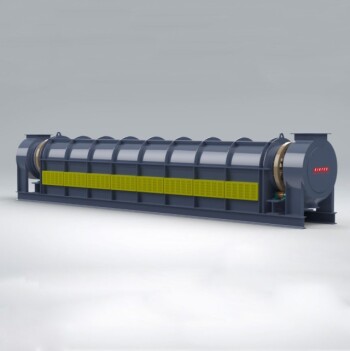
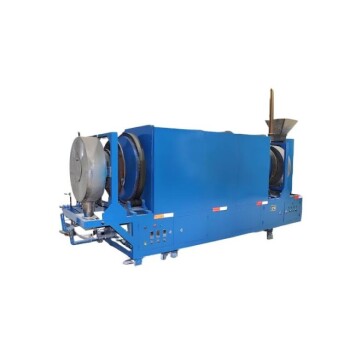
A high-temperature calcination furnace is the critical instrument required to convert raw, synthesized precipitates into usable, medical-grade hydroxyapatite (HAp). By applying intense thermal energy—often reaching temperatures up to 1100°C or higher—the furnace drives the necessary phase transformations to create a highly crystalline, chemically pure, and bioactive material.
Core Takeaway The furnace does not merely dry the powder; it acts as a reactor for atomic rearrangement. It provides the precise thermal energy required to eliminate organic impurities and organize the material's atomic structure into a stable, crystalline phase essential for clinical performance.
Driving Phase Transformation
Converting Amorphous Precipitates
Freshly synthesized HAp precipitates often exist in an amorphous or low-crystalline state. In this form, the material lacks the structural order required for high-performance applications.
The calcination furnace provides the thermal energy needed to overcome the activation barrier for crystallization. This heat induces the material to transform into a distinct, highly crystalline hydroxyapatite phase.
Atomic Rearrangement
At temperatures approaching 1200°C, the thermal energy drives atomic rearrangement.
The atoms within the precipitate are agitated sufficiently to move from disordered positions into a highly ordered lattice structure. This structural ordering is what defines the material as true hydroxyapatite.
Ensuring Purity and Bio-Safety
Elimination of Volatile Impurities
Raw precipitates frequently contain volatile components or organic residues, such as residual complexing agents or biological remnants (e.g., membranes in bio-waste derived HAp).
High-temperature treatment ensures these impurities are completely combusted and removed. This is often a multi-stage process; for example, lower temperatures (around 450°C) may target organic membranes, while higher temperatures ensure total decomposition.
Achieving Medical-Grade Purity
For HAp intended for medical biomaterials, purity is non-negotiable.
Any residual carbon or organic components can compromise biocompatibility. The furnace creates a controlled environment where these contaminants are eradicated, leaving behind only the pure calcium phosphate compound.
Microstructure and Stability
Promoting Grain Development
Thermal activation within the furnace promotes grain development and growth.
As the grains coalesce and grow, the material densifies. This results in a powder that possesses the specific particle size and morphology required for subsequent processing, such as thermal spraying or sintering.
Enhancing Chemical Stability
A highly crystalline structure directly correlates to chemical stability.
Amorphous calcium phosphates dissolve too rapidly in the body. By calcining the powder to a high degree of crystallinity, you ensure the material remains stable enough to function effectively as a bioactive coating or bone substitute.
Understanding the Trade-offs
The Risk of Inprecise Control
While high heat is necessary, precision is paramount.
If the temperature is too low, the conversion to the active phase will be incomplete, and toxic organic residues may remain.
Conversely, if thermal management is poor, you risk inconsistent grain sizes or uncontrolled phase changes. The goal is a uniform thermal field to ensure every particle undergoes the same transformation history.
Making the Right Choice for Your Goal
To optimize your HAp synthesis, align your thermal treatment with your specific end-use requirements:
- If your primary focus is Medical Biocompatibility: Prioritize a furnace with multi-stage capability to ensure the total combustion of organic residues (e.g., at 450°C) before final crystallization.
- If your primary focus is Coating Stability: Target higher temperatures (1100°C–1200°C) to maximize crystallinity and grain development, ensuring the material resists rapid dissolution in physiological fluids.
- If your primary focus is Structural Order: Ensure your furnace provides an extremely uniform thermal field to drive consistent atomic rearrangement across the entire batch.
Ultimately, the high-temperature calcination furnace is the bridge between a raw chemical precipitate and a functional, life-enhancing biomaterial.
Summary Table:
| Process Stage | Temperature Range | Primary Objective |
|---|---|---|
| Organic Removal | 450°C - 600°C | Elimination of volatile impurities and organic residues |
| Phase Transformation | 800°C - 1000°C | Conversion from amorphous state to crystalline hydroxyapatite |
| Grain Development | 1100°C - 1200°C | Atomic rearrangement, densification, and chemical stability |
Elevate Your Biomaterial Synthesis with KINTEK Precision
At KINTEK, we understand that medical-grade hydroxyapatite requires absolute thermal precision and chemical purity. Our advanced high-temperature muffle and tube furnaces provide the uniform thermal fields necessary for complete phase transformation and atomic rearrangement.
Whether you are refining HAp for bioactive coatings or bone substitutes, our laboratory solutions—from calcination systems to crushing and milling equipment—ensure your materials meet the most rigorous clinical standards.
Ready to optimize your synthesis process? Contact our laboratory specialists today to discover how KINTEK can enhance your research and production efficiency.
References
- Fernanda Albrecht Vechietti, Luís Alberto dos Santos. Influence of cobalt chromium alloy surface modification on the roughness and wettability behavior of pine oil/hydroxyapatite as coating. DOI: 10.1088/2053-1591/aae8d6
This article is also based on technical information from Kintek Solution Knowledge Base .
Related Products
- Vacuum Heat Treat and Pressure Sintering Furnace for High Temperature Applications
- Ultra-High Temperature Graphite Vacuum Graphitization Furnace
- High Temperature Muffle Oven Furnace for Laboratory Debinding and Pre Sintering
- 1700℃ Laboratory High Temperature Tube Furnace with Alumina Tube
- 1200℃ Muffle Furnace Oven for Laboratory
People Also Ask
- What is the purpose of the heat treatment (sintering) step? Engineering Robust Electroactive Membranes
- What is a vacuum sintering furnace? Unlock Purity and Performance in Advanced Materials
- How does the vacuum environment impact sintering of diamond-copper composites? Protect Against Thermal Damage
- Why must green bodies produced via binder jetting undergo treatment in a vacuum sintering furnace?
- What are some alternative atmospheres to pure hydrogen for powder metallurgy sintering processes? Top Sintering Solutions