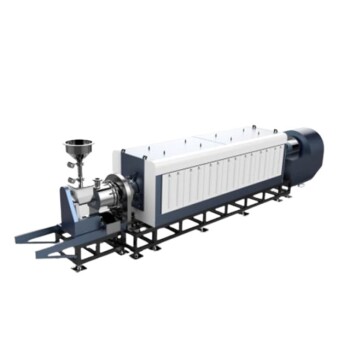
A high-temperature muffle furnace is the primary instrument used to isolate the inorganic mineral content of biomass by completely combusting its organic structure. Operated typically at 575°C, it physically separates volatile solids from non-combustible residues, providing the baseline data necessary for determining the chemical composition of the sample.
Core Insight: The muffle furnace acts as a subtractive tool: by thermally removing the organic "matrix," it isolates the inorganic ash. This step is a prerequisite for accurately calculating the percentages of structural components like cellulose and lignin, or for enriching trace metals for high-sensitivity detection.
The Mechanics of Separation
Total Combustion of Organics
The primary function of the furnace is to subject the biomass to temperatures sufficient to incinerate carbon-based matter (typically 575°C). At this heat, organic compounds oxidize and vaporize, leaving the solid sample.
Isolation of Inorganic Residue
Once the organic matter is removed, only the inorganic mineral residue (ash) remains. This physical separation allows for a precise gravimetric measurement of the sample's non-combustible content.
Critical Role in Compositional Calculations
Enabling Structural Component Analysis
You cannot determine the exact percentages of cellulose, hemicellulose, and lignin based on raw weight alone. You must first subtract the weight of the ash (determined by the furnace) to correct the total mass, ensuring the chemical analysis reflects only the organic fraction.
Verifying Mass Balance
In biomass processing, accounting for every gram of material is essential for efficiency. The data provided by the muffle furnace allows engineers to perform mass balance calculations, verifying that inputs and outputs align across the entire conversion process.
Applications in Trace Element Detection
Eliminating Organic Interference
When analyzing for heavy metals like chromium, manganese, or iron (often at 600°C), the bulk of the biomass can interfere with analytical instruments. The furnace removes this organic "noise," leaving a cleaner sample for analysis.
Enrichment for Sensitivity
By converting a large volume of biomass into a small amount of ash, the furnace effectively concentrates trace elements. This enrichment significantly enhances the sensitivity and accuracy of subsequent measurement techniques.
Understanding the Trade-offs
Risk of Inorganic Volatilization
While the goal is to remove organics, excessive temperatures can cause certain inorganic salts to volatilize and escape. It is critical to select the specific temperature (e.g., 500°C for LOI vs. 600°C for metals) that targets the organic content without degrading the mineral residue you intend to measure.
Processing Duration
Muffle furnace ashing is a slow, batch-based process. Samples often require extended duration at peak temperature to ensure total oxidation, which can create a bottleneck compared to rapid spectroscopic methods.
Making the Right Choice for Your Goal
To maximize the utility of a muffle furnace in your specific context, align your temperature protocols with your analytical objective:
- If your primary focus is Structural Analysis: Operate at 575°C to determine volatile solids and ash content for accurate cellulose and lignin calculations.
- If your primary focus is Trace Metal Detection: Operate at 600°C to fully incinerate organics and enrich the sample for heavy metal sensitivity.
- If your primary focus is Corrosion/Deposit Analysis: Operate at 500°C to perform Loss on Ignition (LOI) tests, distinguishing between organic fouling and inorganic corrosion products.
By strictly controlling the thermal environment, you turn raw biomass into quantifiable data points that drive process accuracy.
Summary Table:
| Analytical Goal | Recommended Temperature | Primary Outcome |
|---|---|---|
| Structural Analysis | 575°C | Isolates ash for cellulose & lignin calculation |
| Trace Metal Detection | 600°C | Removes organic noise & concentrates heavy metals |
| Corrosion Analysis | 500°C | Loss on Ignition (LOI) to identify fouling types |
| Mass Balance | Variable | Validates process efficiency and input/output alignment |
Elevate Your Biomass Research with KINTEK
Precision in compositional analysis starts with reliable thermal processing. KINTEK specializes in advanced laboratory equipment designed for the most demanding research environments. Whether you are performing structural component analysis or trace element enrichment, our comprehensive range of high-temperature muffle furnaces, tube furnaces, and vacuum systems ensures uniform heating and precise temperature control.
From high-performance furnaces to essential consumables like ceramics and crucibles, KINTEK provides the tools needed to eliminate organic interference and achieve accurate mass balance.
Ready to optimize your lab's efficiency? Contact our technical experts today to find the perfect furnace solution for your biomass and material science applications.
References
- Forough Momayez, Ilona Sárvári Horváth. Sustainable and efficient sugar production from wheat straw by pretreatment with biogas digestate. DOI: 10.1039/c9ra05285b
This article is also based on technical information from Kintek Solution Knowledge Base .
Related Products
- 1800℃ Muffle Oven Furnace for Laboratory
- 1200℃ Muffle Furnace Oven for Laboratory
- 1400℃ Muffle Oven Furnace for Laboratory
- 1700℃ Muffle Oven Furnace for Laboratory
- High Temperature Muffle Oven Furnace for Laboratory Debinding and Pre Sintering
People Also Ask
- Why is calcination in a Muffle Furnace necessary for niobate synthesis? Achieve Perfect Phase-Pure Solid Solutions
- What is the role of a high-temperature muffle furnace in YZAO synthesis? Master Nanocrystalline Phase Transformation
- What role do High-Temperature Muffle Furnaces play in metal oxide precursor pre-treatment? Ensure Structural Integrity
- What role does a high-temperature muffle furnace play in BZCY72 densification? Master Precision Sintering at 1500°C
- What is the role of a High-Temperature Muffle Furnace in the preparation of Ce-Mn catalysts? Boost Structural Reactivity