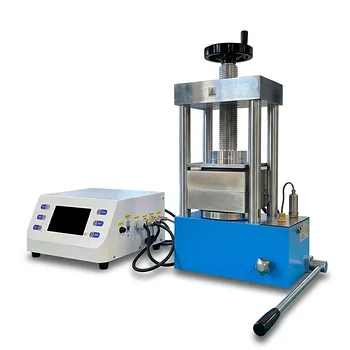
A high-tonnage laboratory hydraulic press is the critical mechanism required to transform high-purity Thallium Bromide (TlBr) powder into a functional semiconductor crystal. Specifically, the press must deliver a constant force of approximately 30 kN while maintaining temperatures near the material's melting point (455-465°C). This precise combination of mechanical force and thermal energy is the only reliable way to achieve the densification necessary for radiation detection applications.
The simultaneous application of high mechanical pressure and thermal energy induces plastic flow in TlBr powder, eliminating internal voids and aligning crystal structures. This densification process is the defining factor in creating semiconductors with high charge collection efficiency and superior gamma-ray attenuation.
The Mechanics of Crystal Formation
Achieving Maximum Densification
The primary function of the hydraulic press is to compress raw TlBr powders into a solid, void-free mass.
By applying 30 kN of vertical pressure, the press forces the powder particles to bond at a microscopic level.
This elimination of internal voids is non-negotiable, as air gaps or structural inconsistencies would ruin the material's ability to act as a semiconductor.
Inducing Plastic Flow
Pressure alone is insufficient; it must be coupled with high heat to induce a state of plastic flow.
Operating at 455-465°C, the material softens enough to move under the force of the press without liquifying completely.
This "solid-phase molding" allows the material to fill the mold perfectly, ensuring structural consistency throughout the depth of the crystal.
Controlling Crystal Orientation
The constant axial pressure does more than just compact the material; it dictates how the crystal lattice forms.
The hydraulic force guides the crystal orientation during the densification process.
A specific, uniform orientation is required to optimize how electrons move through the material when it is eventually used in a detector.
Impact on Detector Performance
Enhancing Gamma-Ray Attenuation
A denser crystal interacts more effectively with incoming radiation.
Because the hydraulic press maximizes density, the resulting TlBr crystals possess a superior radiation attenuation coefficient.
This allows the final detector to stop and measure high-energy photons effectively rather than letting them pass through undetected.
Optimizing Charge Collection
The structural integrity provided by hot pressing directly correlates to electrical performance.
By eliminating defects and stress pockets, the process ensures high charge collection efficiency.
This results in detectors that offer precise energy resolution, specifically improving performance in photon-counting applications.
Understanding the Trade-offs
The Risk of Pressure Fluctuation
The requirement is not just for high pressure, but for constant pressure.
If the hydraulic system allows the pressure to fluctuate during the holding period (often up to 2 hours), the crystal density will be non-uniform.
Inconsistent density leads to variations in electrical properties, rendering the detector unreliable for precise spectral analysis.
Thermal-Mechanical Balance
Applying 30 kN of force is destructive if the temperature is not strictly controlled within the 455-465°C window.
Too much heat under this pressure can cause unmitigated melting or deformation.
Too little heat prevents plastic flow, resulting in a brittle compact full of stress fractures rather than a unified crystal.
Making the Right Choice for Your Goal
To select the correct pressing protocols for TlBr device fabrication, consider your specific performance targets:
- If your primary focus is Physical Durability: Prioritize a press capable of maintaining exact pressure constancy over long durations (2+ hours) to ensure complete void elimination and structural integrity.
- If your primary focus is Spectral Resolution: Focus on the precision of the thermal control coupled with the pressure, as specific crystal orientation is the key driver for high charge collection efficiency and energy resolution.
The success of a TlBr radiation detector is determined by the rigorous stability of the pressure applied during its formation.
Summary Table:
| Feature | Requirement | Impact on TlBr Crystal Performance |
|---|---|---|
| Mechanical Force | Constant 30 kN | Eliminates internal voids and ensures maximum densification |
| Thermal Window | 455-465°C | Induces plastic flow for solid-phase molding without melting |
| Pressure Stability | High (2+ hours) | Prevents non-uniform density and variations in electrical properties |
| Crystal Orientation | Axial Hydraulic Force | Optimizes electron mobility and charge collection efficiency |
Elevate Your Semiconductor Research with KINTEK Precision
Achieving the perfect densification for TlBr crystals requires equipment that delivers uncompromising stability. KINTEK specializes in advanced laboratory solutions, including high-performance hydraulic presses (pellet, hot, isostatic) and high-temperature furnaces designed to meet the rigorous demands of radiation detector fabrication.
From crushing and milling systems for powder preparation to specialized high-temperature high-pressure reactors, our comprehensive portfolio supports every stage of your material science workflow.
Ready to optimize your crystal growth process? Contact our technical experts today to find the ideal pressing solution for your lab.
References
- Malgorzata Rybczynska, Artur Sikorski. Multicomponent crystals of nimesulide: design, structures and properties. DOI: 10.21175/rad.abstr.book.2023.23.1
This article is also based on technical information from Kintek Solution Knowledge Base .
Related Products
- 24T 30T 60T Heated Hydraulic Press Machine with Heated Plates for Laboratory Hot Press
- 30T 40T Split Automatic Heated Hydraulic Press Machine with Heated Plates for Laboratory Hot Press
- Automatic Heated Hydraulic Press Machine with Heated Plates for Laboratory Hot Press 25T 30T 50T
- Automatic High Temperature Heated Hydraulic Press Machine with Heated Plates for Lab
- Manual High Temperature Heated Hydraulic Press Machine with Heated Plates for Lab
People Also Ask
- What role does a heated hydraulic press play in Cold Sintering (CSP)? Enhancing LATP-Halide Densification
- Why is the heating function of a laboratory hydraulic press essential for MEA assembly in DEFC? Optimize Cell Bonding
- What technical conditions does a heated hydraulic press provide for PEO batteries? Optimize Solid-State Interfaces
- How is a heated hydraulic press used for Li-LLZO batteries? Optimize Interfacial Bonding with Thermal-Pressure
- What is the core function of a laboratory heated hydraulic press in CSP? Revolutionize Low-Temp Ceramic Sintering