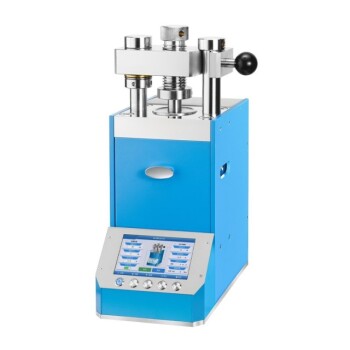
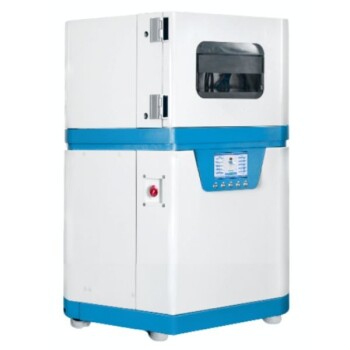
Hot Isostatic Pressing (HIP) is the critical final step required to achieve maximum density and optical quality in Eu:Y2O3 ceramic samples. While initial sintering consolidates the powder into a solid, it frequently leaves behind residual sub-micron pores that degrade performance. By subjecting the samples to extreme temperatures (e.g., 1700°C) and isotropic gas pressure (e.g., 200 MPa of argon), HIP collapses these remaining voids to create a defect-free material.
Initial vacuum hot pressing is effective for shaping, but it rarely achieves perfect density on its own. The Hot Isostatic Press is the definitive tool for eliminating the microscopic porosity that scatters light and compromises structural integrity.
The Mechanism of Defect Elimination
Overcoming the Limits of Sintering
Standard vacuum hot pressing is the first stage of densification. However, once the pores between ceramic grains become closed and isolated, standard sintering often loses its driving force.
The Role of Isotropic Pressure
HIP overcomes this stagnation by applying uniform pressure from every direction using an inert gas, typically argon. This pressure is immense, often reaching 200 MPa.
Thermal Plasticity
The process operates at elevated temperatures, such as 1700°C for Eu:Y2O3. At this heat, the ceramic material exhibits a degree of plasticity.
Pore Collapse
The combination of high heat and crushing isotropic pressure forces the material to flow into the remaining voids. This effectively "heals" internal structural defects that were impossible to remove during the initial sintering phase.
Critical Improvements for Eu:Y2O3
Maximizing Optical Transparency
For Eu:Y2O3 (often used in optical or laser applications), transparency is paramount. Residual sub-micron pores act as scattering centers for light, making the material opaque or cloudy.
Eliminating Internal Voids
The primary function of HIP is the total elimination of porosity. By removing these voids, the material achieves its highest possible density.
Homogeneous Microstructure
HIP promotes a uniform, annealed microstructure. Crucially, it achieves densification without causing segregation or excessive grain growth, preserving the material's intended characteristics.
Enhanced Mechanical Properties
Beyond optics, the removal of voids significantly improves mechanical performance. This includes increased static strength, yield strength, and fatigue resistance.
Understanding Process Considerations
Cost and Complexity
HIP is a secondary, distinct processing step. It adds time and expense to the manufacturing cycle compared to "press and sinter" methods.
Equipment Requirements
The process requires specialized pressure vessels capable of safely containing high-pressure argon gas at extreme temperatures. This is not standard equipment in basic sintering facilities.
Assessing the Necessity of HIP
If you are determining whether to include HIP in your processing flow, consider the specific requirements of your final application.
- If your primary focus is Optical Clarity: HIP is mandatory to remove sub-micron pores that cause light scattering and opacity.
- If your primary focus is Mechanical Reliability: HIP is essential for maximizing fatigue strength and eliminating stress-concentrating voids.
- If your primary focus is Cost Minimization: You may skip HIP only if the application tolerates lower density and reduced transparency.
For high-performance Eu:Y2O3 ceramics, HIP is not merely an optional upgrade; it is the prerequisite for achieving optical-grade quality.
Summary Table:
| Feature | Initial Sintering / Hot Pressing | Post-Treatment (HIP) |
|---|---|---|
| Porosity | Closed, isolated sub-micron pores remain | Virtually zero (defect-free) |
| Pressure Type | Uniaxial or atmospheric | Isotropic gas pressure (up to 200 MPa) |
| Optical Quality | Opaque or cloudy due to light scattering | High transparency (optical-grade) |
| Microstructure | Potential grain growth issues | Homogeneous and annealed |
| Mechanical Strength | Standard structural integrity | Maximum fatigue and yield strength |
Elevate Your Material Research with KINTEK Precision
Achieving the theoretical density and optical clarity required for high-performance Eu:Y2O3 ceramics demands more than standard sintering. KINTEK specializes in advanced laboratory solutions, providing high-performance Hot Isostatic Presses (HIP) and hydraulic presses designed to eliminate microscopic defects and enhance mechanical reliability.
Whether you are developing laser-grade ceramics or high-strength alloys, our comprehensive portfolio—including vacuum furnaces, milling systems, and isostatic presses—ensures your lab has the tools to achieve superior results.
Ready to optimize your densification process? Contact KINTEK experts today to discover how our high-pressure solutions can bring unparalleled quality to your ceramic and material samples.
Related Products
- Warm Isostatic Press for Solid State Battery Research
- Electric Split Lab Cold Isostatic Press CIP Machine for Cold Isostatic Pressing
- Manual Cold Isostatic Pressing Machine CIP Pellet Press
- Automatic High Temperature Heated Hydraulic Press Machine with Heated Plates for Lab
- Isostatic Molding Pressing Molds for Lab
People Also Ask
- What is the temperature of a warm isostatic press? Achieve Optimal Densification for Your Materials
- What is the function of a Warm Isostatic Press (WIP) in all-solid-state pouch cells? Optimize Battery Density
- Why are Warm Isostatic Presses (WIP) necessary for solid-state batteries? Achieve Atomic-Level Contact
- What advantages does a warm isostatic press offer over a traditional uniaxial press for Li6PS5Cl electrolyte sheets?
- How do warm isostatic presses improve dry electrode performance? Enhance ASSB Conductivity with Heat & Pressure